


Picture the pattern. Your field consultant visits a unit that keeps missing an operating standard. She clarifies the standard, retrains the staff, and fixes the immediate problem. The location looks better for a few weeks. Then the issue comes back, and she is on the road again.
The unit was repaired. The franchisee's capability was not.
That is the case for supporting franchisees without excusing underperformance. More franchisee support can protect underperformance when head office repeatedly performs work the franchisee should own. So ask yourself: Is your support helping the franchisee perform—or helping them avoid ownership?
Key Takeaways
- Open-ended support works like an operating subsidy. It fixes the unit and leaves the owner dependent.
- Diagnose before you act. Unclear expectations, missing capability, insufficient capacity, weak commitment, and system problems each need a different response.
- Put every support plan in writing: gap, cause, separate responsibilities, evidence, review date, and exit condition.
- Measure whether capability improved, not whether head office stayed busy.
How Support Can Sustain the Problem
It protects the relationship and the brand. But when your field team keeps resolving the same issue at the same location, the support is no longer neutral. The owner never has to build the skill, the routine, or the staffing to handle it.
The franchisee pays for that. Dependency grows, capability stays weak, ownership stays unclear, and the same problem returns. Your franchisees are business owners. Treating them as people who need rescuing under-rates them.
You pay too. Escalations repeat. Field-support capacity goes to the same few locations while your top performers get less of your attention. Accountability becomes inconsistent, because one manager holds the line and another keeps the peace. That inconsistency weakens franchise performance management across the system.
Underperforming franchisees are not always the cause. Sometimes the gap is in your own instructions or follow-up. That is why the first move is diagnosis, not more help.
Diagnose What Is Missing
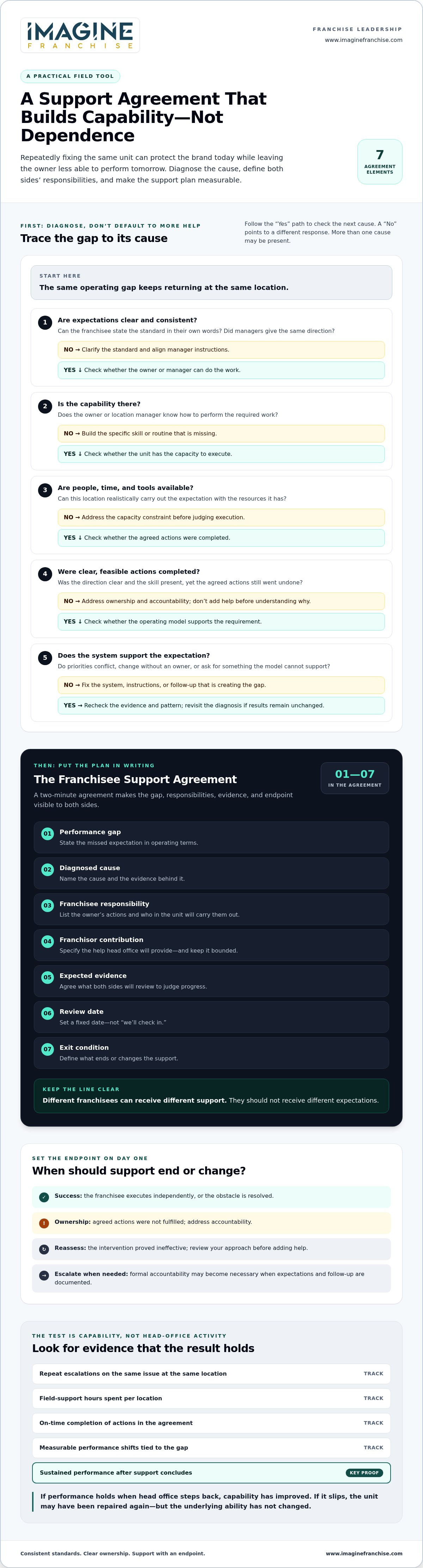
A missed target tells you something is wrong. It does not tell you what is missing. Check five possible root causes before you choose a response:
- Unclear expectations. Can the franchisee state the standard in their own words? Did every manager give the same direction?
- Missing capability. Does the owner or the location manager know how to do the work?
- Insufficient capacity. Does the unit have the people, time, and tools to do it?
- Weak commitment. Was the direction clear and the skill present, yet the agreed actions still went undone?
- A system issue. Do your priorities conflict, change without an owner, or ask for something the model cannot support?
More training will not fix a commitment problem. Stronger accountability will not repair unclear instructions. Applying the wrong remedy costs you field hours and trust, and the gap stays open.
Compare what the franchisee did with what your team communicated, provided, and followed up on. Look at the pattern over several reporting periods, not one bad result. Do not set a universal threshold. Use your own network's economics, standards, and brand promise.
If the cause sits in your system, fix the system. Your field consultants may need a clearer role, which is a point I explore in Stop Training Your Field Consultants to Support Franchisees.
Create a Franchisee Support Agreement
Every support plan needs a written agreement that both sides can read in two minutes. I call it a Franchisee Support Agreement. It holds seven items:
- Performance gap. The missed expectation, stated in operating terms.
- Diagnosed cause. Which of the five causes you found, and the evidence.
- Franchisee responsibility. The actions the owner will take and who in the unit carries them out.
- Franchisor contribution. The specific help head office will provide, and nothing beyond it.
- Expected evidence. What you will both look at to judge progress.
- Review date. A fixed date, not "we'll check in."
- Exit condition. What ends or changes the support.
Keep the standard consistent across the network and tailor the help to the cause. Different franchisees can get different support. They should not get different expectations.
Use the review to make decisions. Confirm what was done, what changed, who owns the next action, and by when. Send a short written record afterward so no one remembers the conversation differently. If agreed actions are done but results have not moved, revisit the diagnosis. If actions were not done, talk about ownership.
Define When Support Ends
Support without an end date becomes a standing arrangement. Put the exit condition in the agreement on day one. Support should conclude or change when one of these happens:
- The franchisee executes independently.
- The obstacle is resolved.
- Agreed actions were not fulfilled.
- The intervention proves ineffective.
- Formal accountability becomes necessary.
The first two are success. The third and fifth are a conversation about ownership. The fourth is a verdict on your approach, and you should be willing to reach it. Do not add new help until you know why earlier actions went undone.
Consequences should follow expectations the franchisee has heard and follow-up your team documented. Surprise penalties damage trust. Predictable accountability protects it, and it lets your franchisees see that every location is held to the same standard. For a related look at where these conflicts start, read Beyond Compliance: How to Handle Difficult Franchisees by Scaling Your Leadership.
Measure Whether Capability Improved
Judge your support by what the franchisee can do without you. Track five measures:
- Repeat escalations on the same issue at the same location.
- Field-support hours spent per location.
- On-time action completion against the agreement.
- Measurable performance shifts in the result tied to the gap.
- Sustained performance after support concludes.
The last one matters most. A result that holds after head office steps back shows capability. A result that slips shows you repaired the unit again.
Franchisor leadership shows up here. If hours keep rising and escalations repeat, the problem may sit in how your team sets priorities and follows through. Franchisexcel© and tailored executive coaching from Imagine Franchise support franchisor leaders as they align priorities and follow through. Results depend on the leadership work itself.
Pick one recurring issue this month. Write the agreement, set the review date, and name the exit condition. If you want to talk through your network's leadership and execution challenges, book an exploratory session.
Frequently Asked Questions
What is the difference between support and excusing underperformance?
Support builds the franchisee's ability to act and leaves execution with them. Excusing underperformance means head office does the work, lowers the standard, or keeps adding help without asking why earlier actions were not completed. Test it by asking whether the owner can perform without your team next time.
How do I know if a franchisee has a commitment problem or a capability problem?
Ask the franchisee to explain the expectation and show how they would carry it out. If they cannot, you have a clarity or capability gap. If they can explain it, have the resources, and still miss agreed actions repeatedly, you are likely facing a commitment problem that calls for accountability.
Can support plans differ between franchisees in the same network?
Yes. Tailor the help to each location's diagnosed obstacle. Keep the expectation and the way you judge progress the same. That lets you respond to local conditions without creating the impression that some franchisees face easier standards.

