


The “Police” Trap: Why Standard Field Consultant Training Fails
As a franchise CEO, you’ve built a field team to be your eyes and ears—a direct line to the operational reality of your network. Yet, a nagging tension persists. Your franchisees see them coming and brace for an audit. Your consultants feel like they’re policing compliance rather than inspiring performance. And you’re left wondering why your investment in “support” isn’t translating into measurable growth in unit-level profitability.
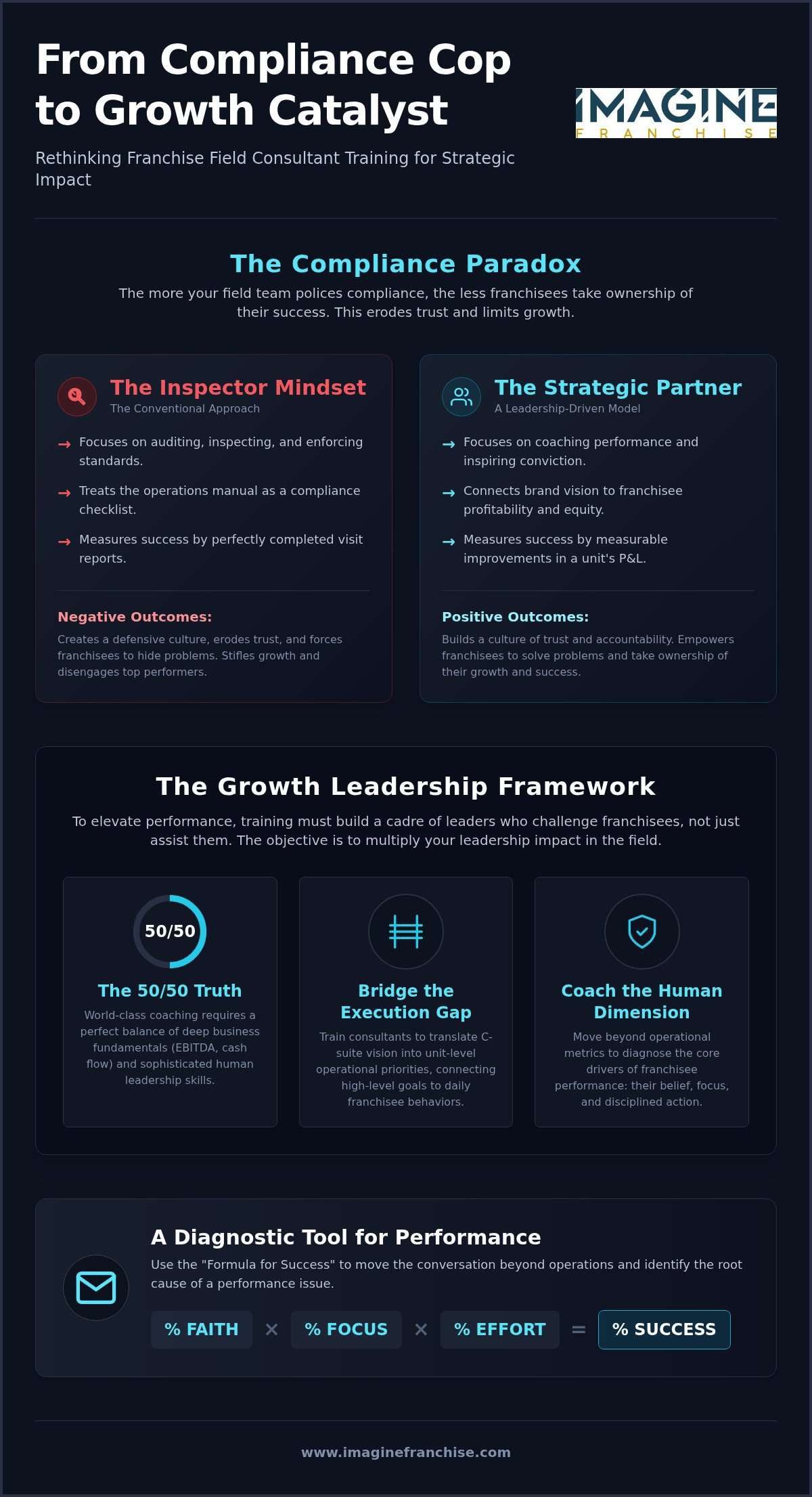
This is the Compliance Paradox: the more your field team audits, inspects, and enforces the operations manual, the less your franchisees take true ownership of their success. The root cause isn’t a lack of effort; it’s a failure of training. Standard franchise field consultant training prioritizes the “what”—the checklist, the manual, the standards—over the “why” of profit, equity, and shared brand vision. The industry has long held that field consultants must act as referees to protect the brand. It’s time to challenge that belief.
The role needs a fundamental reframing. Your field consultant is not a compliance officer. They are a Strategic Growth Partner, the primary lever you have to translate your C-suite vision into franchisee conviction and execution.
The Cost of “Check-Box” Training
An audit-heavy culture, born from well-intentioned but misguided training, erodes the most critical asset in your network: trust. When a field visit feels like an inspection, franchisees become defensive. They hide problems, resist advice, and view corporate as an adversary rather than an ally. This isn’t just a cultural problem; it has a direct financial impact. A field team that cannot speak the language of EBITDA, cash flow, and asset value is fundamentally limited. They can enforce standards, but they cannot coach performance.
Even your highest-performing franchisees—the ones who should be your greatest advocates—eventually stop listening. They’ve already mastered the operations manual. What they need is a strategic peer who can challenge their thinking, help them identify new growth levers, and connect their local success to the network’s broader ambitions. When your consultants only offer generic “support,” your top talent disengages.
Shift from Support to Leadership
The word “support” itself can be a trap. In many franchise networks, support creates dependency, not growth. It encourages franchisees to wait for answers instead of developing their own problem-solving capabilities. The goal of effective franchise field consultant training isn’t to create a team that simply assists franchisees; it’s to build a cadre of leaders who challenge them. A great consultant doesn’t just answer questions; they ask the right ones—the ones that force a franchisee to confront their own assumptions and take greater accountability.
This shift starts in the C-suite. As CEO, you set the tone for what is valued. Is it a perfectly completed visit report, or is it a measurable improvement in a franchisee’s P&L? By redefining the mission of your field team from enforcement to empowerment, you give them the mandate to stop policing the brand and start building it, one unit at a time.
The Growth Leadership Framework for Field Consultants
To move your team from inspectors to influencers, their training must be built on a new foundation. The Franchisexcel© philosophy is grounded in a simple truth: you scale smarter by multiplying your leadership impact in the field. This isn't about adding more people or more visits; it’s about elevating the strategic value of every single interaction. We call this the 50/50 Truth: world-class field coaching requires a perfect balance of deep business fundamentals and sophisticated human leadership skills.
Your field consultants are the bridge between your strategic intent and the unit-level reality. They are uniquely positioned to see, hear, and feel the pulse of the network. But if their training only equips them to discuss operational standards, they become a bottleneck, not a conduit. The objective is to build their “Leadership Capacity,” enabling them to handle the V.U.C.A. (Volatility, Uncertainty, Complexity, Ambiguity) challenges that define modern business and guide franchisees with confidence.
Translating CEO Intent into Operational Reality
Ask yourself a hard question: does your field team truly understand your 3-to-5-year growth vision? Can they articulate it with the same conviction you can? If not, an “Execution Gap” is inevitable. Great strategies die in the space between the boardroom and the front counter because the people on the ground haven’t been trained to translate high-level goals into daily operational priorities. Effective training ensures your consultants can connect a corporate objective, like increasing average ticket size by 5%, to the specific behaviors, processes, and coaching moments required to achieve it in a single unit.
Furthermore, they must be trained to spot “Brand Magnetism” issues before they show up on the P&L. These are the subtle indicators of a franchisee’s declining engagement or a local team’s eroding culture. A well-trained consultant can detect these shifts and intervene, preserving the health of the unit and protecting the brand’s reputation.
The Human Dimension of Performance
A clean store and a compliant P&L are table stakes. True performance is driven by something less tangible but far more powerful: the franchisee’s character and conviction. Your training program must teach consultants how to evaluate and coach this human dimension. Are they simply going through the motions, or do they have a deep-seated belief in the brand and their own potential for success?
We train consultants to use the “Formula for Success” as a diagnostic tool: % Faith × % Focus × % Effort = % Success. This framework moves the conversation beyond operational metrics and into the core drivers of human achievement. It allows a consultant to identify whether a performance issue stems from a lack of belief (Faith), a lack of clarity on priorities (Focus), or a lack of disciplined action (Effort). In this model, trust is not a soft skill; it is a measurable business metric that predicts future performance.
The Essential Field Consultant Training Checklist
Auditing your current training program is the first step toward building a high-impact field organization. This checklist moves beyond the “Foundations of Franchising” and into the advanced competencies required to drive network-wide alignment and what we call Organizational Discipline. The ultimate goal is to cultivate Strategic Field Competency: the ability to align franchisee profit directly with brand standards, proving they are two sides of the same coin.
Business Acumen and Financial Literacy
Your franchisees are entrepreneurs who live and die by their numbers. Your consultants must be able to meet them on that ground with total fluency. The training audit starts here:
- P&L vs. Ops Manual: Can your consultants read a Profit & Loss statement as fluently as they read an operations manual? They must be able to move beyond top-line revenue and diagnose issues in cost of goods, labor, and operating expenses.
- Unit-Level Economics: Is your team trained to identify the key "levers" of profitability for a single unit? They need to understand the financial model inside and out to provide credible, data-driven advice. As we often say, improving franchisee profitability requires more than just enforcing the manual.
- Data-Driven Benchmarking: Are you equipping your consultants with network data to show franchisees where they stand relative to their peers? Training them to use benchmarking effectively is key to fostering healthy competition and inspiring ambition.
Advanced Coaching and Conflict Resolution
Providing advice is easy; ensuring it is heard, adopted, and executed requires a sophisticated coaching skillset. Your training must equip them for the most challenging human dynamics in the network.
- Coaching Methodology: Do you have a consistent, structured coaching model? The BRAVE Coaching Method™ is designed to move consultants from "telling" franchisees what to do to "leading" them to discover the answers themselves.
- Managing Mavericks: Every network has them—the high-performing but non-compliant "maverick" franchisee. Your team needs strategies for realignment that don’t immediately escalate to litigation, preserving the relationship while protecting the system.
- The Art of the Impact Question: Training should focus heavily on active listening and the skill of asking powerful, open-ended questions. An "Impact Question" is one that stops a franchisee in their tracks and forces them to think differently about their business.
Operational Discipline and Compliance
Shifting from "police" to "coach" does not mean abandoning standards. It means integrating compliance into a broader conversation about excellence and profitability. True discipline is about protecting the brand without constantly fighting fires.
- The "Eyes and Ears" Protocol: Your consultants are your primary source of ground-level intelligence. Training must include a clear protocol for what to observe, what to document, and how to communicate it to protect the franchisor from joint-employment and other legal risks.
- Validation vs. Execution: Effective follow-up is critical. A visit is only successful if it leads to action. The training must teach a system where "Validation" (confirming the franchisee understands and commits) is followed by a clear plan for "Execution" and accountability. Forcing this kind of focus is essential for achieving true franchise network alignment.
Implementing the BRAVE Model™ in Field Operations
To truly transform your field team, you need more than a checklist; you need an operating system. The BRAVE Model™ (Baseline, Realignment, Activation, Validation, Execution) provides a structured framework for every field visit, turning a routine “check-in” into a powerful journey of leadership acceleration. This model is the antidote to reactive problem-solving, preventing your consultants from spending their days as “operational firefighters” and recasting them as strategic partners in growth.
By integrating data from tools like the Franchise Performance 360© assessment, the BRAVE Model™ ensures every visit is purposeful, data-driven, and focused on closing the gap between a franchisee’s current performance and their ultimate potential.
Baseline and Realignment: The Pre-Visit Work
The most important part of a field visit happens before the consultant ever leaves the office. The pre-visit phase is about preparation and strategic focus, ensuring the conversation starts at a high level.
- Baseline: The process begins by using performance data (financials, KPIs, customer feedback) to establish an objective "Baseline." This data-driven starting point removes emotion and opinion, focusing the conversation on facts.
- Realignment: The first conversation during the visit is about "Realignment." Here, the consultant and franchisee collaboratively address the gap between the baseline reality and the brand’s standards and potential. This isn't a lecture; it's a strategic dialogue about what's possible.
- SMARTER Goals: From this conversation, the consultant guides the franchisee in setting "SMARTER" goals for the visit and beyond—goals that are Specific, Measurable, Attainable, Relevant, Time-bound, Energizing, and Rewarding.
Activation, Validation, and Execution
With a clear, aligned plan in place, the second half of the model focuses on commitment and action. This is where the consultant transitions from strategist to accountability partner.
- Activation: This stage is about securing the franchisee’s commitment to the "Effort" required for success. The consultant’s job is to build the franchisee’s conviction that the plan is achievable and the results are worth the work.
- Validation: Before the visit ends, the consultant’s role is to validate that the changes being implemented are understood and sustainable. This might involve observing new processes, role-playing with staff, or reviewing updated financial projections.
- Execution: The visit report is no longer a simple summary; it’s a roadmap for 3-to-10-fold growth. The "Execution" phase establishes a clear follow-up cadence and accountability structure, ensuring that the momentum from the visit translates into lasting results.
From Inspector to Growth Catalyst: Scaling Your Field Org
As your network grows from 50 to 250+ units, the complexity multiplies. The informal systems that worked in the early days begin to break down. Structuring your field organization for this next stage of growth requires a deliberate approach. The goal is to evolve your field team into a collective of “Franchise Leadership Catalysts™”—individuals who not only improve individual units but also accelerate the strategic impact of the entire network.
Your franchise field consultant training must evolve with this complexity. What’s required at 50 units (operational consistency) is different from what’s needed at 250 units (managing diverse franchisee cohorts, fostering peer-to-peer leadership). The ultimate objective is to cultivate a self-correcting network, where your field consultants are the drivers of Unity and Agility, enabling the brand to adapt and thrive.
The CEO’s Role in Field Team Excellence
This transformation cannot be delegated. You cannot outsource the "Conviction" of your field team. Your direct involvement is what gives the initiative weight and signals its importance to the entire organization. This means investing in executive coaching for your field leaders—the “Consultant’s Consultant”—to ensure they have the capacity to lead this change.
It also means establishing a culture of Organizational Discipline that starts in the C-suite and flows down. When your field team sees that the executive team holds itself to the same high standards of clarity, accountability, and execution, they are empowered to demand the same from franchisees. This is a critical component of building a growth-ready network.
Measuring the ROI of Your Training Investment
The success of your training program shouldn’t be measured by certifications or course completions. The only metric that matters is results. You must shift your KPIs from activity-based measures like “number of visits per month” to impact-based measures like “improvement in unit-level ROI” or “year-over-year same-store EBITDA growth.”
The Franchisexcel© system provides a framework for tracking the growth of network-wide leadership capacity, linking your training investment directly to enterprise value. It helps you answer the most important question a CEO can ask about their field organization.
So, here is your final impact question: If your field team disappeared tomorrow, would your franchisees notice a loss in profit, or just a loss in paperwork?
Your answer reveals everything you need to know about the work ahead.

