


You already know which locations are slipping. The same units miss the same standard, and the same explanation shows up at the quarterly review: staffing, weather, a slow season, a new manager. The network average still looks acceptable, so the hard decision waits another quarter.
Another dashboard will not change this. The problem is what your network has learned leadership will accept.
Most franchisors do not have a performance-visibility problem. They already know which locations are slipping. They have a performance-tolerance problem. This article shows how underperformance becomes normal, how to draw a line between support and accountability, and how to decide where your limited leadership attention goes.
Key Takeaways
- Most franchisors already know which locations are slipping. The gap is in decisions and follow-through, not in data.
- Set a performance tolerance line: monitor a temporary variance, support a capability or constraint problem, and escalate a repeated gap that persists despite clear expectations and support.
- When several units share the same shortfall, look at your own model, training, communication, technology, and support before blaming franchisees.
- Pick one recurring gap, name one owner, define the evidence you expect, and set a firm review date within 30 days.
Your Network Probably Does Not Need Another Dashboard
When results disappoint, the reflex is to add reporting. A new dashboard, a weekly scorecard, a more detailed monthly package. Your team spends more hours reviewing numbers, and the units that were slipping before are still slipping. More franchise performance data produces more review activity. It does not produce more action on its own.
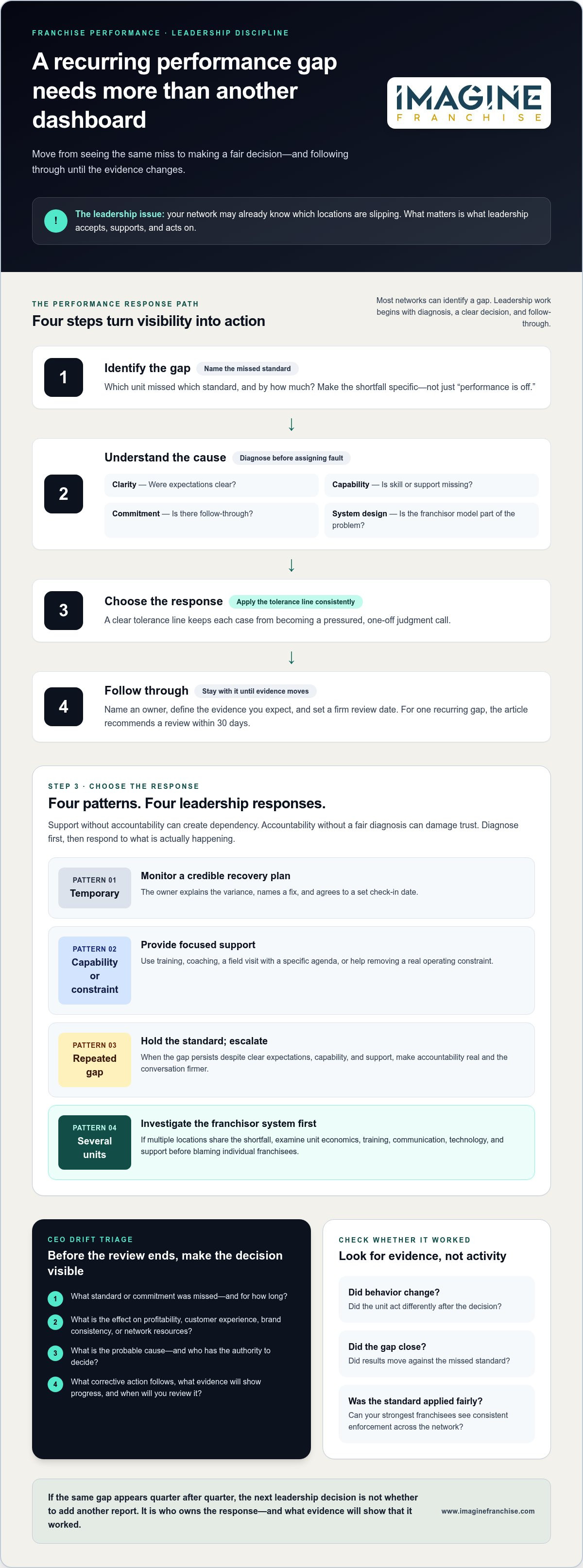
Four separate things have to happen, and most networks stop at the first.
- Identify the gap. Which unit missed which standard, and by how much?
- Understand the cause. Is it unclear expectations, missing skill, a lack of commitment, or a flaw in how you built the system?
- Make a decision. Support, escalate, change the standard, or accept the result on purpose.
- Follow through. Stay on it until the evidence shows the result moved.
Better franchise performance visibility improves step one. Steps two through four are leadership work. If your team can list the five weakest units from memory but nothing has changed in two quarters, you do not lack data.
So ask yourself plainly. Does your organization lack information, or does it lack the discipline to act on what it already has? If a report has shown the same gap three months running and nobody can say who owns it, you have your answer. For a related view on why more procedure rarely closes this gap, see Franchise Operational Excellence: Why Your Manuals Aren’t Saving You.
How Underperformance Becomes Normalized
Nobody decides to lower the standard. It erodes through small, reasonable-sounding moments.
A unit posts the same monthly variance for the fourth time. The explanation is plausible, so no one acts. A review deadline passes with no report and no consequence. A field consultant rescues the same location again, covering the gap the owner or manager should have closed. Meanwhile your best franchisees watch. They notice which expectations get enforced and which ones quietly fade.
Each moment seems small. Together they teach the network that a missed standard costs nothing.
What it costs the franchisor
The damage is operational and it compounds.
- Field resources go to the same few units while healthier ones get little attention.
- The brand erodes at the locations customers actually visit.
- Unit performance becomes harder to predict, which makes planning harder.
- Top performers lose confidence in leadership when enforcement looks uneven.
- Growth can mask fragility. Adding units hides weak ones inside a rising total.
What it costs franchisees
Franchisees pay too. Expectations feel arbitrary or unclear, because they shift depending on who is asked. High-performing owners get less of your time because the struggling units absorb it. Underperformers grow dependent on rescue instead of building their own capability. And unit profitability and enterprise value suffer, which is the owner’s real stake in the system.
None of this makes franchisees the villain. Often the drift started with leadership that never made the expectation clear or never followed up. The related piece Why Franchisees Don’t Follow the System goes deeper on that point.
Establish a Performance Tolerance Line
A tolerance line is a clear, shared answer to one question: what will leadership accept, support, and no longer accept? Without it, every case becomes a judgment call made under pressure, and the network sees inconsistency.
Sort every gap into one of four responses.
- Temporary variance with a credible recovery action: monitor. The owner explains it, names the fix, and you check back on a set date.
- Persistent gap caused by capability or a real operating constraint: provide focused support. Training, coaching, a field visit with a specific agenda, or help removing the constraint.
- Repeated gap despite clear expectations, capability, and support: apply accountability and escalate. The standard stays. The conversation gets firmer and the consequences get real.
- Multiple locations with the same shortfall: investigate your own systems first. Look at your unit economics, training, communication, technology, and support before assigning fault to individual franchisees.
The fourth category matters most for a CEO who wants to be fair. When several units miss the same standard, look at your own system first. A confusing process, a tool that does not work in the field, or unit economics that do not deliver the margin you promised can all look like franchisee resistance.
Support without accountability creates dependency. Accountability without a fair diagnosis damages trust. You need both, in the right order. Diagnose first, support what is real, then hold the line on what remains. This is operational leadership and performance management, and it works through clear expectations and consistent follow-up.
To test whether it worked, check three things. Did the unit’s behavior change? Did the gap close? Do your best franchisees now see the same standard applied to everyone? If you want more on building alignment without relying on compliance alone, read Franchise Network Alignment: Why Compliance Is the Enemy of Conviction.
Give the CEO a Performance Drift Triage
Once you have a tolerance line, you need a fast way to apply it. Run each recurring gap through the same questions.
- What exact standard or commitment was missed?
- How large is the gap, and how long has it lasted?
- What is the effect on profitability, customer experience, brand consistency, or network resources?
- What is the probable cause: clarity, capability, commitment, or franchisor system design?
- Who decides: the franchisee, a field leader, the executive team, or you?
- What corrective action follows, what evidence will you expect, and when is the review?
Put the answers in one table so the whole leadership team sees the same picture. Define what counts as material using your own unit economics and brand standards. A universal threshold from someone else’s network will mislead you.
| Performance signal | Business effect | Probable cause | Accountable owner | Required action | Evidence expected | Review date |
|---|---|---|---|---|---|---|
| Unit margins declining for several periods | Lower owner profit, weaker unit value | Capability or cost control | Franchisee with field leader | Cost review and agreed margin plan | Margin trend moving back toward your standard | Set date |
| Recurring customer complaints on the same issue | Brand damage, lost repeat business | Training gap or unclear process | Franchisee and training lead | Retrain and correct the process | Fewer repeat complaints | Set date |
| Missed brand standards in repeated visits | Inconsistent customer experience | Commitment, or an unclear standard | Field leader, then CEO if repeated | Written expectation and follow-up visit | Standard met on re-inspection | Set date |
| Weak local marketing execution | Flat local sales | Clarity or support design | Marketing lead | Simplify the playbook and coach on it | Campaigns launched on schedule | Set date |
| High manager turnover at several units | Unstable service and lost know-how | Franchisor system design | Executive team | Review hiring, training, and unit economics | Turnover stabilizing | Set date |
| Same units rescued by field team again and again | Drained field capacity | Dependency | Field leader | Define what field support will and will not do | Owner running the fix unaided | Set date |
The table forces three useful habits. Every gap gets one owner. Every action has evidence attached. Every item has a date. If a row cannot be filled in, that is information: you do not yet understand the problem well enough to act.
Decide Where Leadership Attention Will Go
Your head office is lean. You cannot chase every variance, and trying to will spread your team thin and fix nothing. Choose by asking five things about each gap.
- Does it materially affect unit economics, customer experience, or brand equity?
- Is it persistent, not temporary?
- Is it widespread across the network, or a disproportionate drain on your resources?
- Can you or the franchisee realistically influence it?
- Is it important enough to justify pushing something else aside?
That last question is where most plans fail. A priority with no trade-off is just another item on the list. Name what you will stop, delay, or remove. It might be a new program launch, a lower-value report, or a field visit schedule built around the loudest units. If you cannot name the trade-off, you have not chosen.
The work also takes capacity at the top. If your own calendar is the bottleneck, Franchise CEO Burnout Symptoms May Signal a Network-Capacity Problem is worth a read.
Your 30-day leadership plan
- Identify one recurring gap. Pick the one your team keeps explaining away.
- Diagnose the cause. Clarity, capability, commitment, or system failure. Talk to the franchisees involved before you decide.
- Assign a single accountable owner. One name, not a committee.
- Select a specific operational response. Support, escalation, or a fix to your own system.
- Define the evidence of resolution. What will you see if it worked?
- Set a firm review date. Hold it even when something urgent competes.
At the review, judge the work by what changed in execution. If nothing moved, revisit the diagnosis instead of repeating the same action.
What level of underperformance has your network learned that leadership will accept?
That is the question underneath every report. Franchise performance visibility creates value only when you use it to make decisions, assign ownership, and enforce follow-through. Everything else is activity.
Stéphane Breault, MBA, is a former franchisor CEO with more than 25 years of franchise leadership and a board member of the Canadian Franchise Association. Imagine Franchise has coached more than 100 franchise networks since 2008. Results still depend on the leadership work itself, and that work is yours.
If you want to talk through a performance pattern, leadership accountability, or an execution problem in your network, you can schedule a private exploratory conversation.
Frequently Asked Questions
How do I know whether to support or escalate with an underperforming franchisee?
Check four things in order: was the expectation clear, does the franchisee have the capability, did you provide the support you promised, and is the gap repeating anyway? If the answer to the first three is yes and the gap persists, escalate. If any answer is no, fix that first. Escalating before you have ruled out your own part damages trust.
What do I do when field consultants keep rescuing the same units?
Define what field support will and will not do. Set an end point for each rescue, name what the owner must handle alone, and track whether the unit needs less help over time. If the same unit needs the same help every quarter, the rescue is teaching dependency, and the next step is an accountability conversation.
How should I handle it when several units miss the same standard?
Treat it as a franchisor problem until proven otherwise. Review whether the standard is clear, whether training covers it, whether your tools work in the field, and whether unit economics support meeting it. Ask a few affected franchisees what gets in the way. Fix the system cause, then hold everyone to the standard.

