


A franchisee emails field support about a disputed vendor credit. It is an ordinary issue. The field consultant isn't sure he can approve it, so he asks the director of operations. She isn't sure either, because the policy sits between operations and finance. Finance forwards it to you with a note: "Need your call."
Nothing about that issue required the CEO. It reached you because nobody was clear on who had the final word. Repeat that a dozen times a week and you get the pattern behind most franchise CEO burnout symptoms: shorter patience, deferred decisions, and strategic work that never gets done.
CEO burnout is not always a personal resilience or time-management problem. It may be evidence that the franchise organization still depends too heavily on the CEO to make decisions, resolve escalations, and maintain alignment.
So here is the question: Are you exhausted because the network is growing, or because the network still cannot move without you?
Key Takeaways
- Exhaustion in a growing network can be a sign of dependency on the CEO, not a personal failing.
- Routine escalations usually exist because nobody knows who has final decision authority.
- The CEO Dependency Test is a management diagnostic, not a clinical assessment.
- A ten-day escalation log shows where ownership and execution break down, not just how often you are interrupted.
- A decision-rights reset for your top five recurring decisions and a 30-day review diagnose the organization; they do not guarantee relief from burnout.
The exhaustion may be telling you something about the organization
Most advice on franchise CEO burnout symptoms tells you to protect your calendar, build better habits, and get more rest. Some of that helps. But it treats you as the problem, and if the organization keeps sending you decisions that belong to others, a better calendar just fills up again.
Look at what you actually do all day. If you are approving routine franchisee exceptions, settling disputes between your own executives, and re-explaining decisions you already made, the work is not hard because the network is big. It is hard because the network routes through one person.
Watch one ordinary week. A franchisee asks for a marketing fund exception, a field consultant wants to know whether he can waive a late fee, and two executives disagree about who answers a territory question. None of these is a CEO decision, yet each one lands on your phone because the person closest to the problem is not sure the answer will stick.
That is why the work feels heavier than the size of the network explains. You are not carrying 100 locations. You are carrying every unresolved handoff between the people who serve them.
The symptoms tend to look like this:
- Exhaustion that a quiet weekend does not fix.
- Less patience with executives and franchisees.
- Decisions you keep putting off, including important ones.
- Strategic work that gets pushed aside by the next escalation.
Notice that none of these items says you are weak. Each one describes what happens to a capable person who is asked to be the final answer on everything, every day, with no end to the queue.
Notice also when the symptoms ease. If you feel noticeably lighter after a week when the network ran without you, that points to the structure. It tells you the load comes from how decisions flow, not from the job itself.
Be clear on one distinction. Sustained organizational overload is a management problem you can trace to specific decisions and handoffs. Medical or clinical burnout is a health matter. This article addresses the first only. If your symptoms persist or worsen, see a qualified health professional; no management exercise replaces that.
How CEO dependency appears in a franchise network
Dependency rarely announces itself. It shows up as small, reasonable requests: a pricing exception, a territory question, a marketing fund approval, a franchisee who wants an answer from "someone who can actually decide."
Field consultants stop answering questions they could answer because the last time they did, a franchisee called you to overrule them. Executives send you drafts of decisions for a quick look. Your leadership team asks "What would you do?" instead of telling you what they did.
None of this is carelessness. People act cautiously when the boundaries of their authority are vague, and every unclear handoff teaches them that progress requires you.
Consider the field consultant who made a call last quarter and heard that the CEO had reversed it after a franchisee phoned you. He will not make that call again. He is not timid. He learned how the system really works.
Executives learn the same lesson. After a few reversals, they stop deciding and start forwarding, and you become the default owner of every question that has no obvious home.
Where it costs the network
Franchisees get different answers depending on who they ask and how hard they push. Decisions wait on your travel schedule. Executives wait for your reaction before they commit. Alignment then depends on your presence rather than on clear ownership.
The cost is concrete. A franchisee waiting on a credit decision stops trusting field support and starts calling you directly. A new owner learns that the quickest route to a yes is the top of the organization, and the next one learns it from him.
Meanwhile, the strategic work you owe the network, such as planning, hiring, and fixing the support model, keeps slipping behind the next urgent message. The network pays for that delay long after the escalation itself is forgotten.
You built the network by solving problems yourself, and that habit worked at 15 locations. At 100 it turns you into the bottleneck. The leadership capacity gap is where growth runs ahead of the people and decision rights around you.
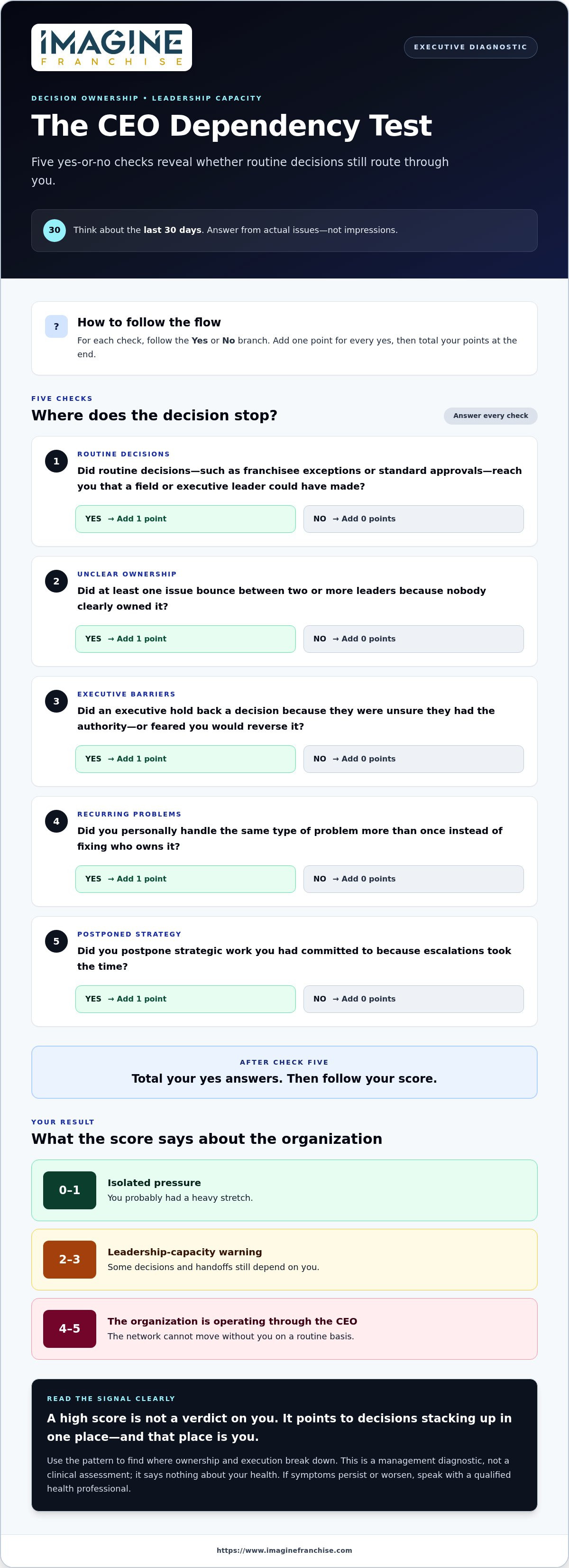
The CEO Dependency Test
Answer yes or no for the last 30 days. Be specific; think of actual issues, not impressions.
- Routine decisions: Did routine decisions, such as franchisee exceptions or standard approvals, reach you that a field or executive leader could have made?
- Unclear ownership: Did at least one issue bounce between two or more leaders because nobody clearly owned it?
- Executive barriers: Did an executive hold back a decision because they were unsure they had the authority, or feared you would reverse it?
- Recurring problems: Did you personally handle the same type of problem more than once instead of fixing who owns it?
- Postponed strategy: Did you postpone strategic work you had committed to because escalations took the time?
Score one point for each yes.
- 0–1: isolated pressure. You probably had a heavy stretch.
- 2–3: leadership-capacity warning. Some decisions and handoffs still depend on you.
- 4–5: organization operating through the CEO. The network cannot move without you on a routine basis.
This is a management diagnostic, not a clinical assessment. It says nothing about your health. If your symptoms persist, talk to a qualified health professional.
Read your score as a statement about the organization. A high score does not mean you are failing. It means decisions are stacking up in one place, and that place is you.
If you score 2 or higher, do not start by changing your habits. Start by finding out which decisions keep arriving and why. The tools below are built for that.
Tools for reducing unnecessary dependency
The two tools below work in sequence. The log shows what is reaching you and why. The reset assigns each recurring decision to someone who can make it without you.
The Ten-Day Escalation Log
For ten working days, log every issue that reaches you and should not have needed you. The point is not to count interruptions. Counting only tells you that you are busy. The log shows structural ownership and execution failures: where issues start, who should have owned them, and why they ended up on your desk.
| Issue | Where it started | Who should have owned it | Why it reached the CEO | Decision made | Future owner | Escalation trigger |
|---|---|---|---|---|---|---|
| Vendor credit dispute | Franchisee email to field support | Director of operations | Policy sits between operations and finance | Approved up to the franchisee's claim | Director of operations | Any credit above an agreed amount, or a policy change |
After ten days, read the "Why it reached the CEO" column first. Repeated reasons, such as no authority limit, no named owner, or fear of being overruled, point to what to fix.
Fill in the log as each issue happens, not at the end of the day. Memory softens the details, and the details are the point. Write the real reason in plain words, even when it is uncomfortable, such as "he did not think he could approve it" or "two directors each thought the other owned it."
Pay attention to the "Future owner" and "Escalation trigger" columns. If you cannot name either one, the issue will come back, and it will come back to you.
The Decision-Rights Reset
From the log, pick the top five recurring decisions. For each one, write down:
- Decision owner: one named person, not a team.
- Boundaries of authority: what they can decide alone, such as dollar limits or policy exceptions.
- Who must be consulted: the people whose input they need before deciding.
- Who must be informed: the people who hear about it after.
- The exact condition requiring CEO escalation: a specific trigger, not "anything difficult."
Then keep your side of it. When the owner decides inside the boundaries, you do not reverse it, even when you would have chosen differently.
Walk each owner through their decision rights in person and put them in writing. Tell the field team and the executives who the owner is, so franchisees stop shopping for a better answer. The first time someone tests the boundary by calling you, send them back to the owner.
Expect a few mistakes. An owner will make a call you would have made differently. Let it stand unless it crosses the escalation condition, because reversing it teaches the organization to send everything back to you.
What to do during the next 30 days
Treat this as an organizational diagnostic, not a guaranteed cure for burnout. It shows you where the network depends on you, and it gives you a chance to change that.
The sequence is deliberately plain. Most of the value comes from seeing your own escalations written down, which is something few CEOs have done.
- Week 1: Tracking. Run the escalation log every working day. Do not fix anything yet.
- Week 2: Identify the top dependency patterns. Group the entries and find the repeated reasons the issues reached you.
- Week 3: Define ownership and boundaries. Complete the Decision-Rights Reset for your top five decisions and walk each owner through it.
- Week 4: Review decision speed and quality. Check whether those decisions moved faster, whether owners stayed within their boundaries, and whether the outcomes held up.
In week 1, resist the urge to hand things off as they arrive. Your only job is to record them accurately. In week 2, look for the same reason showing up three or four times, because that is your first fix.
In week 3, keep the scope small: five decisions, five owners, written boundaries. In week 4, ask the owners what slowed them down, not only what you observed. Their answers show where the boundaries still need work.
If decisions still return to you, ask what is missing: authority, information, or your own willingness to let go. Coaching can help you work through that, but it will not do the work for you.
If you became unavailable for 30 days, which decisions would stop moving? If you want to talk it through, you can take a franchise leadership diagnostic or book a private exploratory conversation.

