


Your franchisee says no to a second location, and your first instinct is to ask what is wrong with them. Maybe the better question is what is wrong with the proposal. A franchisee who refuses to expand may be showing better judgment than the franchisor who keeps pushing the development target.
You built a network by believing in growth, so a flat unit with a capable owner feels like wasted potential. But ambition and growth readiness are two different things. An owner can want more from the business and still be right that a new unit is not the way to get it. How to reignite ambition in franchisees who have stopped growing starts with a harder question than "How do we motivate this franchisee?" Ask instead: does this franchisee have a sound business case, the operating capacity, and a personal reason to grow?
Premature expansion carries real costs for both sides. The franchisee may take on debt, become more dependent on their own presence, and watch margins fall. You may get a weak opening, stretch your field team, lose some trust across the network, and find that development bias has clouded your judgment. This article gives you a way to sort the decision out and turn it into a commitment you can track.
Key Takeaways
- A franchisee who declines a new unit may be showing discipline, not a lack of ambition. Ambition and growth readiness are different questions.
- Diagnose five areas before you push: unit economics, management capacity, market opportunity, owner commitment, and the credibility of your own growth proposal.
- Offer four legitimate paths: improve the current unit, build management depth, prepare for a new unit, or hold the footprint to brand standard.
- Turn the decision into a 90-day commitment with one outcome, one constraint, one owner, one metric, and one review date.
Stop treating stalled growth as a motivation problem
When a strong franchisee stops growing, head office tends to reach for motivation. More recognition, a better incentive, another conversation about the franchisee's potential. That approach assumes the owner is the variable that needs fixing. Often the proposal is.
Three different situations look the same from the outside. The first franchisee does not want to grow. They have a unit that supports the life they want, and a second location would cost them time, money, and peace of mind they are unwilling to give up. That is a business decision, and it deserves respect.
The second franchisee wants to grow but is not ready. Perhaps the manager cannot run the unit without them, or the numbers do not yet carry the debt a new location would require. Your job here is to help them get ready, not to hurry them.
The third franchisee agreed to a goal and is not executing it. This is the one that calls for accountability. They said they would fix staffing, hit a service standard, or complete a renovation, and the commitment keeps slipping.
Choosing not to expand is a business decision. Failing to execute an agreed goal is an accountability issue. If you treat all three as one motivation problem, you will pressure the first, rush the second, and let the third off the hook. Before you decide who needs a push, find out which conversation you are actually in.
There is an uncomfortable fairness test here too. If your development targets drive the conversation more than the franchisee's economics do, the resistance you see may be the franchisee reading the situation accurately.
Diagnose the actual barrier
Before you set a new target, test five areas. Each one points to a different decision, and a wrong diagnosis wastes scarce field time.
Start with unit economics. Does the current unit generate enough profit to support the owner's life and the cost of another location? If it barely does, a second unit adds risk without adding security. Then look at management capacity. If the owner is the unit's only reliable operator, a second location splits one person across two sites and both may suffer.
Next, examine market opportunity. Is there a real site, with real demand, that your own data supports? Then ask about owner commitment. Does this person want to build something larger, and do they have a personal reason to take on the work? A franchisee with no reason of their own will not carry a development target for you.
The fifth area is yours. Ask your leadership team this question plainly: have we created a credible growth opportunity, or are we asking the franchisee to carry the risk of our development target? If the site is uncertain, the support is thin, and the economics are untested, you are not offering an opportunity. You are transferring risk.
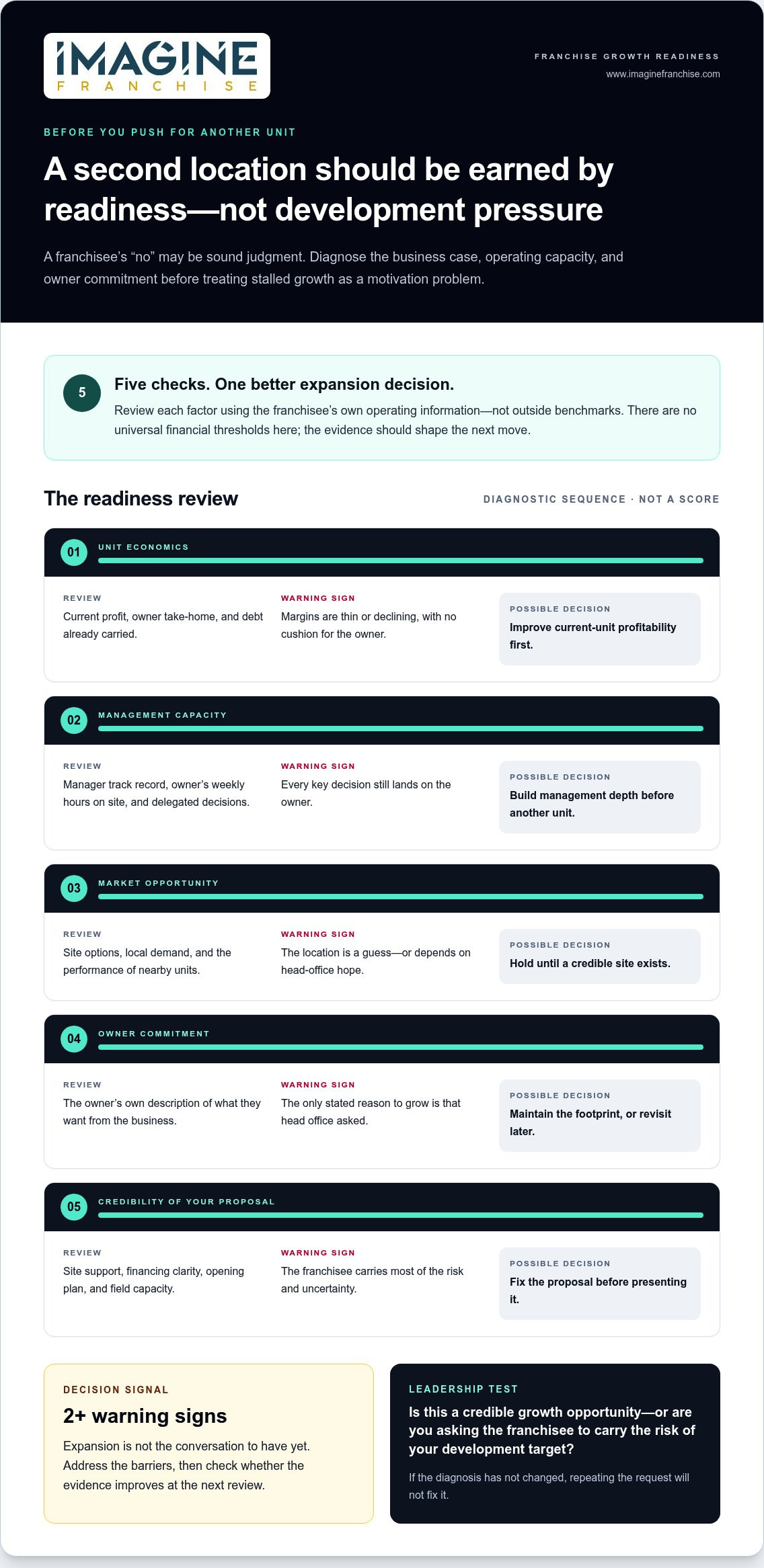
Franchisee Growth Readiness Scorecard
Use this scorecard with your field team before you raise expansion. Fill it with the franchisee's own operating information, not outside benchmarks, and set no universal financial thresholds.
| Question | Evidence to review | Warning sign | Possible decision |
|---|---|---|---|
| Do the unit economics support more commitment? | Current profit, owner's take-home, debt already carried | Margins are thin or declining and the owner has no cushion | Improve current-unit profitability first |
| Can the unit run without the owner? | Manager track record, owner's weekly hours on site, delegated decisions | Every key decision still lands on the owner | Build management depth before any new unit |
| Is there a real market opportunity? | Site options, local demand, performance of nearby units | The location is a guess or depends on head-office hope | Hold until a credible site exists |
| Does the owner have a personal reason to grow? | The owner's own description of what they want from the business | The only stated reason is that head office asked | Maintain the footprint, or revisit later |
| Have we built a credible opportunity? | Site support, financing clarity, opening plan, field capacity | The franchisee carries most of the risk and uncertainty | Fix the proposal before presenting it |
If two or more rows show a warning sign, expansion is not the conversation to have yet. Check whether the scorecard improved at the next review. If it did not, revisit the diagnosis instead of repeating the same request.
Present four legitimate growth paths
Once you know the barrier, give the franchisee a real choice. Expansion is one path, not the only proof of ambition. Four paths deserve a place in the conversation.
Improve existing unit profitability
Some owners will get more from tightening sales, labor, and execution in the unit they already run. Define the result that counts, such as a specific margin or service measure from their own numbers, and agree on how you will both see it.
Develop management depth
If the owner is the bottleneck, the next stage of growth is a manager who can carry real responsibility. This path frees the owner's time, and it is the best preparation for any future unit.
Prepare for a new unit
Some franchisees are ready, or can become ready. Set the conditions in writing: the capacity, the financing plan, the site evidence, and the support you will provide. Then proceed when those conditions are met, not before.
Maintain the current footprint to brand standard
Staying the same size is a legitimate choice. It is not a license to ignore standards. A franchisee who chooses not to expand still owes the network consistent execution, and you should say so without apology.
Done well, this approach benefits both sides. The franchisee gets a decision based on their own numbers, less debt risk, and a goal they chose. You get stronger openings, field time spent where it counts, a network that trusts your proposals, and a development pipeline built on readiness rather than pressure. For more on the risk of pushing too fast, see Is Your Franchise System Growing Too Fast?
Turn the decision into a 90-day commitment
A path without a commitment is a pleasant conversation. Turn the decision into a 90-day plan with five parts, written down and read back to the franchisee before you leave the room.
- One business outcome. State what will be different in 90 days, in business terms.
- One constraint. Name the single barrier you will remove first, whether it sits with the franchisee or with head office.
- One owner. Assign a named person for each action, including any head-office commitment.
- One metric. Choose the measure drawn from the unit's own results that shows whether the outcome is advancing.
- One review date. Set it now, and decide then whether to continue, adjust, or close the work.
At the review, look at the metric and the completed action, not the number of calls or visits. If the work stalled, decide where it is waiting: with the franchisee, a manager, or your own team. Often the answer is a leadership decision you have not made yet, and the same discipline applies to your commitments as much as theirs. For ideas on getting buy-in, see How to Get Franchisee Buy-In for New Initiatives.
If you want support aligning priorities and following through, Franchisexcel© and tailored executive coaching are built for franchisor leaders. Results depend on the leadership work itself.
Are your franchisees resisting growth, or rejecting a weak proposition?
How to reignite ambition in franchisees who have stopped growing comes down to a shift in your own thinking. Stop asking how to motivate them and start asking whether the opportunity you are offering has earned their confidence. Some franchisees will move once the proposal is credible. Others will choose to stay put, and they may be right.
Stéphane Breault is a former franchise CEO with more than 25 years of franchise leadership experience and more than 15 years of executive-coaching experience. He has coached more than 100 franchise networks since 2008.
Are your franchisees resisting growth, or are they rejecting a growth proposition that has not earned their confidence? If you want to think it through, you can schedule an exploratory conversation about your leadership and execution challenges.
Frequently Asked Questions
Is a franchisee who does not want another location necessarily unambitious?
No. Declining a new location says little about ambition by itself. The owner may be focused on raising unit profit, developing a manager, or protecting the business they built. Return to their stated objective and the evidence tied to it. A clear choice not to expand differs from failing to meet an agreed commitment.
Are financial incentives enough to restart franchisee growth?
No. An incentive cannot fix weak unit economics, create management capacity, or give an owner a reason to grow. Establish a sound business case and an agreed objective first. Only then decide whether an incentive fits. If the real barrier is staffing or workload, money leaves it untouched.
How can a franchisor tell whether a franchisee needs more support or clearer accountability?
Check whether the expected result, the owner of each action, the required capability, and the main constraint are clear to both sides. If direction is unclear, head office may need to clarify it. If responsibilities are clear and within the owner's control, accountability is the issue. Review one specific commitment and its result together.

