


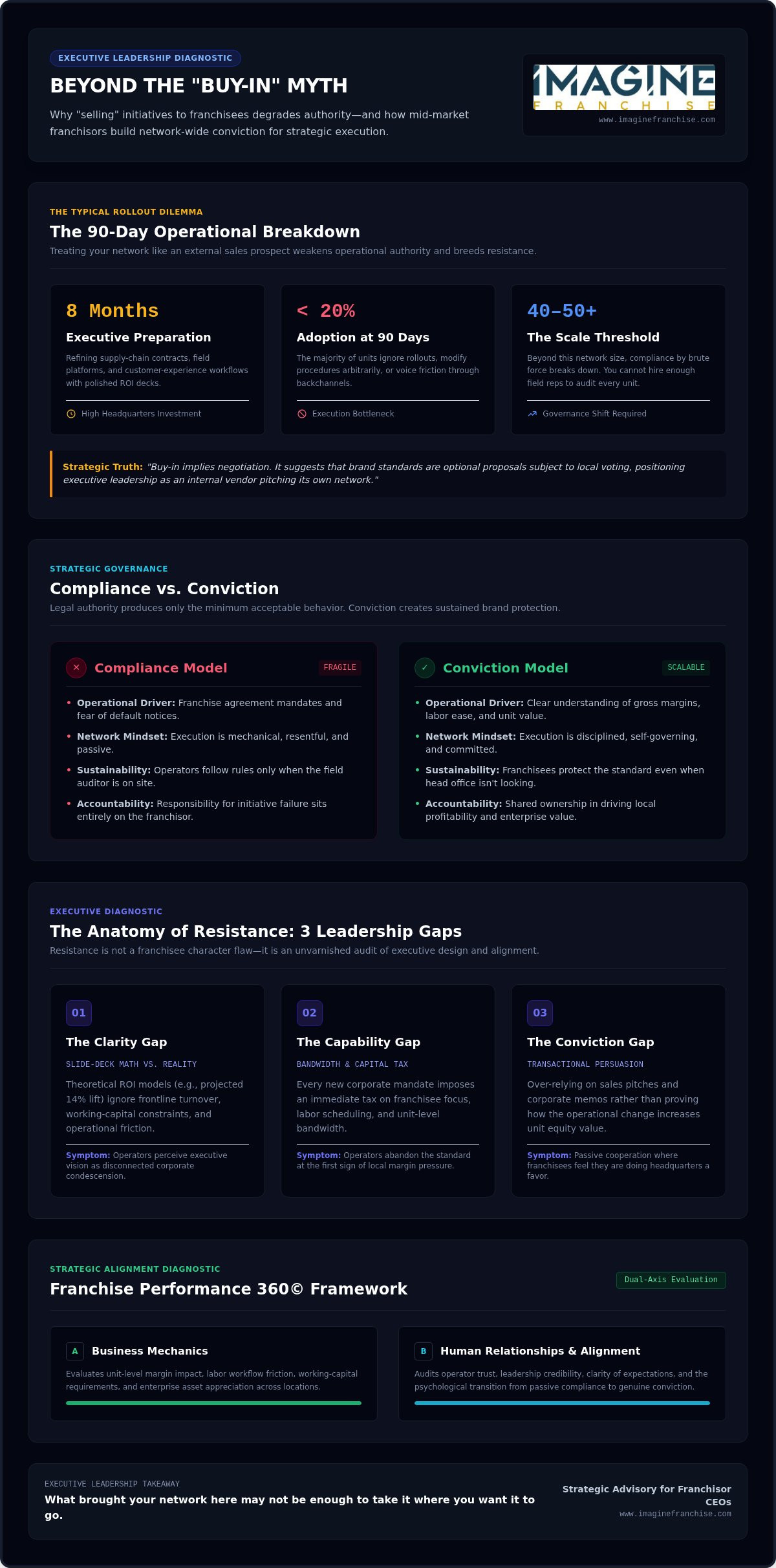
You announce a major operational overhaul at your annual franchise convention. The leadership team worked on it for eight months: refined supply-chain contracts, an updated field-operations platform, and a revised customer-experience workflow. You delivered a polished presentation with slide decks showing revenue projections, polished marketing collateral, and a clear call to action.
The room clapped. A few veteran franchisees shook your hand in the hallway afterward. Yet, ninety days later, your field consultants report that fewer than twenty percent of your locations have deployed the changes. The rest are ignoring the rollout, modifying the procedures to suit themselves, or actively venting their frustrations on private WhatsApp threads and regional phone calls.
Your first instinct may be to treat this as an operational insurrection. You assume your franchisees are stubborn, resistant to change, or incapable of seeing the bigger picture. But when owners stop using the system, rewrite procedures, or rally peers against a rollout, the more useful question is: what has leadership failed to make practical, profitable, or credible?
That question itself is the problem.
The moment you frame operational progress around "getting buy-in," you have already surrendered the leadership high ground. Buy-in makes a business-critical standard sound like a proposal that can be bargained away. It turns the franchisor into an internal salesperson and leaves franchisees weighing whether the change is worth the labor hours, cash investment, disruption, and risk to their local operation.
Resistance is rarely just a franchisee character flaw. It is often an unvarnished audit of executive leadership capacity. If your network stalls every time you introduce change, the breakdown is not simply occurring at the frontline. It is visible there, but it begins in how your C-suite designs the initiative, tests its unit-level impact, aligns the leadership team, and earns confidence before demanding execution.
The Buy-In Myth: Why 'Selling' Your Initiative Is a Losing Strategy
Most franchise executives approach a new rollout as if they were pitching an enterprise sales deal. They build a deck, outline projected returns, present the features, and try to persuade operators to get on board. When operators push back, corporate leadership adds more webinars, explanatory memos, and support calls. The result is often more noise without less friction: owners still do not know what the change will cost, how it will affect staffing, or whether it will improve their numbers.
This approach backfires in small and medium franchise networks. Franchisees are not passive shareholders or corporate middle managers; they are independent business owners who mortgaged homes, invested personal capital, and work daily inside their businesses. When corporate leadership behaves like a sales team, franchisees behave like skeptical buyers. They look for hidden labor, technology, training, and cash-flow costs because they—not headquarters—will absorb the consequences when the rollout disrupts a busy location.
Selling an initiative creates conditional alignment. If an operator accepts a change because you persuaded them, responsibility for its operational success still feels like yours. The moment margins tighten, staffing becomes difficult, or execution requires extra effort, the operator can abandon the process. They were not committed to the outcome; they were responding to a pitch. Durable execution begins when franchisees can see the problem, test the solution, and connect the result to the health of their own business.
Conviction Over Compliance
Franchise systems cannot scale on compliance alone. The franchise agreement gives you legal authority, but legal authority usually produces only the minimum acceptable behavior. A network governed entirely by compliance moves when someone is watching: operators follow the rule during an audit, then revert when the field consultant leaves. That may protect a checklist, but it will not create consistent customer experiences, stronger margins, or reliable adoption across locations.
As a small or mid-sized franchisor scales past forty or fifty units, compliance-driven governance becomes expensive and brittle. You cannot hire enough field support representatives to supervise dozens of independent owners through constant inspection. You need conviction: owners who understand the business reason for the standard and keep executing it when no one from the franchisor's office is in the building.
- Compliance: The franchisee adopts the new inventory tool because the operations manual mandates it and non-compliance risks a default notice. The tool may be installed, but usage is mechanical, resentful, and easy to abandon when oversight fades.
- Conviction: The franchisee executes the inventory protocol because they understand how it protects gross margins, simplifies labor scheduling, and increases the enterprise value of their business. They can explain the benefit to their team and keep the standard alive under daily pressure.
When an initiative is grounded in conviction, franchisees protect the standard even when nobody from the franchisor office is looking. To learn more about navigating this transition, examine why compliance is the enemy of conviction across scaling franchise networks.
The Fragility of Persuasion
Franchisor leaders often believe more communication automatically solves resistance. They assume that if franchisees disagree, they simply have not seen enough financial modeling or attended enough town halls. That assumption misses what owners are actually experiencing: a rollout can look attractive on a slide while creating longer shifts, new training demands, equipment costs, and lost sales during implementation.
Logic and corporate ROI models are necessary, but they are insufficient. A spreadsheet created at headquarters showing a projected 14% lift in net profit looks entirely different to an owner dealing with turnover, rising food or material costs, and immediate working-capital constraints. When leadership answers those immediate pressures with theoretical slide-deck math, operators hear that headquarters does not understand the unit. Credibility improves only when the business case addresses the cash, labor, and workflow consequences they face this week.
Persuasion is fragile because it operates on the surface. True strategic alignment requires you to remove or reduce the operational friction an initiative creates at the unit level before asking owners to stake their capital, staff time, and customer relationships on it. When the rollout is workable in a real location—not just compelling in a presentation—adoption becomes far more durable.
The Anatomy of Resistance: Diagnosing the Leadership Gap
When a network pushes back on a brand initiative, weak leadership blames the franchisees. Seasoned franchise CEOs look in the mirror. Resistance is rarely an act of malice; it is often the visible symptom of a disconnect between executive vision and frontline reality. The owner who says, "This will not work here," may be identifying an untested workflow, an unaffordable investment, or a trust problem that headquarters has ignored.
In mid-market systems, every new corporate demand carries an immediate tax on franchisee focus and capital. If corporate leadership introduces a brand-wide initiative that operators reject, that friction indicates a failure in one of three areas: clarity, capability, or conviction.
Using Franchise Performance 360© as a Diagnostic
To pinpoint the source of operational stalls, franchisors need a systematic way to evaluate both the business mechanics and human relationships across their systems. The Franchise Performance 360© assessment was developed to help leadership teams audit these two dimensions simultaneously.
Too many franchisors focus exclusively on financial metrics—top-line royalty generation, unit revenue, and speed of unit expansion—while remaining blind to the health of the relationship between corporate and the network. A rollout can look successful in a dashboard while owners quietly delay adoption, work around the process, or warn prospective franchisees about the burden. When your executive team cannot see operator sentiment, labor realities, or unit-level margin pressure, every new demand arrives with hidden resistance.
Using a structured diagnostic reveals the real dynamic beneath the surface:
- Are operators resisting the tool itself, or do they lack confidence in your leadership team's operational competence?
- Is the pushback financial, or is it an emotional reaction to being treated as an afterthought in your strategic planning?
- Does your leadership team hold a unified perspective on the change, or are your field consultants quietly validating franchisee complaints behind closed doors?
When you stop asking "What is wrong with my franchisees?" and start asking "What gap in my executive leadership is this resistance revealing?", you regain control over network execution. That shift changes the work from blaming owners to fixing the conditions that make adoption fail: unclear instructions, weak support, poor economics, or leadership messages that do not match the reality of the unit.
The Three Pillars of Alignment: Clarity, Capability, and Conviction
A strategic initiative stalls when leadership fails to secure all three essential pillars of organizational momentum:
- The Clarity Gap: Leaders often confuse strategic intent with operational clarity. Telling your network that you are "modernizing our digital ordering experience" is intent. Defining the specific workflow adjustments, counter space allocations, hardware requirements, and daily metrics is clarity. When your instructions are vague, franchisees fill the vacuum with worst-case assumptions.
- The Capability Gap: You cannot demand enterprise-level execution from an under-resourced operational team. If an initiative requires complex technological adoption, have you provided simple, reproducible operational training? Or have you simply emailed a sixty-page PDF manual and assumed your franchisees have the time to train their teams?
- The Conviction Gap: Does your executive team truly believe in the initiative, or are you adopting an industry fad because a competitor did? Franchisees spot executive hesitation instantly. If your team cannot articulate the unit-level profitability impact without corporate jargon, you cannot expect operators to embrace the change.
For a deeper look into why systems fail to gain traction at the frontline, read our analysis on why franchisees don't follow the system.
The BRAVE Framework for Strategic Alignment
Successful change in a franchise system does not come from clever marketing or boardroom edicts. It requires a structured, repeatable methodology that links leadership intent to unit-level execution. This is the foundation of the BRAVE Model™ (Baseline, Realignment, Activation, Validation, Execution), delivered through the BRAVE Coaching Method™.
Most franchise rollouts collapse because leadership jumps directly from an idea to Activation, bypassing the critical stages of Baseline assessment and executive Realignment. The consequences are predictable: unclear expectations, overloaded teams, frustrated owners, and expensive initiatives that never become daily habits. When you deploy a change into an unprepared system, you magnify friction instead of results.
Baseline and Realignment: The Foundation
Before introducing any major network change, you must audit the current health of your system. This is the Baseline phase. What is the current level of trust between your operators and corporate leadership? What are the actual, unvarnished unit-level EBITDA margins across your top, middle, and bottom quartiles? If your bottom half is barely breaking even due to inflationary headwinds, launching a capital-intensive initiative will trigger immediate, justifiable pushback.
Once you understand your baseline, you must achieve internal Realignment. In many emerging and mid-market networks, the executive team is fractured. Marketing pushes an aggressive customer acquisition campaign that operations cannot support; franchise development promises territory flexibility that contradicts field operations; and finance protects corporate margins at the expense of unit profitability.
To establish true alignment, franchise leadership must embrace the Formula for Success:
% Faith × % Focus × % Effort = % Success
Notice that this is a multiplicative formula, not an additive one. If your network's focus and effort are at 100%, but their faith in leadership's direction is at zero, total operational success remains zero. Faith is built on transparency, consistency, and proven unit economics—not emotional speeches.
Activation and Validation: Building Real Momentum
Once baseline trust is understood and the leadership team speaks with a unified voice, you move to Activation and Validation.
Activation should feel like the natural culmination of a shared journey, not an ambush from headquarters. It begins by engaging a disciplined pilot group to test the initiative in live market conditions. A real pilot exposes the problems a boardroom cannot: a workflow that adds an extra hand during the rush, hardware that does not fit the counter, or training that managers cannot complete between shifts. Fixing those issues before a system-wide launch protects trust and improves adoption.
Validation requires objective operational visibility. This is where systems like FranConnect—including tools such as FranConnect Operations, FranConnect Field Ops, and the FranConnect Command Center—prove useful. These platforms are not silver bullets for culture, but they provide the shared data layer needed to measure whether a rollout is actually happening in the field.
Consider the research: an extensive InGage Consulting study conducted with FranConnect across 300 franchise brands and 24,000 participants revealed that highly engaged franchisees are 3.7 times more profitable than their disengaged peers. Engagement does not mean agreement on every detail; it means having a shared operational framework where data is visible, expectations are unambiguous, and outcomes are validated systematically.
5 Steps to Execution: Moving from Mandate to Network Unity
To move your network from skepticism to disciplined execution, you need an actionable operational sequence. This five-step roadmap turns strategic initiatives into shared operating habits across mid-sized systems while confronting the concerns that cause owners to delay, modify, or reject a rollout.
-
Step 1: Pilot with the Respected Influencers, Not Just the Cheerleaders
Most franchisors run pilots with their most agreeable operators—the franchisees who say yes to every corporate request. This is a mistake. Agreeable operators rarely hold operational influence over the rest of the network. Choose operators who are rigorous, operationally disciplined, and respected by their peers for their business acumen. If a respected, skeptical franchisee tests your initiative, refines it, and reports improved unit margins to their peers, the rest of the network will follow. -
Step 2: Quantify the Unit-Level ROI (The 50/50 Truth)
In franchising, there is an inescapable rule: If it does not work for the franchisee's bottom line, it does not work for the franchise system. Your network is not in business to build your brand's equity; they are in business to generate returns on their personal capital. Translate every corporate demand into direct unit-level financial terms:- How many labor minutes does this procedure remove from the weekly schedule?
- What is the payback period on required hardware or inventory purchases?
- How does this initiative protect gross margin against rising local operating costs?
-
Step 3: Create Transparent Performance Visibility
Ambiguity protects underperformance. Break through network inertia by establishing real-time visibility around core execution metrics. When operators see benchmarked performance comparisons showing that peers who deployed the new protocol saw immediate cost savings or customer retention gains, peer accountability takes over. Transparency eliminates excuses far more effectively than executive reprimands. -
Step 4: Over-Communicate Strategic Context, Not Just Tactical Steps
Franchise manuals are filled with the what and the how, but they are notoriously devoid of the why. If you instruct operators to implement a complex customer-intake procedure without framing it within market competition and customer expectations, it feels like needless busywork. Explain the strategic market pressures demanding this evolution. Show them the risks of inaction, and connect their operational consistency directly to the long-term enterprise value of their units. -
Step 5: Hold the Line on Non-Negotiables
True leadership is not a popularity contest. Once an initiative has been tested, validated, and shown to improve unit performance, executive leadership must establish firm boundaries. Making compliance optional out of fear of operator conflict shows disrespect to the top performers who invested their time and capital to execute the system. Firm, fair accountability—grounded in operational respect—builds trust across a franchise system.
Leveraging Peer Influence
In any small to medium franchise network, informal peer dynamics carry more weight than corporate communications. A memo from the corporate office may be skimmed or ignored; an off-the-cuff endorsement from an experienced operator during a regional call can determine whether a doubtful owner gives the initiative a fair test. Peer credibility matters because operators trust evidence from someone who has faced the same staffing, cash-flow, and customer pressures.
When you select the right pilot operators and involve them in refining the rollout, you shift the dynamic from corporate enforcement to peer-led momentum. When a colleague says, "We hated the idea at first, but we ran the pilot for sixty days, and our food waste dropped by three points," the debate ends. Skepticism transforms into operational curiosity.
Focusing on Unit-Level Profitability
Too many emerging franchisors behave as though their primary product is their consumer offering. To franchisees, the primary product is the unit-level economic model. If that model is already strained, every new initiative feels like another demand on scarce cash, labor, and management attention. A change that improves the brand while weakening the unit is not a growth strategy; it is a transfer of risk to the owner.
Before launching any initiative that requires capital expenditure or operational friction, review your unit economics honestly. If your manual focuses entirely on brand aesthetics while ignoring operator cash flow, your initiatives will fail. For guidance on this operational reframe, explore our perspective on improving franchisee profitability beyond operations manuals.
Beyond the Rollout: Building a Culture of Perpetual Buy-In
Securing alignment for a single initiative is a tactical project. Building a franchise system that can absorb continuous evolution is a leadership discipline. If your network treats every system update like an existential battle, your business is resting on fragile foundations: each rollout consumes executive time, damages trust, and creates another reason for owners to work around the system.
According to research published in the MIT Sloan Management Review, 75% of new franchisors disappear within 12 years. They do not fail because their initial product concept was flawed. They disappear because their systems ossify, their leadership fails to scale, and their networks fracture under the weight of operational friction and strategic inertia.
Conversely, research from PwC shows that the top 20% of companies outperform their peers by 13 times in profit margin and revenue growth. In franchising, that performance gap is determined by leadership capacity: the franchisor's ability to maintain high operational standards, foster mutual trust, and evolve the system without tearing the network apart.
The CEO's Ongoing Evolution
The operational skills that helped you launch a franchise system—hustle, tactical problem-solving, and personal charisma—are not the skills required to lead a 100- or 200-unit network. As a franchisor grows, the CEO must transition from a hands-on problem solver to an enterprise strategist. Otherwise, every decision bottlenecks at the top, field teams receive mixed signals, and franchisees wait for rescue instead of building confidence in the system.
In my book, For Franchise Leaders’ Eyes Only, I outline how leadership capacity is the ultimate ceiling on franchise growth. When the complexity of the network outpaces the strategic maturity of the leadership team, the system stalls. You cannot expect franchisees to grow their operational maturity if the C-suite remains stuck in reactive, ad-hoc management habits.
Maintaining strategic momentum requires executive self-reflection. When you encounter persistent network resistance, consider what internal adaptations your team must make. Discover how this dynamic shapes system growth in our article on why past success blocks future franchise CEO leadership.
Creating a High-Accountability, High-Trust Network
Franchise leaders often oscillate between two flawed approaches: authoritarian enforcement and permissive appeasement. Both destroy enterprise value. One drives owners into quiet resistance; the other allows exceptions to multiply until customers receive different experiences and strong operators question why they should keep carrying the standard.
- The Authoritarian Approach: Demands blind compliance through default notices and legal threats. It breeds quiet resentment, minimal effort, and organized franchisee pushback.
- The Permissive Approach: Backs down at the first sign of franchisee discomfort, granting exceptions to keep the peace. It creates operational drift, brand inconsistency, and destroys system value.
True strategic leadership operates with high accountability and high trust. You respect your operators enough to present unvarnished business realities, demand operational discipline, and hold them to their commitments. In return, you offer transparency, validated unit economics, and an executive team that values their capital as much as your own. That balance replaces quiet resistance with clearer decisions, faster execution, and a network that can scale without constant enforcement.
Stop trying to win franchisee support through salesmanship and persuasion. Build leadership capacity, validate unit economics, align your leadership team, and lead with enough clarity to make the hard trade-offs visible. The payoff is not ceremonial agreement at a convention; it is owners who execute consistently when the rollout becomes difficult, protect the standard in their locations, and help the network grow without breaking trust.
Are you ready to build the leadership capacity required to scale your franchise network without breaking operational discipline? Discover how the proprietary Franchisexcel© Growth Leadership System helps franchisor CEOs align their executive teams, protect unit profitability, and build networks that scale.

