


The most dangerous lie in franchising is that you can fix a difficult person. You can't. If you're spending your days putting out fires and wondering how to handle difficult franchisees, you aren't dealing with a personality conflict. You're hitting the ceiling of your current leadership system. It's a frustrating place to be. You've built a successful brand, yet you're met with pushback on every new initiative. The network you created to give you freedom is starting to feel like a weight.
I know the feeling of watching inconsistent execution erode the brand you've spent years protecting. It's tempting to lean harder on legal compliance or more support. But more support often just creates more dependence. We need to shift the perspective. This isn't about managing individuals. It's about building organizational discipline that makes alignment the only logical path forward for your operators. We're going to stop chasing compliance and start scaling conviction. By the end of this, you'll see exactly how to move from a network that needs you to one that performs because of the system you've built. Let's look beneath the surface of the resistance.
Key Takeaways
- Shift your focus from fixing individual personalities to closing the systemic leadership gaps that create friction in the first place.
- Understand why relying on legal compliance is a strategic dead end and how to leverage human leadership as 50% of your success formula.
- Discover how to handle difficult franchisees by diagnosing the root cause of resistance using the Franchise Performance 360© lens.
- Implement the BRAVE Model™ to transition from managing daily problems to leading a high-performance culture that demands alignment.
- Navigate the evolution from founder to strategic CEO to build a scalable network that remains agile and responsive to new initiatives.
The 'Difficult Franchisee' Label: A Symptom of a Systemic Leadership Gap
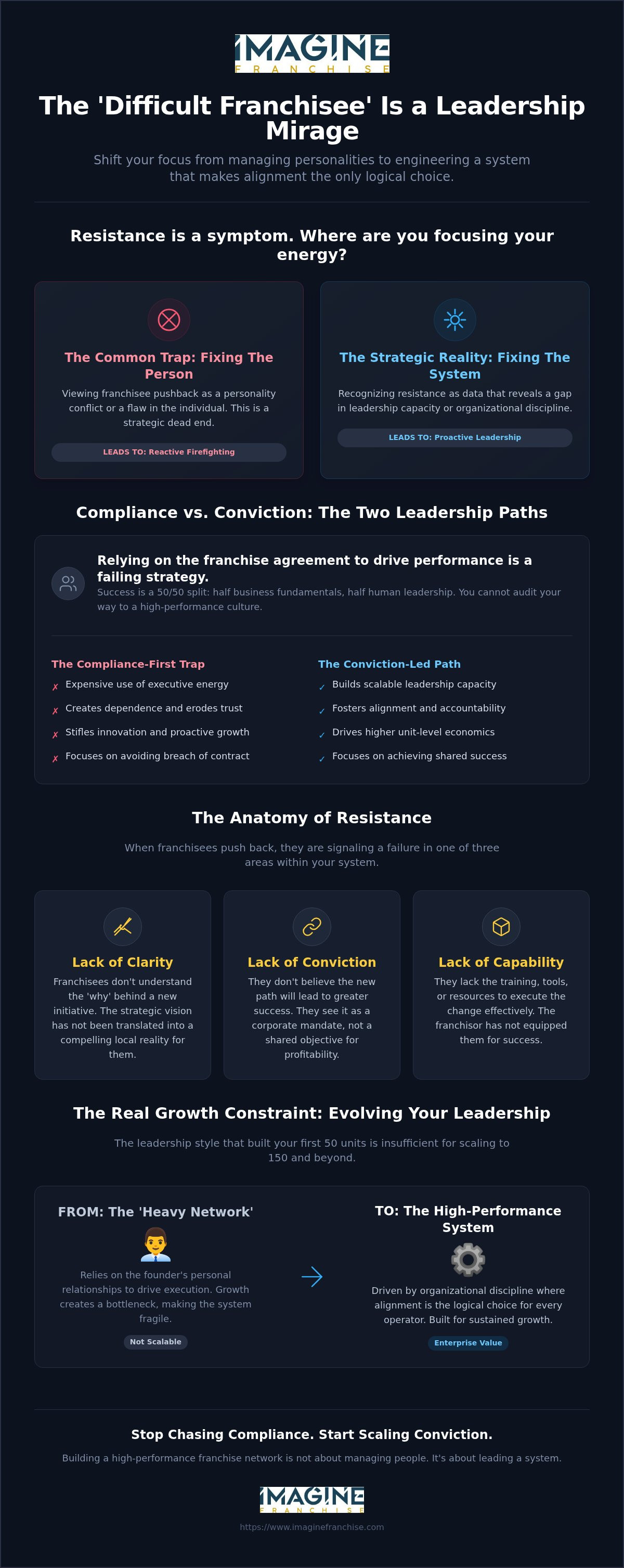
When a CEO tells me they're struggling with "difficult" operators, I hear a leader who has reached their current limit. Labeling a franchisee as difficult is a strategic dead end. It's an executive exit strategy from responsibility. It allows you to externalize the problem, suggesting the issue is a personality flaw you can't control rather than a system failure you can. If you want to know how to handle difficult franchisees, you must first stop using the label as a shield. It blinds you to the actual friction in your network.
Resistance is data. It's the smoke that points to a fire in your organizational discipline. When franchisees push back on initiatives, they're often signaling a lack of clarity, conviction, or capability within the system. In the early stages of understanding the franchise model, founders often rely on personal relationships to drive execution. But as you scale, that "Heavy Network" becomes fragile. Reliance on your personal touch doesn't scale. It creates a bottleneck where growth makes the system more susceptible to collapse. Friction isn't an obstacle to your leadership; it's the primary indicator of where your leadership needs to evolve.
The Cost of 'Managing' vs. 'Leading'
Policing compliance is an expensive use of executive energy. If your leadership team spends their weeks in "fix-it" mode, you aren't building enterprise value. You're just maintaining a status quo. This micro-management approach treats the symptom, not the cause. Fixing one problematic operator doesn't prevent the next one from emerging. The underlying environment remains the same. Unresolved friction has real consequences:
- Executive burnout from constant, repetitive conflict.
- Stagnant unit-level economics due to poor execution.
- Erosion of brand consistency that devalues the entire network.
True performance comes from alignment, not just avoiding a breach of contract. When you shift from managing individuals to leading a high-performance system, the "difficult" behaviors often evaporate because they no longer have a vacuum to fill.
Leadership Capacity: The Real Growth Constraint
Many franchisors hit a wall because the style that worked for 50 units is insufficient for 150. At a certain point, your ability to lead without creating dependence becomes the primary lever for growth. Leadership capacity is the ceiling of your network's growth. If you don't expand that capacity, you'll continue to struggle with how to handle difficult franchisees at every new stage of expansion. You don't need a way to "handle" people. You need to scale a system where alignment is the only logical choice for every franchisee in the room.
The Anatomy of Resistance: Why Compliance-First Strategies Always Fail
Most franchisors reach for the legal manual the moment friction starts. It's a standard reflex. But if you're relying on the franchise agreement to drive performance, you've already lost. The agreement is a safety net. It's designed to protect the brand from disaster, not to propel it toward growth. When you focus solely on how to handle difficult franchisees through enforcement, you ignore the human engine behind the business. Success in this industry is a 50/50 split. Half is business fundamentals; the other half is human leadership. You can't audit your way to a high-performance culture.
We often see the "Good Enough" trap. This happens when a franchisee reaches a level of profitability where they no longer feel the need to innovate or follow your latest initiatives. They plateau. They stop listening. This creates a dangerous execution gap between your corporate strategy and their local reality. If you treat this as a simple breach of contract, you'll get compliance, but you won't get conviction. You might find a practical guide for franchisors useful for documenting these issues, but documentation alone won't close the gap. Documentation records the failure; leadership prevents it.
The Trust-Performance Multiplier
Trust isn't a soft metric. It's a financial one. Every time trust drops, a tax is levied on your organization in the form of increased monitoring and enforcement costs. Conversely, when trust is high, speed increases and costs drop. A study by InGage Consulting found that engaged franchisees are 3.7 times more profitable than their disengaged peers. That's a massive performance multiplier. It proves that character and conviction aren't just nice-to-haves. They are the bedrock of brand value. When you know how to handle difficult franchisees by rebuilding trust, you're actually improving your bottom line.
Why Support is Not the Same as Alignment
Most franchisors respond to resistance with more support. They offer more training, more tools, and more hand-holding. This is often a mistake. Over-supporting can create a network of dependents who can't make a move without corporate permission. It breeds weakness. You need to shift the conversation from "What do you need?" to "What are we achieving?" Alignment requires clarity on the mission and the capability to execute it. If you're tired of putting out fires and want to build a self-sustaining network, a private exploratory session can help identify where your leadership system is leaking energy. Stop trying to support them into submission and start leading them into alignment.
Diagnosing the Friction: Is it a Maverick, a Laggard, or a Leadership Failure?
You can't solve a problem you haven't accurately diagnosed. When you're stuck wondering how to handle difficult franchisees, the "difficult" label often acts as a fog that obscures the root cause. To clear it, we use the Franchise Performance 360© lens. This framework moves beyond emotional reactions and looks at the intersection of results and behaviors. It forces you to categorize the friction so you can apply the right leadership lever. Not every act of resistance is a rebellion. Sometimes, it's a distress signal.
The Maverick is perhaps the most taxing for a CEO's ego. These operators deliver high performance but show low system compliance. They make money, but they do it their way. They view your latest initiative as a suggestion rather than a standard. On the other end, you have the Laggard. These franchisees are highly compliant but show low performance and zero ambition. They follow the manual to the letter while their unit-level economics slowly bleed out. Both are "difficult," but they require entirely different leadership responses. One needs a re-alignment of conviction; the other needs a boost in capability.
The CEO’s Self-Evaluation
Before you look at the network, you have to look at the mirror. Is the resistance you're facing a personality flaw in the franchisee, or is it a reaction to a lack of strategic clarity from your office? Leadership magnetism is what keeps a network together when things get hard. If your operators only follow you because of the contract, you don't have a leadership system; you have a legal one. You must ask if you've given them a vision worth following or just a set of rules to obey.
Success isn't accidental. The Formula for Success is defined as % Faith × % Focus × % Effort. If any of those variables are low, the output fails. If your franchisees don't have faith in your strategy, no amount of focus or effort will close the execution gap. Your job as CEO is to ensure those percentages remain high across the entire network.
Identifying Systemic Misalignment
Inconsistent execution often points to a lack of shared understanding rather than a lack of will. Many common franchisor-franchisee issues are actually symptoms of a broken process that leadership has ignored. Sometimes the "difficult" franchisee is actually the most valuable person in your network. They're the only one calling out a process that doesn't work on the ground. You have to distinguish between personal friction and operational failure. If multiple high-performers are pushing back, the problem isn't their attitude. It's your system. Knowing how to handle difficult franchisees starts with having the intellectual honesty to admit when they're right.
The BRAVE Reframe: Moving from 'Managing Problems' to 'Leading Performance'
Managing problems is a drain on your enterprise value. Leading performance is an investment in your future. If you're stuck in a loop searching for how to handle difficult franchisees, you're likely treating the friction as an isolated personality conflict. It's not. It's a signal that your leadership system hasn't yet scaled to match the complexity of your growth. The BRAVE Model™ provides the framework to break this cycle. We move past tactical "fixing" and enter the territory of executive-level realignment. This isn't about changing people. It's about changing the system so that alignment becomes the only logical path for your operators.
Step 1: Establishing the Baseline
Real change starts with the truth. You can't lead where you won't look. Establishing a baseline requires a candid, peer-to-peer conversation between you and the franchisee. Speak as one business owner to another. Remove the corporate hedging. You must name the tension and surface the uncomfortable truths that everyone feels but no one says. Use objective performance data to ground the discussion, but focus on the human reality behind the numbers. This isn't a legal audit. It's a strategic assessment of whether the current partnership is actually capable of delivering the desired results. When you know how to handle difficult franchisees with this level of transparency, the "blame game" dies a quick death.
Step 2: Realignment and Activation
Once the truth is on the table, you can build a roadmap. We use the Franchisexcel© framework to define a clear 3-to-5 year growth path that serves both the brand and the individual operator. This is where you apply the BRAVE Coaching Method™. You aren't coaching for compliance. You're coaching for conviction. If an operator doesn't believe in the destination, they won't follow the map. You must establish your non-negotiables clearly, but do it within a container of human trust. Activation occurs when the franchisee realizes that your vision is the most efficient vehicle for achieving their personal goals.
Step 3: Execution and Accountability
Accountability is often misunderstood as surveillance. In a high-performance network, it feels like support. You need a cadence of accountability that keeps momentum alive without suffocating the operator's autonomy. Celebrate the small wins. Rebuilding faith in the system takes time and consistent proof of concept. When a previously "difficult" franchisee sees success through the new alignment, they often become your most vocal advocates. If you're ready to reframe your leadership and stop putting out daily fires, let's look at the gaps in your system together.
Scaling Your Network Capacity: The Franchisexcel© Path to Unity
Scaling a franchise network isn't just about adding locations. It's about expanding your internal capacity to lead them. If you're still personally trying to figure out how to handle difficult franchisees at 100 units the same way you did at ten, you're the bottleneck. The transition from founder to CEO is the most difficult pivot you'll ever make. Founders rely on grit and personal influence. CEOs rely on systems of organizational discipline and strategic clarity. What brought you here won't take you to the next level. You have to stop being the hero and start being the architect of a system that performs without you.
You need a C-Suite team that executes the vision without your constant intervention. Building this team requires a shift in your own leadership maturity. This is the core focus of the Franchise Leadership Catalyst™, a 12-month journey from Imagine Franchise designed for strategic acceleration. We move from a network that is fragile and dependent on your personal energy to one that is robust and unified in its execution. When you scale smarter, you don't just grow the number of units. You multiply your network’s impact and protect your personal freedom.
The Role of the Franchisexcel© Program
The Franchisexcel© Program, a signature offering from Imagine Franchise, moves you from mere clarity of action to a genuine unity of the network. Executive coaching at this level isn't about basic management tips. It's about transforming your ability to handle complexity and human friction. When your leadership capacity grows, the network stops being a collection of individual fires you have to put out. It becomes a high-performance engine. You'll spend less time wondering how to handle difficult franchisees and more time leading a system where alignment is the only logical choice for every operator in the room.
Your Next Strategic Move
Stop seeing friction as a nuisance. Start seeing it as an opportunity for leadership growth. The "difficult" operator is often just the person highlighting where your system is no longer sufficient for the scale you've reached. They are the data point that tells you your leadership needs to evolve. Reframing this resistance allows you to move from a position of frustration to one of strategic power. It forces you to build the conviction and clarity that your network is currently missing.
I want to leave you with an impact question. What would your network look like if trust was your primary currency instead of legal compliance? Imagine the speed and performance of a network where everyone is pulling in the same direction because they believe in the destination. That future is possible, but it requires a different version of you at the helm. If you're ready to lead boldly and explore how Imagine Franchise can transform your network, book your private 45-minute exploratory session to discuss your network's future. Let's stop putting out fires and start building a legacy.
Mastering the Shift Toward High-Performance Unity
Stop looking for a legal solution to a leadership gap. The friction you feel isn't a sign that your franchisees are broken; it's a signal that your leadership system needs to evolve. By moving from compliance policing to strategic alignment, you transform the network from a collection of dependents into a unified force. This is the core of the Franchisexcel© Growth Leadership System. It's about recognizing that success is 50% business fundamentals and 50% human leadership. You can't audit your way to excellence.
If you're tired of putting out daily fires and want to know how to handle difficult franchisees with conviction instead of conflict, it's time to step into your role as a strategic CEO. With over 35 years of hands-on experience and as the author of 'For Franchise Leaders’ Eyes Only', I help leaders like you scale without making the system more fragile. You've built something valuable. Now, build the capacity to lead it to the next level.
Book your private 45-minute exploratory session with Stéphane Breault to discuss your network's future. The freedom you want is on the other side of your next leadership shift.
Strategic Leadership: Frequently Asked Questions
What is the primary cause of franchisee resistance?
Resistance is usually a symptom of a systemic gap in clarity, capability, or conviction. If operators don't understand the "why" behind a change or lack the tools to execute it, they push back to protect their local business. It's rarely about being difficult for the sake of it. Most friction indicates that your leadership magnetism hasn't kept pace with your network's growing operational complexity.
How do I deal with a high-performing franchisee who refuses to follow the system?
This is a classic "Maverick" scenario where you must move beyond the contract to realign their conviction. High performers often believe their individual success justifies bypassing the system. You need to show them how total network alignment increases the enterprise value of their specific units. If you're struggling with how to handle difficult franchisees who are also top earners, focus on the long-term strategic benefits of a unified brand.
Is it ever too late to rebuild trust with a 'difficult' franchisee?
Trust can be rebuilt if both parties are willing to establish a new baseline and move past the blame game. It requires a candid, peer-to-peer conversation that surfaces uncomfortable truths without ego. If the franchisee still has faith in the brand's potential but has lost focus or effort, realignment is possible. However, if the variables in the Formula for Success are zeroed out, a strategic exit may be the only logical path.
What is the difference between franchisee management and franchise leadership?
Management is the act of policing compliance and monitoring the legal safety net of the franchise agreement. Leadership is the act of building conviction and scaling a system where alignment is the logical choice. Management creates dependents who wait for corporate instructions. Leadership creates partners who are unified by a shared vision. True leadership capacity allows you to grow without making the network more fragile or harder to lead.
When should a franchisor consider termination instead of coaching?
Termination is a tool for failures of character or integrity, not failures of performance or clarity. If a franchisee is intentionally harming the brand or operating in bad faith, coaching won't fix the root cause. However, if the issue is poor execution or resistance to change, coaching through the BRAVE Model™ is more effective. You don't terminate your way to a high-performance culture; you lead your way there with organizational discipline.
How does the BRAVE Model™ differ from standard executive coaching?
The BRAVE Model™ is a proprietary strategic framework specifically designed for the unique tensions of the franchise relationship. Unlike generic coaching, it follows a rigorous five-stage path: Baseline, Realignment, Activation, Validation, and Execution. It focuses on the 50/50 split between business fundamentals and human leadership. It doesn't just improve the CEO's skills; it builds the organizational capacity required to scale a network of 50 to 250 units effectively.
Why does growth often lead to more friction within a franchise network?
Growth often triggers the "Heavy Network" trap where the system becomes more fragile as it expands. In the early days, founders lead through personal relationships and grit. As you scale, that personal touch becomes a bottleneck. If your leadership capacity doesn't grow faster than your unit count, the network becomes harder to lead. The friction you feel is simply the gap between your current system and your new reality.
How can I tell if the problem is the franchisee or my leadership system?
Use the Franchise Performance 360© lens to evaluate whether the friction is isolated or systemic. If multiple high-performing operators are pushing back on the same initiative, the issue is almost certainly your system or strategy. If the resistance is limited to one "Laggard" with low performance and low compliance, it may be an individual issue. Always look for the leadership dynamic beneath the visible symptom before assigning blame to the operator.

