


Your Franchise Advisory Council (FAC) feels like a drag on momentum. Meetings are circular, dominated by the loudest voices, and rarely produce anything that moves the network forward. You created it to foster alignment, but it often feels more like a forum for organized complaint.
You’ve been told the solution is in the franchise advisory council bylaws. A tighter legal document. Clearer rules of order. But you suspect the problem isn’t a missing paragraph. It’s a missing premise.
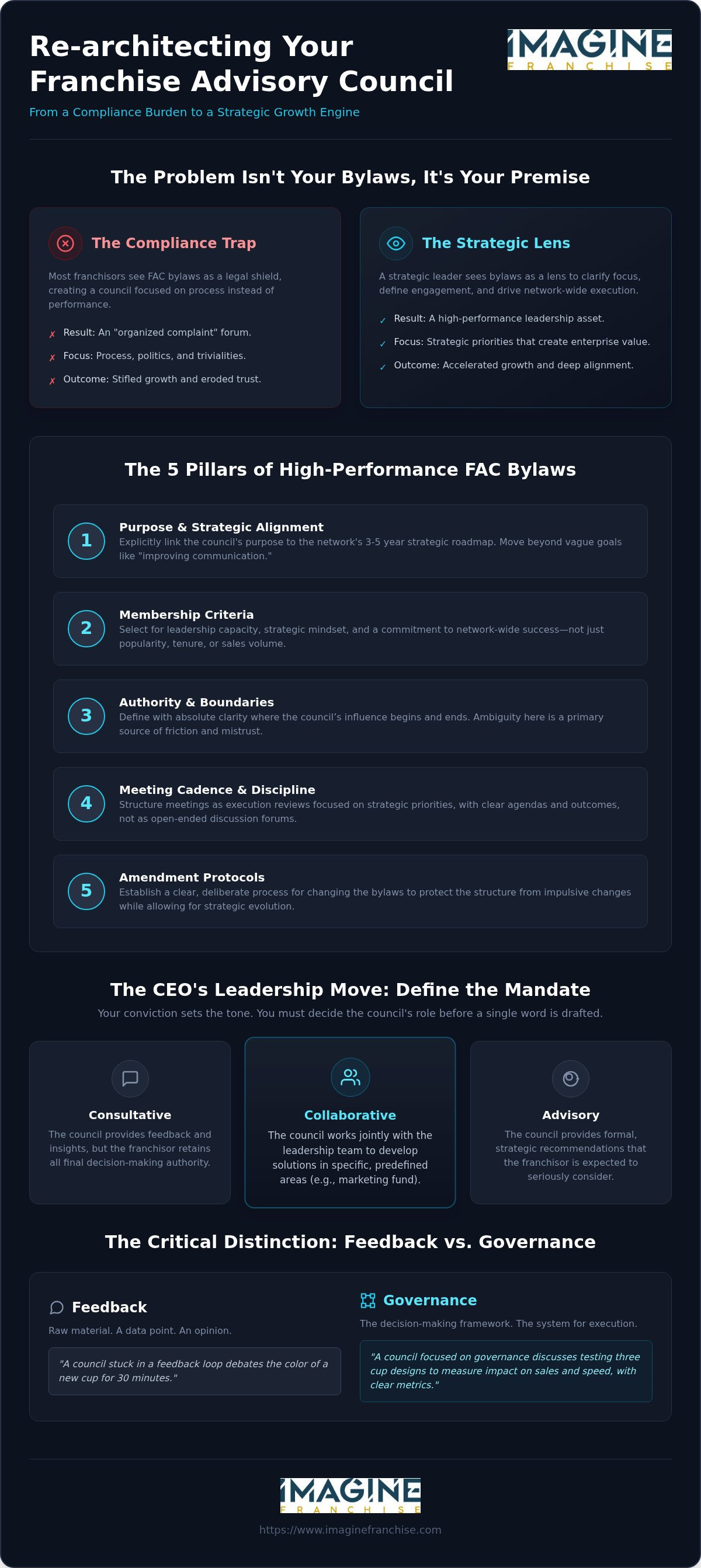
Most franchisors treat their FAC bylaws as a compliance document—a necessary legal shield to manage franchisee relations. This is a profound strategic error. Well-crafted bylaws are not a shield; they are a lens. They clarify where leadership capacity is focused, define the rules of engagement for strategic execution, and transform a potential liability into a high-performance leadership asset.
The standard approach creates a council that talks. A strategic approach builds a council that executes. This guide will show you how to draft and implement bylaws that stop stifling growth and start driving it.
Why Most Franchise Advisory Council Bylaws Stifle Growth
If your FAC bylaws are sitting in a binder, collecting dust, they are failing. They are not a static legal formality but a dynamic governance tool. When they are treated as a box-ticking exercise, they create predictable friction that slows you down, breeds mistrust, and widens the gap between your vision and network-wide execution.
- The 'Compliance Trap': You see the bylaws as a way to manage legal risk. Your franchisees see them as a rulebook for meetings. The result? A council focused on process instead of performance, where strategic momentum dies in sub-committee debates over trivialities.
- The Lens, Not the Shield: Your bylaws define how leadership capacity is distributed and focused. Vague bylaws create a vacuum, which is inevitably filled by personality, politics, and operational complaints. Strong bylaws focus the council’s energy on the 3-5 strategic priorities that actually create enterprise value.
- The Invisible Cost of Ambiguity: Vague purpose clauses lead to wasted time. Unclear authority boundaries lead to lost trust. Poorly defined membership criteria lead to the wrong people in the room. These aren’t minor issues; they are execution gaps that tax your leadership team and frustrate your best franchisees.
- Challenging the 'Communication' Myth: An FAC that exists merely to “improve communication” is a liability. Communication without a shared objective is just noise. The goal isn’t to talk more; it’s to build a shared conviction about how to win, together.
The Difference Between Feedback and Governance
Many councils devolve into a "complaints department" because the franchisor has not clearly distinguished between collecting feedback and enabling governance. They are not the same thing.
Feedback is a data point. It’s a franchisee’s opinion on a new marketing campaign, a supplier issue, or a software update. It’s valuable, but it’s raw material. Governance, on the other hand, is the decision-making framework. It’s the system you use to process that feedback, weigh it against strategic goals, and make a binding decision. Your council’s primary role should be focused on governance—advising on how the network executes its strategic plan, not just debating what individual franchisees like or dislike.
For example: A council stuck in a feedback loop debates the color of a new cup for 30 minutes. A council focused on governance discusses a proposal to test three new cup designs in select markets to measure the impact on sales and operational speed, with clear success metrics.
The CEO’s Role in Defining the Council’s Mandate
The clarity of your FAC begins with your conviction as a leader. If you are unclear about the council’s purpose, or if you see it as a necessary evil, that ambiguity will be reflected in the bylaws and your franchisees will feel it. You must decide its mandate before a single word is drafted.
Is your council:
- Purely Consultative? It provides feedback, but the franchisor retains all decision-making authority.
- Collaborative? It works with the leadership team to develop solutions in specific, predefined areas (e.g., the marketing fund budget).
- Advisory? It provides formal recommendations on strategic initiatives, which the franchisor is expected to seriously consider.
Each of these models requires different language, boundaries, and expectations in your bylaws. This is why you must lead the drafting process. Delegating it entirely to your legal team without providing this strategic framework is an abdication of leadership. Lawyers translate intent into binding language; they don’t define your network’s leadership philosophy.
The 5 Pillars of High-Performance FAC Bylaws
Moving beyond compliance requires building your franchise advisory council bylaws on a foundation of strategic intent. These five pillars ensure your governance document is a tool for alignment and execution, not just a rulebook for meetings.
- Pillar 1: Purpose and Strategic Alignment. The bylaws must explicitly link the council's purpose to the network's 3-5 year strategic roadmap.
- Pillar 2: Membership Criteria. The rules must select for a growth mindset and leadership capacity, not just popularity or seniority.
- Pillar 3: Authority and Boundaries. The document must define with absolute clarity where the council’s influence begins and, more importantly, where it ends.
- Pillar 4: Meeting Cadence and Discipline. The bylaws should structure meetings as execution reviews focused on strategic priorities, not open-ended discussions.
- Pillar 5: Amendment Protocols. The process for changing the bylaws must be clear, protecting the structure from impulsive changes while allowing for strategic evolution.
Defining Strategic Alignment in Your Bylaws
A purpose statement like “to foster better communication between the franchisor and franchisees” is a recipe for failure. It’s too vague to be actionable. Instead, your bylaws should bake strategic alignment directly into the council's mandate.
Weak Bylaw Clause: “The purpose of the FAC is to represent the interests of the franchisee community.”
Strong Bylaw Clause: “The purpose of the FAC is to provide strategic counsel to the franchisor on the execution of the three corporate priorities as defined in the annual strategic plan: 1) System-wide implementation of the new CRM platform, 2) Improving unit-level profitability by 5% through supply chain optimization, and 3) Enhancing brand consistency across all digital channels.”
This level of specificity focuses the council’s energy. It links their work directly to network-wide enterprise value and ensures they are working on the same problems as your leadership team. Using a framework like the BRAVE Model™ can help ensure the council’s activities are focused on the right priorities for Realignment and Execution.
Authority vs. Influence: Drawing the Line
One of the biggest fears for a franchisor is losing control. This fear often leads to bylaws that are overly restrictive, creating an adversarial dynamic. The solution isn't to remove all franchisee power, but to be surgically precise about its limits.
The franchisor must always retain final decision-making power on core brand standards, financial strategy, and legal obligations. The "veto" is not a myth; it's a structural necessity. However, you can grant the council specific authority in designated “safe zones” to build trust and ownership.
Concrete Example: The Marketing Fund.
- Influence: “The FAC will review and provide feedback on the annual marketing plan proposed by the franchisor.” (The franchisor listens but decides.)
- Authority: “The FAC holds three of five seats on the Marketing Fund Committee and has binding voting power on the allocation of the national advertising budget, provided the allocation aligns with brand standards set forth by the franchisor.” (The franchisor sets the boundaries, but the council decides within them.)
Your bylaws must use clear language to prevent "mission creep," where a council slowly expands its perceived authority into areas where it has none. Define what is in-bounds and what is out-of-bounds with no room for interpretation.
Managing Member Selection: Capacity Over Popularity
Who sits on your council determines its value. If your selection process is a simple popularity contest, you risk filling the room with charismatic complainers or a stagnant "Old Guard" resistant to change. Strategic bylaws engineer a council composed of your best growth-oriented leaders.
- The 'Old Guard' Problem: Seniority does not equal strategic insight. Bylaws that favor tenure can inadvertently create a council that defends the past instead of building the future. Your longest-serving franchisees have valuable institutional knowledge, but that shouldn't guarantee them a permanent seat at the leadership table.
- Term Limits are Non-Negotiable: To ensure a constant influx of fresh thinking, term limits are essential. A common structure is two-year staggered terms, with a maximum of two consecutive terms. This prevents the "council for life" stagnation while maintaining continuity.
- The 'Appointed vs. Elected' Balance: A purely democratic election can be a gamble. A hybrid model often works best for strategic unity. For example, for a seven-person council, you might have four members elected by franchisees from regional districts and three members appointed by the franchisor to ensure specific skill sets (e.g., a multi-unit operator, a technology early adopter) are represented.
Drafting Membership Qualifications That Matter
Your bylaws should act as a filter, ensuring that only franchisees who have demonstrated success and a commitment to the system’s growth are eligible to serve. This isn’t about elitism; it’s about ensuring the council is led by those who best exemplify the brand's standards.
Example Membership Qualifications:
- Minimum Performance: "Candidates must be in the top 50% of the network for gross revenue and have passed their last two operational evaluations with a score of 90% or higher."
- Good Standing: "Candidates must be current on all fees and have no outstanding defaults under their franchise agreement."
- Diversity of Experience: "The council will strive to include representation from both multi-unit and single-unit owners, as well as representation from different geographic regions."
- The 'Ambition Check': While harder to write into bylaws, the selection process should vet for franchisees who are still hungry for growth and actively engaged in improving their own operations, not just criticizing the system. This often comes through in the nomination or interview process.
The Strategic Use of Term Limits
Term limits are more than just a logistical rule; they are a cultural tool. They signal that serving on the council is a tour of duty, not a position of permanent status. They democratize leadership opportunities and create a healthy sense of urgency for council members to make an impact during their tenure.
Consider including a "cooling off" period in your bylaws. For example, a member who has served two consecutive terms must step down for at least one full term before being eligible for re-election. This prevents the same small group of individuals from dominating the council for a decade, ensuring a wider range of perspectives over time.
The Drafting Process: Building Conviction Before the Vote
How you create your franchise advisory council bylaws is as important as what they contain. A document handed down from on high will be met with suspicion. A collaborative process builds the trust and buy-in necessary for the bylaws to become a living, respected framework for your partnership.
- Step 1: The Internal Audit. Before you write a single line, get your own leadership team in a room. Where is your current governance model failing? Are meetings unproductive? Is there a lack of trust? Be brutally honest about the problems you need to solve.
- Step 2: The 'BRAVE' Consultation. Align your C-suite on the new leadership framework. Use a model like the BRAVE Model™ to clarify the council's new Baseline and the goals for Realignment and Execution. Your team must have a unified conviction about the 'why' behind the changes.
- Step 3: The Collaborative Workshop. Invite a small group of trusted, high-performing franchisees—not the entire network—to participate in a workshop. Don’t present them with a draft. Instead, present them with the problems you identified in Step 1. Ask for their perspective. Involve them in designing the solution. This builds advocacy before you ever ask for a vote.
- Step 4: The Legal Refinement. Now, take the strategic framework you’ve co-designed and give it to your franchise lawyer. Their job is to translate that strategic intent into clear, enforceable, and legally sound language.
- Step 5: The Launch. Present the finished bylaws to the entire network not as a new set of rules, but as a shared commitment to a more productive and aligned future. Explain how the new structure will help everyone achieve their goals faster.
How to Handle Resistance During the Drafting Phase
Resistance is inevitable. But it’s rarely about the specific wording of a clause. Resistance is a symptom of unclear purpose, low trust, or a perceived loss of status. When a franchisee pushes back, don't argue about the paragraph; ask about the principle. Address the "What's in it for me?" question directly. Show them how a more focused, professional council will solve the problems that frustrate them, too—like slow decision-making or a lack of follow-through from the corporate office.
Use network data to justify changes. If you are proposing stricter membership criteria, show how top-quartile performers are driving the brand forward. Ground the changes in objective reality, not subjective opinion. For many, seeing the data provides the context they need to understand the 'why' behind the new structure.
Moving Beyond the Template
A generic template for FAC bylaws is a starting point, not a solution. Your governance must reflect the unique culture, industry, and growth stage of your network. A 75-unit quick-service restaurant chain has different needs than a 150-unit home services brand. Your bylaws should be customized to reflect your reality. For example, consider integrating requirements related to the technology platforms you use for operations and communication, ensuring the council is aligned with the tools that run the business. Ultimately, simple, clear bylaws that are actively used are far more strategic than a comprehensive, 50-page document that no one ever reads.
From Paper to Performance: The CEO’s Leadership Move
Your new franchise advisory council bylaws are complete. The document is clear, strategic, and has franchisee buy-in. But the work is not done. It has just begun.
Bylaws are only as strong as the leadership of the CEO who upholds them. They provide the structure, but you must provide the conviction. This is the 50/50 Truth: 50% of your success comes from having the right fundamentals (like strong bylaws), but the other 50% comes from your day-to-day human leadership. You must model the discipline, focus, and strategic mindset you expect from the council.
Use the council as a leadership catalyst for the entire network. When the council functions at a high level, it sets a new standard for collaboration and accountability. Its successes should be communicated widely, demonstrating the power of a true franchisor-franchisee partnership. This is how you integrate your council into a broader growth leadership system, like Franchisexcel©, turning governance into a competitive advantage.
Self-Evaluation for the Franchisor CEO
As you implement this new framework, ask yourself the hard questions:
- Are you using the bylaws to lead with clarity, or are you hiding behind them to avoid difficult conversations?
- Can you draw a direct line from the council's work to an improvement in unit-level profitability?
- Is the council helping you execute your strategic roadmap faster and with less friction?
The ultimate ROI of a well-governed network is not just reduced conflict. It’s accelerated growth, higher enterprise value, and the magnetism that attracts the best franchisees in the industry. It’s the difference between a network that grows and a network that scales intelligently.
Scaling Smarter with Strategic Alignment
Strong FAC bylaws are a critical tool in the transition from a founder-led organization to a professionally managed enterprise. They create the discipline and structure needed to support a 10x growth jump without breaking your culture or your operational capacity. They are an investment in your own leadership, freeing you up to focus on the future of the brand, confident that you have a powerful engine for alignment working alongside you.
Your bylaws are more than a document. They are a declaration of how you intend to lead. Make sure they reflect the high-performance network you are committed to building.
Frequently Asked Questions About Franchise Advisory Council Bylaws
What are the most critical sections to include in franchise advisory council bylaws?
The most critical sections are: 1) The Purpose/Mission, which must be tied to the franchisor's strategic goals; 2) Membership Criteria, defining eligibility, term limits, and the selection process; 3) Authority and Boundaries, clearly stating what the council can and cannot decide; and 4) Amendment Procedures, outlining how the bylaws can be changed.
How do I prevent my franchise advisory council from becoming too powerful?
You prevent overreach by being crystal clear in the bylaws about the council's limits. State explicitly that the council's role is advisory and that the franchisor retains final authority on all matters related to brand standards, contracts, and financial strategy. Define specific, limited areas where they might have binding authority (like a marketing fund committee) to give them ownership without ceding control.
Can a franchisor change the FAC bylaws without franchisee approval?
This depends on what the bylaws themselves say. A well-drafted "Amendment" section will specify the process. Best practice is to require a joint approval process—for example, a change might need to be approved by both the franchisor and a two-thirds majority of the FAC members. Unilaterally changing the rules is a sure way to destroy trust.
How many members should be on a franchise advisory council for a 100-unit network?
For a 100-unit network, a council of 5 to 7 members is typically effective. This is large enough to represent different viewpoints (e.g., regional, multi-unit vs. single-unit) but small enough to remain nimble and make decisions efficiently. An odd number is always recommended to prevent tie votes.
What is the difference between a Franchisee Association and an Advisory Council?
A Franchise Advisory Council (FAC) is typically initiated and sanctioned by the franchisor to act as a formal channel for advice and collaboration. A Franchisee Association is an independent, franchisee-formed organization, often created without the franchisor's involvement, to represent franchisee interests and engage in collective bargaining. The relationship with an FAC is collaborative; the relationship with an Association can sometimes be adversarial.
How often should a franchise advisory council meet according to standard bylaws?
Most bylaws specify quarterly meetings, with the option for special meetings to be called as needed. This cadence is frequent enough to maintain momentum on key initiatives but not so frequent that it becomes a burden. It's often effective to have two in-person meetings and two virtual meetings per year.
Should the franchisor CEO always chair the advisory council meetings?
Not necessarily. While the CEO must be actively involved, having a franchisee chair the meeting can foster greater ownership and more open dialogue among members. A common model is to have a franchisee as the FAC Chair and a senior executive from the franchisor (like the COO) as the Co-Chair to ensure meetings are productive and aligned with corporate priorities.
How do I handle a council member who is consistently disruptive?
Your bylaws should include a "Code of Conduct" and a "Removal" clause. This allows for the removal of a member for specific reasons, such as violating the conduct code, failing to attend meetings, or no longer meeting the eligibility criteria (e.g., falling out of good standing). This provides a formal, objective process and avoids personal confrontations.

