


You’ve seen it happen. A franchisee you value—a solid operator, a brand believer—doesn’t renew. Or worse, they exit early. The official reason is retirement or a change in lifestyle, but you suspect there’s more to it. You’re left with a territory to fill, a gap in your royalty stream, and a quiet unease that spreads through the network.
Most franchisors treat this as a cost of doing business. They analyze the exit interview, tweak the support system, and focus on selling the next unit. But this reactive cycle does nothing to solve the underlying issue. It misdiagnoses the problem entirely.
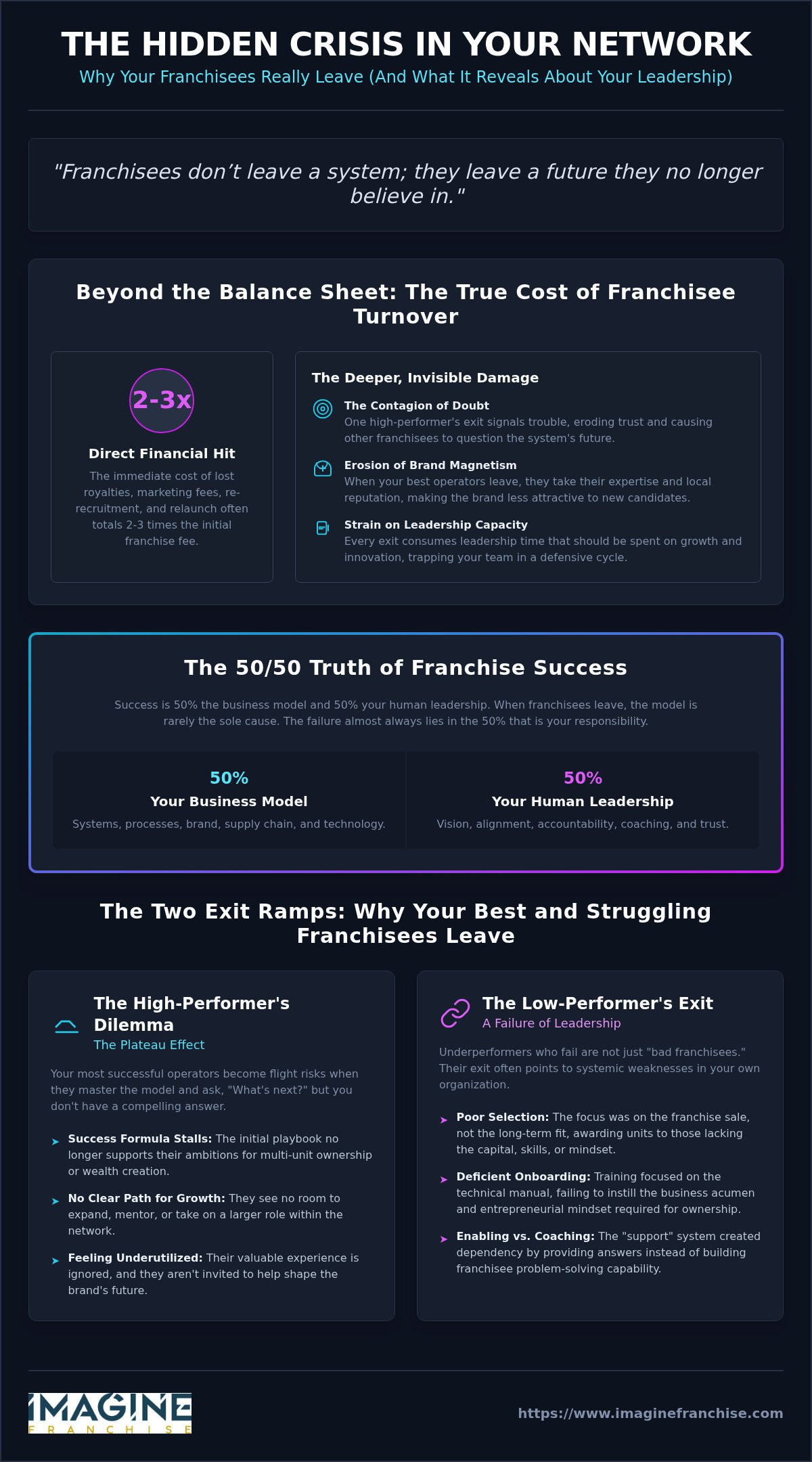
Franchisee turnover isn’t a series of isolated business decisions. It’s a referendum on your leadership and the perceived future of the network. The hard truth is that franchisees don’t leave a system; they leave a future they no longer believe in. This guide will show you how to reduce franchisee turnover by confronting the real issues: the loss of alignment, the failure of leadership, and the urgent need to build a network people are excited to stay in.
Beyond Exit Interviews: The Real Cost of Franchisee Turnover
When a franchisee leaves, the financial hit is obvious. You lose royalties and marketing fees, and you incur costs for re-recruitment, training, and site relaunch. Most estimates place this direct cost at two to three times the initial franchise fee. But the real damage is far greater and harder to quantify.
- The Contagion of Doubt: One high-performer’s exit sends a powerful signal to the rest of the network. Other franchisees start to wonder, “What do they know that I don’t?” This doubt erodes trust, the essential currency of a healthy franchise system.
- The Erosion of Brand Magnetism: Your best franchisees are your most credible brand ambassadors. When they leave, they take their operational expertise, local reputation, and institutional knowledge with them. The brand becomes less attractive to new candidates and less formidable to competitors.
- The Strain on Leadership Capacity: Every exit consumes a massive amount of your leadership team’s time and energy—time that should be spent on strategic growth, innovation, and supporting your performing franchisees. Turnover isn’t just a vacancy; it’s a leak in your leadership capacity.
The Mathematical Reality of Attrition
Consider the impact on your enterprise value. Private equity firms and other buyers scrutinize turnover rates as a key indicator of system health and stability. A high churn rate is a red flag that signals underlying operational, financial, or relational problems. It directly discounts the multiple they are willing to pay for your business.
This instability also trickles down to your field support team. Instead of coaching for performance and growth, your field consultants are trapped in a cycle of managing exits and onboarding replacements. This defensive posture kills morale and prevents them from adding real value to the network.
Why the 'Support' Trap Increases Turnover
Here is a contrarian truth: more support is rarely the answer to retention. In fact, too much of the wrong kind of support can make franchisees more dependent, less resilient, and ultimately, more likely to leave. When a franchisee faces a challenge, the default response is often to provide a solution—a new marketing plan, a script, a technology fix.
This “helping” feels productive, but it can quickly become “enabling.” It trains franchisees to look to the franchisor for answers instead of developing their own problem-solving capabilities. Your most successful, entrepreneurial franchisees—the very people you want to keep—are the ones who feel most suffocated by this model. They didn’t sign up to be managed; they signed up to build a business.
Why Franchisees Really Leave: It’s Not Just About Money
Franchisee turnover is almost always a symptom of a deeper issue: a loss of confidence. Specifically, a loss of confidence that the franchisor’s project for the future is still aligned with the franchisee’s personal and financial goals. This misalignment happens for two distinct reasons, affecting your best performers and your struggling operators in different ways.
The "50/50 Truth" of franchising is that success is 50% the business model and 50% your human leadership. When franchisees leave, the model is rarely the sole cause. The failure almost always lies in the 50% that is your responsibility.
The High-Performer’s Dilemma: The Plateau Effect
Your most successful franchisees often become your biggest flight risks. They’ve mastered the operational model, built a profitable business, and are now asking, “What’s next?” If you don’t have a compelling answer, they will find one elsewhere.
This is the Plateau Effect, and it’s driven by concrete frustrations:
- The Success Formula Stalls: The strategies that helped them succeed in their first unit don't apply to multi-unit ownership or wealth creation. The "formula for success" that you sold them no longer works for their next chapter.
- No Clear Path for Growth: They see no room to expand within the network. Either territories are sold out, or there isn't a clear, supported path for them to become a multi-unit operator, a mentor, or take on a new leadership role.
- A Feeling of Being Underutilized: They have wisdom and experience to share but feel their contributions are not recognized or sought after. They want to help shape the future of the brand, not just execute yesterday's playbook.
This is a direct consequence of the Lone CEO problem. When the leader’s vision for growth stops expanding, the network’s best people have no choice but to look for a bigger pond.
The Low-Performer’s Exit: A Failure of Leadership
The other side of the turnover coin is the underperforming franchisee who eventually fails or is managed out. It’s tempting to blame this on a "bad franchisee," but more often than not, the failure began long before they opened their doors. It began with a failure of your leadership.
This turnover is a direct result of systemic weaknesses in your own organization:
- Poor Selection: You were more focused on the sale than the fit, awarding a franchise to someone who lacked the capital, skills, or mindset to succeed.
- Deficient Onboarding: Your training was focused on the technical manual, not on instilling the entrepreneurial mindset and business acumen required for ownership.
- Lack of Early Intervention: You didn't provide close, rigorous follow-up in the critical first 90 days, allowing bad habits to take root.
- "Buying Peace": You tolerated deviations from brand standards because you lacked the courage to have difficult conversations, eroding the brand for everyone. You hoped the problem would fix itself.
- A "Wait and See" Mentality: Instead of proactively addressing performance gaps, you waited, hoping for a turnaround that never came. This lack of courage is a choice—one that ultimately leads to a predictable and costly exit.
How to Reduce Franchisee Turnover Through Strategic Alignment
If misalignment is the disease, strategic alignment is the cure. But alignment is not agreement. It’s not about getting everyone to like your decisions. It is a shared conviction in the roadmap—a deep, collective belief that the destination is worth the journey and that the plan to get there is sound.
Your job as CEO is to build that conviction. This requires moving from a culture of "policing" compliance to a culture of "coaching" for performance. It’s a shift from managing franchisees to building leadership capacity throughout the network.
Building Trust Through Performance Visibility
Trust is not a "soft" topic; it is a hard operational metric. A lack of trust leads to "system-drifting," where franchisees stop following the playbook long before they officially exit. The fastest way to destroy trust is to hide data or lack transparency. Franchisees become suspicious, assume the worst, and start operating from a place of self-preservation rather than collective growth.
The solution is to create a single source of truth. Platforms like FranConnect can provide network-wide visibility on key performance indicators, allowing everyone to see where they stand. When data is open and accessible, conversations shift from opinion to fact. This allows your field consultants to stop being inspectors and start being what they should be: performance coaches who use data to help franchisees win.
Creating a Culture of Accountability and Recognition
A culture of accountability is not about punishing underperformance; it’s about upholding a standard of excellence that protects the investment of every franchisee in the network. High-performers crave this. They are frustrated when they see others devaluing the brand they work so hard to build. Having the courage to manage out those who won't or can't meet standards is one of the most powerful retention tools you have for your best people.
This culture is built on a clear "Formula for Success": Faith x Focus x Effort = Success. It’s your job to ensure every franchisee has faith in the model, a clear focus on the right priorities, and is putting in the required effort. At the same time, you must build in systems for recognition. Acknowledge milestones, celebrate wins, and create platforms for your top franchisees to contribute their expertise. Feeling valued is a powerful anchor.
A CEO’s Roadmap to Reducing Network Attrition
Reducing franchisee turnover requires a disciplined, strategic approach, not a collection of piecemeal initiatives. It starts at the top, with you and your leadership team. Here is a practical, five-step roadmap to shift from a reactive to a proactive retention strategy.
- Diagnose the Root Cause: Before you can prescribe a solution, you need an accurate diagnosis. A comprehensive assessment like the Franchise Performance 360© goes beyond satisfaction surveys to measure the health of your network across both business and human dimensions. It gives you an unvarnished look at the alignment gaps between your vision and your franchisees' reality.
- Realign Your C-Suite: Turnover doesn’t start at the unit level; it starts in the executive suite. Is your leadership team fully aligned on the vision, priorities, and definition of success? If your VPs of Operations, Marketing, and Development are sending conflicting messages, you are creating the confusion that fuels franchisee frustration.
- Implement a Framework for Transformation: Lasting change requires a structured process. The BRAVE Model™ provides a framework to move from diagnosis to execution. It’s a disciplined method for closing the gap between your intent and your impact as a leadership team.
- Re-engage Your High-Performers: Actively create new growth paths for your veteran franchisees. This could mean developing a multi-unit growth track, creating a formal mentorship program, or establishing a franchisee-led innovation council. Give them a new mountain to climb within your brand, not outside of it. This act of "contribution" is a powerful retention tool.
- Shift from a Recruitment-First to a Retention-First Mindset: Reframe your growth strategy. The most sustainable way to grow your network is by ensuring the success and longevity of the franchisees you already have. Make retention a primary KPI for your entire leadership team, and resource it accordingly.
The BRAVE Model™ in Action
The BRAVE Model™ is designed to create strategic clarity and disciplined execution. It’s a journey, not a quick fix, that unfolds in logical stages:
- Baseline: Gaining an objective, data-driven understanding of where your network truly stands today—its strengths, weaknesses, and, most importantly, its alignment gaps.
- Realignment: Facilitating the tough, necessary conversations at the leadership level to forge a unified vision and a clear, measurable roadmap for the future.
- Activation: Translating the strategic plan into concrete actions, assigning ownership, and communicating the "why" behind the change to the entire network to build buy-in.
The final two stages, Validation and Execution, ensure that the plan is implemented with rigor and adapted as needed, creating a cycle of continuous improvement and building momentum for lasting change.
Future-Proofing Your Network with the Franchisexcel© System
The challenges of retention and growth in a network of 50, 100, or 250+ units are fundamentally different from those you faced as a startup. The thinking and leadership style that got you here will not get you to the next level. In fact, as many leaders discover, past success can block future growth.
The Franchisexcel© system is a Growth Leadership System designed specifically for this stage. It’s not about working harder; it’s about scaling smarter. It’s about building the leadership capacity in you and your team to lead a larger, more complex network—one that moves from a fragile state of dependence to a magnetized state of interdependence.
The Next Step for Your Leadership
You cannot solve the problem of franchisee turnover with the same level of thinking that created it. Continuing to focus on better "support" or more "communication" while ignoring the underlying issues of alignment, leadership capacity, and franchisee growth paths will only lead to more of the same frustration.
The path to reducing franchisee turnover begins with a commitment to elevating your own leadership. The Franchise Leadership Catalyst™ is a 12-month strategic journey designed to equip you with the frameworks and coaching to make that leap.
I’ll leave you with one final question:
Is your current leadership style building a network that people are afraid to leave, or one they are excited to stay in?

