


The Paradox of Scale: When Your “Proven System” Becomes a Liability
You have a successful franchise growth strategy. On paper. You’re opening new units, signing new franchisees, and the map on your wall is filling up with pins. So why does it feel like you’re losing control? Why are the same operational headaches, franchisee disputes, and quality inconsistencies multiplying with every new location?
Here’s the uncomfortable truth I’ve learned after more than 25 years in franchise leadership, both as a CEO and as a coach to over 100 networks: most franchise growth strategies fail not because of a bad market or a weak sales plan, but because of a critical leadership capacity gap. The very strategies that got you to 50 units are the ones that will cause the system to fracture on the way to 250.
The problem is complacency—not just from your franchisees, but from your own leadership team. We fall in love with our “proven model” and begin applying it like a cookie-cutter. We stop innovating, we stop listening, and we start repeating the same small mistakes at scale. In franchising, if you have a network of 100 units and you make one systemic mistake, you aren’t making one mistake. You’re making 100 mistakes, simultaneously.
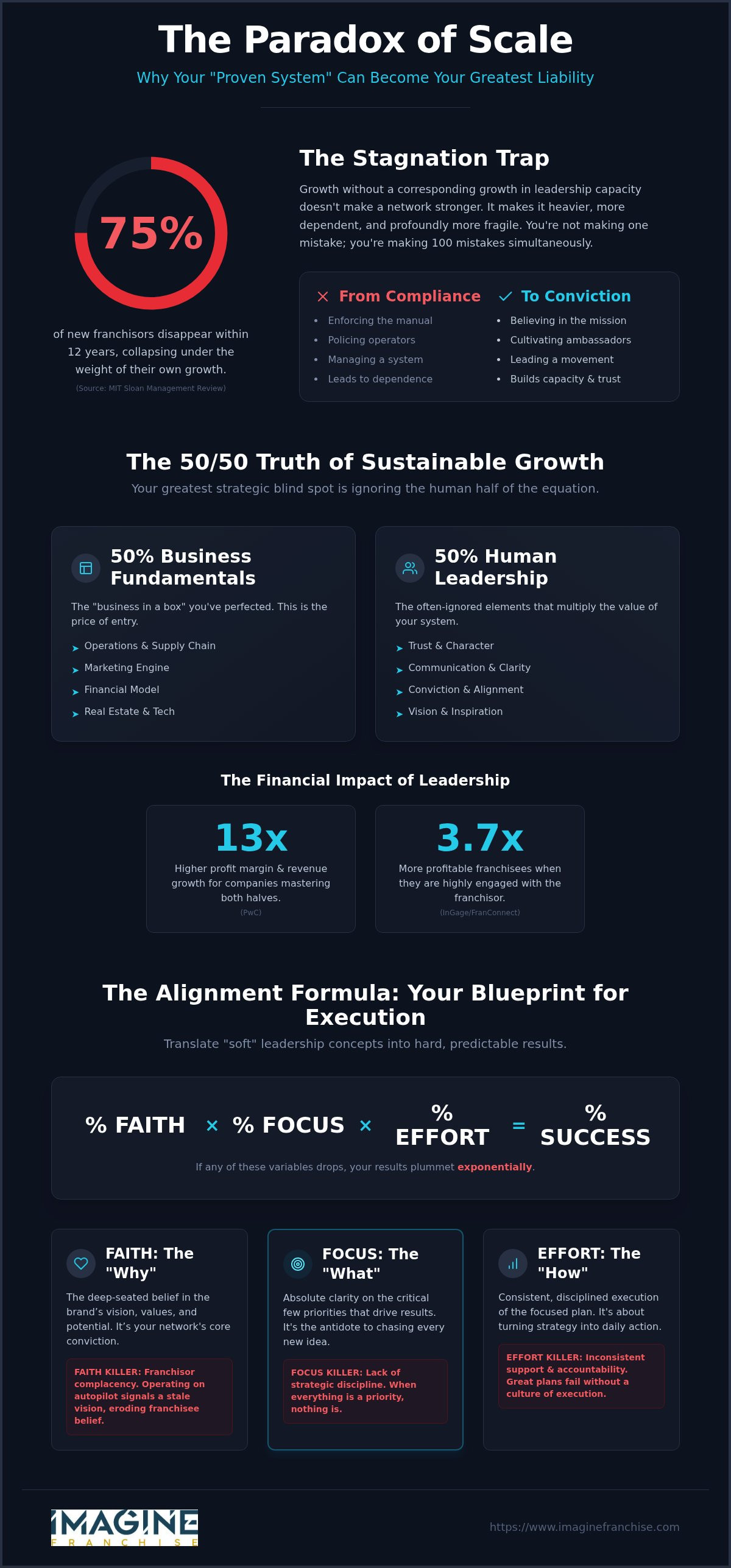
This is the paradox of scale. Growth, without a corresponding growth in leadership capacity, doesn’t make a network stronger. It makes it heavier, more dependent, and profoundly more fragile. It’s why research from the MIT Sloan Management Review shows a staggering 75% of new franchisors disappear within 12 years. They don’t fail from a lack of growth; they collapse under its weight.
The Stagnation Trap for Established Networks
For established networks, this fragility often manifests as stagnation. You hit a plateau where adding more units doesn’t translate to a healthier bottom line or a stronger brand. You find yourself in endless conversations about compliance, royalties, and enforcing the manual. These are symptoms, not the disease. The root cause is that your growth has outpaced your leadership’s ability to inspire alignment and conviction across a decentralized network. You’re managing a system, but you’ve stopped leading a movement.
Moving From Compliance to Conviction
Enforcing the operations manual is the lowest form of franchise management. It’s a sign that the trust and clarity that once fueled your network have eroded. The goal of a world-class franchise growth strategy isn’t to create a network of compliant operators. It’s to cultivate a network of convicted brand ambassadors who execute the system with excellence because they believe in it, not because they’re being policed. This requires a shift in your own thinking, away from control and toward capacity-building. True growth leadership is the ability to expand your network without it becoming more fragile.
The 50/50 Truth: The Real Engine of Your Growth Strategy
After decades of sitting in boardrooms and working one-on-one with franchise CEOs, I’ve found that sustainable success comes down to a simple, often-ignored reality. I call it the 50/50 Truth.
Sustainable franchise growth is 50% business fundamentals and 50% human leadership.
Most franchisors are masters of the first 50%. You’ve perfected your operations, your supply chain, your marketing engine, and your financial model. You have the “business in a box.” But you treat the other 50%—the messy, human elements of trust, character, communication, and conviction—as soft skills or afterthoughts. This is the single biggest strategic blind spot in the franchise industry.
Ignoring the human half of the equation is not just a philosophical error; it’s a massive financial one.
- Research from PwC shows that the top 20% of companies, those who master both the business and human dimensions, outperform their peers by 13 times in profit margin and revenue growth.
- A landmark study by InGage Consulting for FranConnect, covering 300 brands and 24,000 participants, found that franchisees who feel highly engaged with their franchisor are 3.7 times more profitable than those who are disengaged.
Think about that. Your ability to connect with, inspire, and align your franchisees has a greater impact on unit-level profitability than almost any operational tweak you can make. Your franchise growth strategy, therefore, cannot just be a plan for territory expansion. It must be a deliberate roadmap for scaling trust, clarity, and leadership character right alongside it. If you're wondering if your franchise system is growing too fast, the answer lies in whether your leadership development is keeping pace.
The ROI of Authentic Engagement
When you, as a leader, demonstrate unwavering character and build genuine trust, it has a direct impact on royalty sufficiency and network health. Franchisees who trust their leadership are more likely to invest back into their business, adopt new initiatives, and champion the brand in their communities. This creates a powerful “magnetism” that attracts the high-performing, multi-unit operators you need for your next stage of growth. They aren’t just buying a system; they are investing in your vision and your leadership.
The Alignment Formula: Your Blueprint for Execution
So how do you translate the “soft” concept of leadership into hard results? You need a practical framework. For years, I’ve used a simple but powerful formula with my clients to diagnose and build network alignment. It’s not about complex spreadsheets; it’s about getting brutally honest about the three core drivers of performance.
The formula is: % Faith × % Focus × % Effort = % Success
If any of these three variables drops, your results plummet exponentially. Let’s break down what this means for you as a CEO.
1. Faith: The Conviction in the “Why”
Faith is not blind hope. It is the deep-seated belief—held by you, your leadership team, and your franchisees—in the brand’s vision, its values, and its potential. It’s the answer to “Why do we exist, and why does it matter?”
- Franchisor Complacency Kills Faith: When you operate on autopilot, rolling out the same tired playbook, you signal to the network that the vision is stale. Your franchisees see this. They feel it. Their faith erodes, and they start looking for their own answers, often outside the system.
- Your Job as CEO: You are the Chief Faith Officer. Your primary role is to constantly articulate and reinforce the vision. Are you communicating a future that is more compelling than the present? Are you celebrating wins that align with your core values, not just your profit targets?
2. Focus: The Discipline to Say “No”
Focus is about strategic clarity. It’s the relentless discipline to identify the 2-3 initiatives that will drive 80% of your results and the courage to say “no” to everything else. In a growing network, complexity is the enemy of focus. New ideas, new technologies, and new franchisee requests create a constant storm of distractions.
- The “Initiative of the Month” Trap: Many well-meaning franchisors overwhelm their franchisees with a flood of new programs, promotions, and platforms. This doesn’t create momentum; it creates confusion and paralysis. Franchisees can’t execute a dozen priorities with excellence.
- Your Job as CEO: You are the Chief Clarity Officer. Your job is to protect the network’s focus. Does every member of your C-Suite know the single most important priority for this quarter? Can every franchisee articulate how their daily work contributes to that priority? If not, you don’t have a focus problem; you have a leadership communication problem.
3. Effort: The Aligned Action
Effort is not about being busy; it’s about intelligent, aligned execution. It’s what happens when everyone in the network—from the executive team to the front-line employee—is channeling their energy toward the same focused objectives. When faith and focus are high, this kind of aligned effort feels natural and powerful. When they are low, effort becomes a grind.
- Misaligned Effort is Waste: When a franchisee resists a new technology platform, it’s rarely because they are lazy. It’s usually because leadership has failed to build the Faith (the “why”) and the Focus (the “what”) to make the effort feel worthwhile. They are pushing back against what they perceive as wasted effort.
- Your Job as CEO: You are the Chief Alignment Officer. Your role is to remove the friction that prevents aligned effort. This means ensuring your field consultants are coaching, not just auditing. It means creating systems where franchisees can see their performance and understand how it connects to the bigger picture. Creating this alignment is a core part of any effective franchise leadership development program.
From Complacency to Conviction: Your Next Move as CEO
Understanding these principles is one thing. Implementing them is another. The journey from a stagnant, compliance-driven network to a vibrant, growth-oriented one begins with a single decision: the decision to stop blaming your franchisees and start examining your own leadership.
“Good enough” is the greatest threat to your franchise growth strategy. It’s the complacency that allows a franchisor to use a cookie-cutter approach and the same complacency that allows a franchisee to settle into a “survival” mindset instead of a “growth” mindset. Your task is to reignite the ambition that built the network in the first place.
Practical Leadership Moves to Make Today
This isn’t about a massive, disruptive overhaul. It’s about making small, deliberate shifts in how you lead.
- Audit Your Communication: For the next week, track every memo, email, and call from your corporate team to franchisees. Tally how many are about compliance, rules, and reporting versus how many are about vision, shared success, and growth opportunities. The ratio will tell you everything you need to know about your culture.
- Schedule a Strategic Alignment Session: Get your senior leadership team in a room for four hours. The only agenda item: debating and agreeing on the single most important priority for the network for the next 90 days. If you can’t leave the room with a crystal-clear, unified answer, you don’t have a strategy; you have a collection of departmental goals.
- Study Your Top 20%: Identify your top-performing franchisees—not just by revenue, but by engagement and brand alignment. Spend time with them. Don't talk; listen. What do they believe about the brand? Where do they focus their energy? Their answers are a living blueprint for the network-wide conviction you need to build. For a deeper dive, consider a framework that moves beyond simple compliance, as discussed in our article on why compliance is the enemy of conviction.
Leading Boldly Into the Future
Ultimately, your franchise growth strategy is a reflection of your leadership. The health of your network will never exceed the capacity of you and your executive team to lead it. That’s why it’s critical to have outside perspective, whether from a peer-advisory group or an executive coach who truly understands the unique dynamics of franchising.
As you plan your next phase of growth, ask yourself this one "Impact Question":
Does my current leadership style attract and retain the kind of franchisees I need for the next 10 years, or just the kind I have today?
The answer will determine whether you simply add more units or whether you multiply your network’s impact and enterprise value. Building a system that grows without becoming heavier requires a proven leadership framework. It’s about building your capacity to lead boldly, so your network can scale smarter.
If you're ready to move beyond the conventional growth playbook and build the leadership capacity your network needs to thrive, let's talk. [Schedule a strategy call with Stéphane Breault to discuss your network’s growth capacity.](https://www.imaginefranchise.com/)

