


The franchise sales reports are glowing. You’re opening new territories at a record pace, the industry press is calling, and your unit count is the envy of your competitors. By every conventional metric, your franchise system is a success. So why does it feel like you’re losing control? Why are you spending your days putting out fires instead of planning the future? Why does your network feel more fractured and chaotic with every new franchisee you onboard?
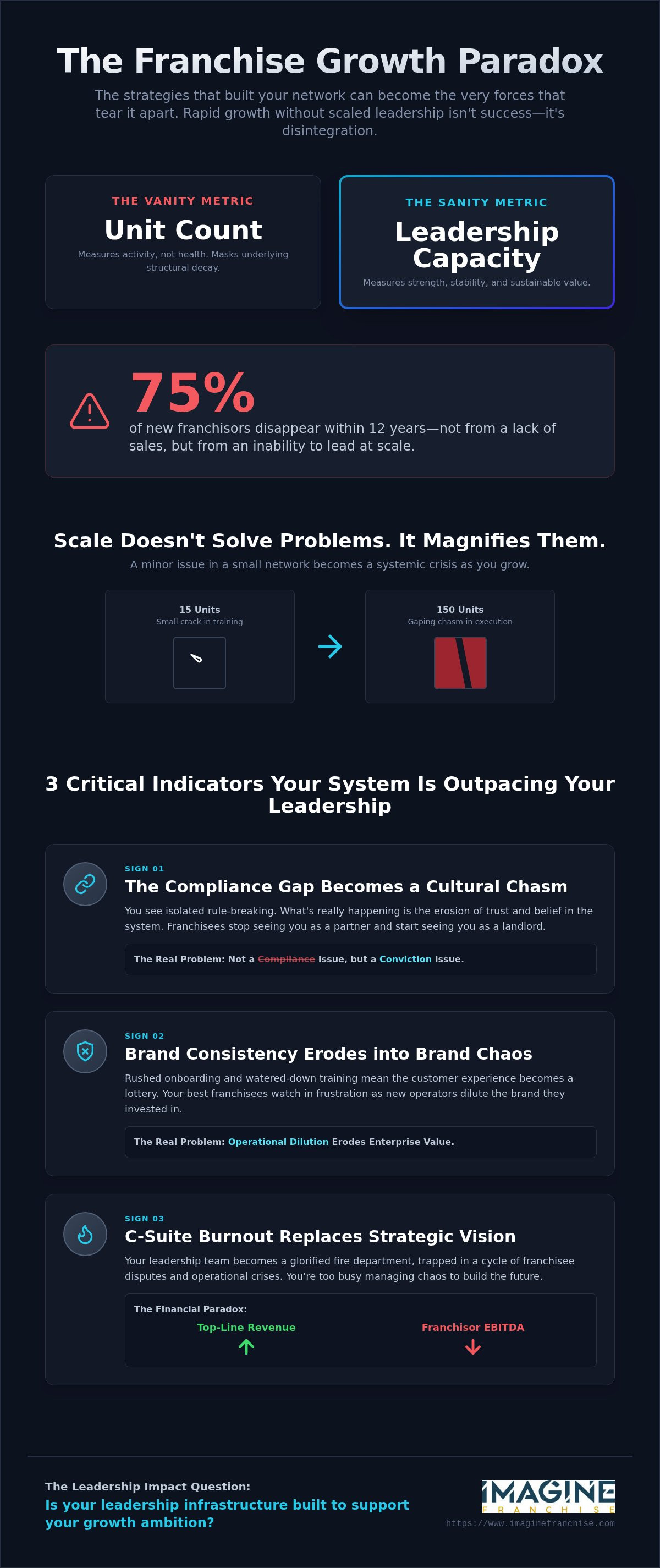
This is the dangerous reality of scaling a franchise system without scaling your leadership. The very growth you celebrate can become the force that tears your network apart from the inside. The hard truth is that unit count is a vanity metric; leadership capacity is the sanity metric. If your systems, culture, and leadership capabilities aren't scaling faster than your location map, you aren't growing—you're disintegrating.
This isn't about minor growing pains. It’s about a structural decay that, if left unaddressed, can lead to brand erosion, franchisee litigation, and total system failure. The MIT Sloan Management Review found that 75% of new franchisors disappear within 12 years. This isn't because they couldn't sell franchises; it's often because they sold too many, too fast, without the leadership infrastructure to support them.
Before your success becomes your undoing, it's time for a candid, CEO-to-CEO assessment. Let's diagnose the real problem and outline the strategic moves required to stabilize your network and build a foundation for truly sustainable growth.
The Growth Paradox: Why Rapid Expansion Often Masks Structural Decay
In the early days of a franchise system, growth feels like the only goal. The first 10, 20, or even 50 units are often willed into existence through the sheer force of the founder's personality and effort. You’re personally involved in every opening, you know every franchisee by name, and you can plug operational gaps with a single phone call. This is founder-led growth, and it’s a necessary but temporary stage.
The paradox is that this early success creates a dangerous illusion. You mistake your personal effort for a scalable system. You believe that what worked for 20 units will work for 200, just with more staff. This is a critical strategic error. As your network grows, complexity doesn't increase linearly; it increases exponentially. Every new franchisee, new market, and new support staff member adds layers of communication, cultural, and operational challenges that the founder-led model simply cannot handle. This is the world of V.U.C.A. (Volatility, Uncertainty, Complexity, and Ambiguity), and a fast-growing franchise system is its perfect storm.
The industry mantra that "scale solves everything" is a lie. Scale doesn’t solve problems; it magnifies them. A small crack in your training program at 15 units becomes a gaping chasm at 150. A minor ambiguity in the franchise agreement becomes the basis for a class-action lawsuit. The belief that you can simply hire more field consultants to manage the chaos is a trap. You don't need more managers; you need more leadership capacity, starting at the top.
3 Critical Indicators Your System Is Outpacing Your Leadership Capacity
The signs of a franchise system growing too fast are rarely found in the sales numbers. They appear in the cultural and operational fabric of your network. They are leading indicators of future financial distress. If you recognize your organization in the following descriptions, the time for corrective action is now.
Sign 1: The Compliance Gap Becomes a Cultural Chasm
It starts small. A franchisee "innovates" on the menu, another develops their own local marketing, and a third ignores a system-wide technology rollout. You see these as isolated compliance issues to be corrected with stern memos or legal threats. But you're misdiagnosing the symptom. You don't have a compliance problem; you have a conviction problem.
In a healthy, well-led network, franchisees follow the system not because they have to, but because they believe in it. They see the franchisor as a partner in their success. When growth is prioritized over support and relationship-building, that trust erodes. The franchisor is no longer a partner but a landlord collecting a royalty check. This creates an "us vs. them" culture. Franchisees stop calling corporate for advice and start calling each other to complain. This is the moment trust is replaced by suspicion, and inspiration is replaced by litigation. The antidote to this resistance is what we call 'Network Magnetism'—the powerful pull of a brand that franchisees are proud to be a part of, led by a team they implicitly trust.
Sign 2: Brand Consistency Erodes into Brand Chaos
Your best franchisees are the canaries in the coal mine. They are the first to notice when the brand promise starts to fray. They built their business on the strength of your system, and they see new, poorly trained, or culturally misaligned franchisees diluting the brand they invested in. The customer experience, once a reliable constant, becomes a lottery.
This operational dilution is a direct result of rapid, poorly managed growth. When you’re focused solely on selling the next territory, onboarding becomes a rushed, box-ticking exercise. Training quality gets watered down. The deep cultural immersion that created your initial success is replaced by a superficial online module. In larger networks, a phenomenon known as 'Social Loafing' can take hold, where individual franchisees feel less accountable because they are just one of hundreds. This erosion of standards is not just an operational issue; it is a direct assault on your enterprise value.
Sign 3: C-Suite Burnout Replaces Strategic Vision
Look at your own calendar and that of your leadership team. Are you spending your time on high-level strategy, innovation, and coaching your key people? Or are you trapped in an endless cycle of franchisee disputes, supply chain emergencies, and operational crises? When the leadership team becomes a glorified fire department, it's a clear sign that the system has outgrown its design.
This is where the financial paradox appears. Your top-line revenue from royalties is increasing, but your franchisor's EBITDA is shrinking. Why? Because you’re throwing money and people at problems that are systemic. You hire more field consultants to deal with unhappy franchisees, more lawyers to handle disputes, and more administrators to manage the paperwork. The C-suite is exhausted, reactive, and making decisions from a place of fatigue rather than foresight. They are too busy managing the chaos to lead the network toward its future.
The 'Success Trap': Why Past Strategies Fail in a High-Growth Network
The most difficult lesson for a successful founder and CEO to learn is this: the strategies, mindset, and leadership style that got you here will not get you there. The very skills that made you a brilliant entrepreneur—being tactical, hands-on, and controlling every detail—become liabilities as your system scales. This is the 'Success Trap'.
You fall into the 'Support Trap' by believing that more support staff will fix franchisee performance. But adding more field consultants often decreases franchisee accountability. It turns them into dependent employees waiting to be told what to do, rather than empowered business owners executing a proven system. You also accumulate 'Documentation Debt,' where your operations manuals, training materials, and onboarding processes are hopelessly outdated, creating an anchor that drags down every new franchisee.
The fundamental shift required is from 'Tactical Founder' to 'Strategic Visionary'. Your job is no longer to have all the answers. It is to build a system and a culture that produces the right answers. This requires a profound change in how you view your role and your network.
The Myth of the 'Self-Running' System
No franchise system is truly 'set it and forget it'. The market changes, consumer behavior evolves, and your network matures. A system requires constant refinement, driven by data and deep insight into unit-level performance. This is why periodic diagnostics, like our 'Franchise Performance 360©', are essential to find the hidden friction points before they cause a breakdown. As you cross the 50-unit and 100-unit thresholds, the level of 'Business Discipline' required from your leadership team must evolve from informal to institutionalized.
Leadership Capacity vs. Staff Headcount
The most common mistake franchisors make when facing growth-related chaos is hiring more managers. But hiring more people doesn't solve a lack of leadership clarity. If your team doesn't understand the 'Why' behind the 'How,' you're just adding more bodies to a confused mission. We use a 'Clarity of Action' framework to ensure that every initiative, every new hire, and every communication is aligned with a crystal-clear strategic intent. There is a profound difference between managing a network and leading a movement. Managers control a process; leaders cultivate potential. In a high-growth system, you need leaders.
Strategic Deceleration: How to Stabilize Your Core Without Losing Momentum
If your system is showing signs of stress, the most powerful, strategic move you can make is to slow down. This isn't about stopping; it's about 'Strategic Deceleration'—a conscious, temporary pause on new territory sales to allow your leadership and systems to catch up. It’s a contrarian move that takes courage, but it may be the only thing that can save your brand from imploding. This is the time to re-invest in your existing network and fortify your foundation.
During this phase, you must realign your leadership team with 'Unity' and 'Agility'. Your success depends on it. Remember the 'Formula for Success': % Faith x % Focus x % Effort = % Success. Without faith in the vision and focus on the right priorities, your team's effort will be wasted.
Step 1: The Integrity Audit
The first step is to turn your focus inward. Conduct a rigorous audit of your existing franchisees, evaluating them not just on financial performance, but on their character, commitment, and alignment with the brand's core values. Who are your champions? Who are the detractors? Who is coachable, and who is actively resisting the system?
This process will inevitably lead to a difficult but necessary conclusion: you may need to prune your network. Letting go of 'bad fit' franchisees—even if they are profitable—is one of the highest-ROI growth strategies you can deploy. It sends a powerful message to the rest of the network that brand integrity and cultural alignment are non-negotiable. The ROI of investing in the success of your existing, high-potential franchisees will always be greater than the ROI of recruiting new ones into a broken system.
Step 2: Strengthening the Operational Spine
With your network realigned around your best people, the next step is to rebuild your operational infrastructure for the scale you want to achieve, not the scale you have. This means modernizing your documentation, training platforms, and communication channels for a 2026 workforce. It's about creating robust accountability loops that are clear, fair, and consistently enforced.
Most importantly, this process must begin with you. True leadership transformation starts with 'Self-Evaluation' at the CEO level. You must model the accountability and commitment to excellence you expect from your team and your franchisees. Are your strategic plans clear and actionable? Is your leadership team fully aligned? As a leader, you must diagnose your own contribution to the chaos before you can hope to fix it. This is how you prevent future plateaus and build a system capable of enduring growth.
Mastering the Scale: Realignment Through the Franchisexcel© Framework
Stabilizing your core is the essential first step. But to truly master the scale and achieve exponential growth, you need a new operating system for your leadership. Strategic Deceleration fixes the immediate problems; a Growth Leadership System prevents them from ever happening again. This is the purpose of our Franchisexcel© framework.
Franchisexcel© is not a consulting package or a simple to-do list. It is a comprehensive, six-stage system designed to transform your leadership capacity and, by extension, your entire network. It is the methodology we have used for over 35 years to help franchisors achieve 3-to-10-fold growth in three to five years by focusing on the root causes of performance, not just the symptoms.
The journey involves intensive executive coaching to enhance your 'magnetism' and 'conviction' as a leader. It's about shifting your C-suite from a reactive management team to a proactive leadership engine. We serve as your senior advisor, providing the peer-level counsel needed to navigate the complexities of the next stage of growth—a perspective you simply cannot get from your internal team.
Building a Resilient Network Ready for Growth
Through the Franchisexcel© framework, we move your organization from 'Clarity of Action' to 'Unity' across the entire system. We install tools like the 'Franchise Performance 360©' as a recurring health check to ensure you stay ahead of challenges. The goal is to build a resilient, self-correcting network where franchisees are engaged, the leadership team is aligned, and the brand is poised for dominant, sustainable growth.
The final lesson is one of radical accountability: You are 100% responsible for the results you achieve. The state of your network today is a direct reflection of your leadership. If you are ready to accept that responsibility and transform your approach, a truly exceptional future is possible.
Take the Next Step in Your Leadership Journey
As a CEO navigating the pressures of a fast-growing franchise system, you don't need another consultant who has only read the books. You need an advisor who has been in the room, faced the same challenges, and successfully guided over 100 networks through these exact inflection points. A 12-month 'Franchise Leadership Catalyst™' journey is a commitment to transforming not just your business, but your impact as a leader.
If you are ready to move from managing chaos to leading a movement, let's have a conversation. There will be no sales pitch, only a candid, strategic discussion about the future of your network.
Book your private 45-minute exploratory session with Stéphane Breault.
Frequently Asked Questions
- What are the first signs that a franchise system is growing too fast?
-
The earliest signs are often cultural, not financial. Look for an increase in franchisee complaints that shift from operational questions to "us vs. them" grievances. Other key indicators include declining brand consistency across locations, a rise in franchisees "customizing" the system, and a leadership team that is constantly firefighting rather than executing strategic plans.
- How can I improve franchisee compliance without resorting to legal threats?
-
True compliance comes from conviction, not coercion. Instead of asking "How do I enforce the rules?", ask "Why have my franchisees lost faith in the system?" Improving compliance requires rebuilding trust. This involves clear communication of the "why" behind system standards, demonstrating the value of the system through unit-level profitability, and ensuring franchisees feel heard and respected.
- Does rapid growth always mean a decrease in quality control?
-
Not always, but it does if leadership capacity and systems don't scale ahead of unit growth. A decrease in quality is a direct symptom of an overwhelmed system. If your onboarding, training, and field support infrastructure were designed for 50 units, they will break at 150. Proactive, systemic investment in your operational spine is the only way to maintain quality during rapid expansion.
- How do I know if my C-suite team has the capacity for our next growth stage?
-
Assess their focus. Is their time consumed by reactive, day-to-day problems, or are they driving proactive, long-term strategic initiatives? A leadership team ready for the next level is obsessed with the future, not the past. They are developing other leaders, simplifying complexity, and operating with a high degree of alignment and trust. If they are burned out and stuck in the weeds, they lack the capacity for the next stage.
- Is it ever a good idea to stop selling franchise territories temporarily?
-
Yes. A "Strategic Deceleration" can be the most intelligent and courageous move a CEO makes. Pausing new sales to reinvest in your existing franchisees, upgrade your systems, and realign your culture is not a sign of weakness; it is a sign of profound strategic strength. It allows you to build a stable foundation that can support much faster and more sustainable growth in the future.
- What is the difference between a franchise consultant and a franchise executive coach?
-
A consultant typically provides answers and deliverables—they might write your operations manual or develop a marketing plan. An executive coach builds capacity. A coach, particularly a Franchise CEO Coach, works with you and your leadership team to develop the strategic thinking, leadership skills, and organizational discipline needed to find the right answers yourselves. The consultant gives you a fish; the coach teaches you to fish at scale.
- How does the Franchisexcel© program help with rapid scaling issues?
-
Franchisexcel© is a Growth Leadership System designed specifically to address the root causes of scaling problems. It goes beyond surface-level fixes to rebuild your leadership alignment, strategic clarity, and cultural health. By installing a new operating system for how your team leads, it creates the capacity to manage complexity, drive franchisee performance, and achieve sustainable, profitable growth.
- What is the 'Success Trap' in franchising?
-
The 'Success Trap' is the mistaken belief that the strategies and leadership style that made you successful in the early stages will work at scale. The hands-on, controlling, tactical approach of a founder becomes a bottleneck in a large system. Escaping the trap requires a conscious evolution from being the heroic problem-solver to becoming the architect of a system that solves its own problems.

