


Why Most Franchise Turnarounds Fail: The Myth of the Broken Manual
Every successful franchisor knows the curve. It’s a picture of momentum: a steep, thrilling climb as you add units, build brand recognition, and watch royalties grow. The system works. The model is proven. Then, almost imperceptibly, the angle of ascent begins to shallow. Growth continues, but it feels harder. Heavier. Eventually, the curve flattens into the one thing you never planned for: a plateau.
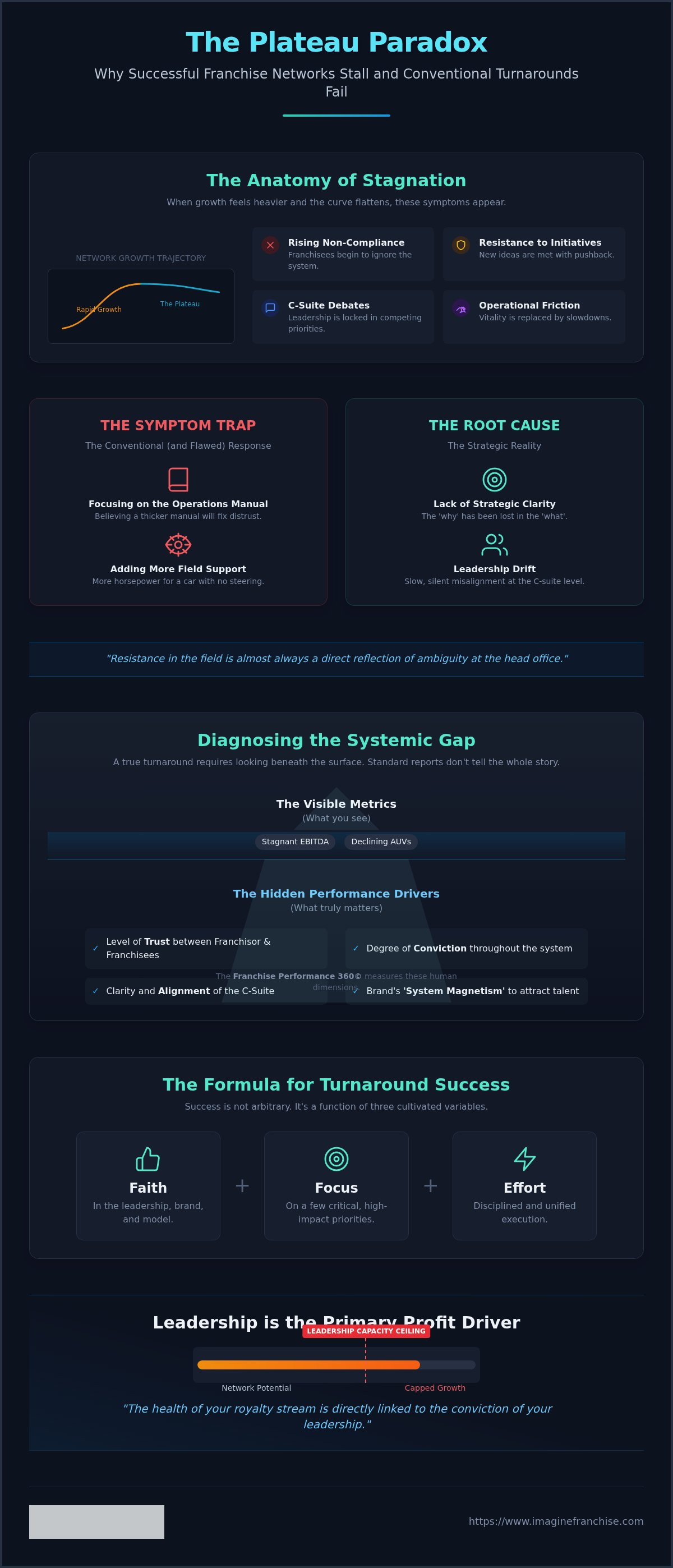
This is the stagnation that keeps CEOs of mature franchise networks awake at night. You see the symptoms everywhere: franchisee non-compliance is on the rise, new initiatives are met with resistance, and your C-suite seems to be locked in a perpetual debate over competing priorities. The vitality that once defined your network has been replaced by a low-grade friction that slows everything down.
The conventional response is to look outward. You blame the franchisees, the market, or the operations manual. The temptation is to double down on what worked before—more field support, stricter compliance checks, a thicker manual. But this is the fundamental mistake that causes most franchise system turnarounds to fail before they even begin.
- The ‘Symptom Trap’: Focusing on franchisee compliance is a waste of time and resources when the root cause is a lack of leadership clarity. You’re treating the symptom, not the disease. Resistance in the field is almost always a direct reflection of ambiguity at the head office.
- Defining Leadership Drift: The very success that built your network also breeds complexity. As the system grows, the CEO’s vision can become diluted, translated differently by various departments. This is Leadership Drift—a slow, silent misalignment where the C-suite and the network lose their single point of focus.
- Why More Support Isn't the Answer: Hiring more field consultants to enforce a broken or unclear strategy is like adding more horsepower to a car with no steering wheel. It only accelerates the chaos. Before you can support your franchisees, you must have a unified, compelling direction to lead them toward. For a deeper look at this, explore our analysis on why franchisees don’t follow the system.
- The High Cost of Stagnation: A plateau isn't just a pause; it's a regression. It erodes enterprise value, invites competitors, and creates an "invisible" cost as your best, most ambitious franchisees lose faith and begin to look elsewhere.
The Illusion of Operational Fixes
In a struggling system, the operations manual becomes a scapegoat. The leadership team believes that if they could just document every process and create a rule for every contingency, the network would snap back into line. This is an illusion. A 500-page manual will never solve a culture of distrust. Over-documentation creates friction, not flow, and it signals a shift from leading a brand to merely managing a network. The two are not the same. Management seeks compliance; leadership inspires commitment.
Leadership as the Primary Profit Driver
The health of your royalty stream is directly linked to the conviction of your leadership. When a CEO and their team execute with unwavering clarity and alignment, it creates a powerful ripple effect. Franchisees feel the stability, gain confidence in the brand’s direction, and refocus their energy on the profit-driving activities you’ve defined. A successful franchise system turnaround is not an operational project; it is a psychological and strategic shift, beginning in the C-suite. Your network’s potential is capped by the leadership capacity at its center. Leadership Capacity is the ceiling of network growth.
Diagnosing the Systemic Gap with Franchise Performance 360©
To fix a stalled network, you must first have an honest, unvarnished look at its true condition. Standard financial reports and franchisee satisfaction surveys only skim the surface. They show you what is happening—stagnant EBITDA, declining AUVs—but they can’t tell you why. A genuine turnaround requires a diagnostic tool that goes deeper, measuring the powerful but often-overlooked human dimensions of your business.
The Franchise Performance 360© is a proprietary diagnostic designed for this purpose. It moves beyond simple ROI checks to assess the interconnected business and human factors that truly determine a network’s vitality.
- Measuring the ‘Human Factor’: We believe that trust, character, and commitment are not soft skills; they are measurable performance metrics. The 360© process quantifies the level of trust between the franchisor and franchisees, the alignment of the C-suite, and the degree of conviction throughout the system.
- Identifying the V.U.C.A. Impact: We live in a world of Volatility, Uncertainty, Complexity, and Ambiguity (V.U.C.A.). This diagnostic identifies how these external pressures are specifically impacting your network and leadership team, revealing vulnerabilities you may not see.
- The ‘Formula for Success’: A turnaround timeline is not arbitrary. It is a function of three key variables we measure and cultivate: Faith (in the leadership and the model), Focus (on a few critical priorities), and Effort (disciplined execution). This formula provides a clear framework for the turnaround journey.
Beyond Financial Metrics
EBITDA doesn't tell the full story of a struggling network. A system can be financially stable in the short term while its cultural foundation is cracking. We assess what we call ‘System Magnetism’—the brand’s ability to attract and retain high-performing, growth-oriented franchisees. If your best operators are leaving or your pipeline of new talent is drying up, it’s a critical warning sign that no balance sheet can reveal. This diagnostic process must also include a rigorous Self-Evaluation by the CEO, confronting the hard truth that the strategies that brought the network to 50 or 100 units may be the very things preventing it from reaching 500.
The 360-Degree Perspective
A turnaround cannot be dictated from an ivory tower. The Franchise Performance 360© is a collaborative tool that gathers candid, confidential feedback from every level: the C-suite, corporate staff, field consultants, and a cross-section of franchisees—from top performers to the vocally dissatisfied. This data-driven approach achieves two critical goals. First, it identifies the "pockets of excellence" within your network—franchisees or regions that are thriving despite systemic challenges—providing a model for what can be scaled. Second, it uses quantitative and qualitative data to silence the noise of the "vocal minority," allowing you to base your turnaround strategy on a true understanding of the entire system, not just the loudest voices.
Stage 1 of the Turnaround: Restoring Strategic Clarity
Once you have an honest diagnosis, the work of the franchise system turnaround begins. The first and most critical stage is restoring absolute strategic clarity, starting with you and your leadership team. A network cannot be aligned if the C-suite is not. If your VPs are running their own independent kingdoms—marketing focused on one goal, operations on another, and development on a third—you are broadcasting confusion to your franchisees.
This phase is about ruthless prioritization. It’s about moving from a dozen well-intentioned initiatives to the three that will actually drive franchisee profitability and system health. This is the prerequisite for rebuilding trust and momentum.
- The ‘Clarity of Action’ Phase: The goal is to narrow the focus to the vital few objectives that create the most value. This isn't just about setting goals; it's about eliminating the distracting "strategic noise" that consumes your franchisees' time and energy.
- Re-aligning the C-Suite: This requires direct, facilitated conversations to ensure every executive is committed to the same short-term and long-term vision. Their individual departmental goals must be secondary to the primary objectives of the overall turnaround.
- The SMARTER Planning Framework: We adapt the classic goal-setting framework for the unique dynamics of a franchise environment, ensuring objectives are not only Specific and Measurable but also Agreed-upon, Relevant, Time-bound, Ethical, and Recorded.
- Communicating the ‘New Reality’: Once the leadership team is unified, the new, focused plan must be communicated to the network. This communication needs to be handled with care, presenting the changes not as a sign of panic, but as a confident and necessary evolution to ensure future success for everyone.
The CEO’s Real Job: Alignment
During a turnaround, the CEO has one job that supersedes all others: Chief Alignment Officer. Your primary function is to create and maintain a single, coherent narrative that builds conviction from the boardroom to the front lines. You must be the chief editor of your company’s strategy, cutting away anything that doesn't serve the core plot of restoring franchisee profitability and brand consistency. True franchise network alignment isn't about getting everyone to agree with you; it's about getting everyone to commit to a shared destination.
Defining Non-Negotiables
With a clear strategy in place, you can redefine accountability. This isn’t about micromanagement. It’s about identifying the 20% of activities that produce 80% of franchisee results and making them non-negotiable standards. When franchisees understand that these core disciplines are directly linked to their own success, accountability shifts from a source of conflict to a tool for mutual growth. This is the essence of strategic clarity. Strategic Clarity is disciplined focus on what truly matters.
Rebuilding the Bridge: Moving from Resistance to Unity
With strategic clarity established at the leadership level, the next stage of the Franchisexcel© framework is to rebuild the bridge between the home office and the network. A turnaround plan, no matter how brilliant, is worthless without franchisee buy-in. This is where many top-down initiatives fail. They mistake communication for connection and compliance for commitment.
Unity isn’t achieved through a memo or a webinar. It’s built through a deliberate, consistent effort to dismantle the "us vs. them" mentality that plagues struggling systems. It requires a fundamental shift from dictating solutions to co-creating the future, guided by the newly established strategic clarity.
- The ‘Unity’ Stage: This phase is about translating the C-suite’s alignment into genuine network-wide buy-in. It is the essential human work of the turnaround.
- Building a ‘We’ Culture: The "us vs. them" dynamic must be actively dismantled. This involves creating new forums for dialogue, such as revitalized franchisee advisory councils and multi-unit franchisee summits, where operators feel heard and can contribute to solving problems within the strategic guardrails you've set.
- The Role of Compassion and Consistency: Rebuilding broken trust requires both. Compassion means acknowledging the legitimate frustrations of your franchisees. Consistency means your actions, words, and decisions must remain unwaveringly aligned with the new, focused strategy.
- Leveraging Your Champions: Your top-performing franchisees are your most powerful allies. Engaging them first and turning them into advocates for the turnaround plan creates a ripple effect of positive influence that is far more effective than any corporate mandate.
The Character of Leadership
During this delicate phase, the network will be watching you, the CEO, more closely than ever. Your personal commitment and character will set the tone for the entire culture. To move your franchisees from a mindset of compliance to one of true commitment, you must lead with transparency. This includes addressing the "elephant in the room"—admitting where the franchisor has failed in the past. This act of vulnerability is not a sign of weakness; it is a demonstration of strength and the single fastest way to gain the credibility needed to lead the network forward.
Scaling Operational Excellence Together
As unity grows, you can begin to scale operational excellence in a collaborative way. This means publicly rewarding the "System Followers" who embrace the new direction and providing focused coaching for the "System Rebels" to help them get on board. The goal is to create a culture of Agility, where franchisees see the system as a dynamic platform that empowers their success, rather than a rigid set of rules that restricts it. This disciplined, collaborative execution is what builds long-term, sustainable enterprise value for both the franchisor and the franchisee.
Executing the Franchisexcel© Framework for Exponential Growth
A franchise system turnaround is not just about fixing what’s broken. It’s about building a new foundation for the next stage of growth. The process of restoring clarity and unity creates a resilient, aligned, and disciplined organization capable of moving beyond survival mode and into a phase of exponential growth. The Franchisexcel© framework is the roadmap for this entire journey.
This is where the hard work of the initial stages pays off, transforming the network from a source of friction into an engine of momentum. It’s how you transition from fighting for incremental gains to achieving 3-to-10-fold growth over a 3-to-5-year horizon.
- The 6-Stage Journey: The framework guides your leadership team through a complete franchise leadership transformation, from diagnosing the root causes of stagnation to embedding a culture of high performance and continuous improvement.
- From Survival to Growth Leadership: A successful turnaround fundamentally changes the role of the CEO. You move from being the chief firefighter to the chief architect of the future, focusing on strategic opportunities instead of daily crises.
- The Foundation for Exponential Growth: The discipline, trust, and alignment forged during the turnaround become your greatest competitive advantages, allowing you to scale faster and more effectively than ever before.
- Maintaining Momentum with Executive Coaching: The journey doesn't end when the crisis is over. Ongoing executive coaching ensures that you and your team maintain the focus and discipline required to navigate future V.U.C.A. challenges and sustain high-growth momentum.
The 12-Month Catalyst Journey
What can you expect in the first year of a dedicated turnaround effort? The first 90 days are focused on the diagnostic and strategic clarity phases—achieving total C-suite alignment. The following months are dedicated to rebuilding the bridge with the network, securing franchisee buy-in, and implementing the non-negotiable performance standards. Throughout this catalyst journey, we work alongside you to build a resilient leadership team, integrating the "Formula for Success"—Faith, Focus, and Effort—into the daily operational rhythm of your business.
Your Next Leadership Move
If you recognize your network in the description of the Stagnation Curve, waiting for the "right time" to act is a strategy for continued decline. The drift will only widen, and the cost of inaction will only grow. The most powerful leadership move you can make is to get an objective, expert perspective on your situation.
A turnaround begins with a single, decisive conversation. It's a chance to step out of the day-to-day firefight and diagnose the real issues holding your network back. If you are ready to stop the drift and restore your franchise system’s vitality, the first step is a private, confidential discussion.
Ready to stop the drift? Book your private 45-minute exploratory session with Stéphane Breault.
Frequently Asked Questions
- How long does a typical franchise system turnaround take to show results?
- You can expect to see initial positive changes in leadership alignment and network morale within the first 90-120 days. Measurable financial improvements, such as royalty growth and franchisee profitability, typically become evident within 6 to 12 months as the new strategic clarity and operational disciplines take hold.
- Can a franchise system be fixed if the majority of franchisees are unhappy?
- Yes, absolutely. Widespread franchisee unhappiness is a symptom of leadership drift, not an incurable condition. The key is to address the root causes—lack of clarity, broken trust, inconsistent support. By demonstrating new leadership, admitting past failures, and presenting a clear, compelling plan for mutual success, you can win back the support of the vast majority of your network.
- What is the difference between a consultant and a franchise executive coach?
- A consultant typically provides answers and deliverables, such as a new operations manual or marketing plan. A franchise executive coach, like Stéphane Breault, focuses on building the leadership capacity within your team. The goal is not just to solve the immediate problem, but to equip you and your executives with the mindset, skills, and frameworks to lead the turnaround and navigate future challenges successfully.
- Is the Franchisexcel© program suitable for smaller, emerging brands?
- The Franchisexcel© program is specifically designed for established networks (typically 50+ units) facing the complex challenges of mature growth, such as stagnation, franchisee unrest, or C-suite misalignment. Emerging brands have different needs focused on initial setup and validation, which is a different area of practice.
- How do I deal with 'legacy' franchisees who refuse to adopt the turnaround plan?
- The 360-degree diagnostic helps identify if these franchisees are a vocal minority or representative of a larger issue. The strategy is to build a coalition of the willing, celebrating and rewarding the early adopters. This creates positive peer pressure. For the few who consistently refuse to align with standards that benefit the entire system, a structured, respectful exit strategy may ultimately be necessary to protect the health of the brand.
- What is the most common reason franchise systems plateau after reaching 100 units?
- The most common reason is that the leadership skills and infrastructure that got the system to 100 units are insufficient for the next stage of growth. The founder's direct, hands-on approach must evolve into a more systematic, C-suite-led strategy. This transition often creates "Leadership Drift," where complexity outpaces leadership capacity, leading to the plateau.
- How much does a franchise system turnaround typically cost in terms of leadership time?
- The most significant investment is the CEO's and C-suite's focused attention, particularly in the first 90 days. This involves dedicated time for strategic sessions, franchisee communication, and driving accountability. While it is a substantial commitment, it is far less costly than the alternative: years of stagnation, lost enterprise value, and the constant drain of managing a misaligned network.

