


What if improving franchisee satisfaction scores has less to do with asking better questions and more to do with what your leadership team does after the answers arrive? You already know feedback matters. But when franchisees share concerns and see little change, another survey can deepen frustration rather than build trust.
A weak score is a signal, not a diagnosis. It may point to unclear priorities, inconsistent support, or a gap between what leadership believes the network needs and what franchisees experience every day. Treating the number as the problem can leave the real issue untouched.
The stronger move is to turn feedback into a disciplined leadership process. This article will help you interpret what satisfaction scores reveal about alignment and execution, identify practical actions tied to franchisee concerns, and establish clear ownership for follow-through. Franchisees don’t judge leadership only by the questions you ask. They judge it by what changes next.
Key Takeaways
- Read satisfaction scores as franchisee perceptions, not a complete diagnosis of network health.
- Look for leadership gaps behind recurring concerns, including unclear expectations, priorities, and decision-making.
- Match feedback methods to the questions you need answered; patterns and context are different kinds of evidence.
- Make improving franchisee satisfaction scores a disciplined process: investigate concerns, set priorities, assign ownership, and report back.
- Build the leadership capacity to sustain alignment, accountability, and execution across your network.
Improving franchisee satisfaction scores starts by questioning what the number measures
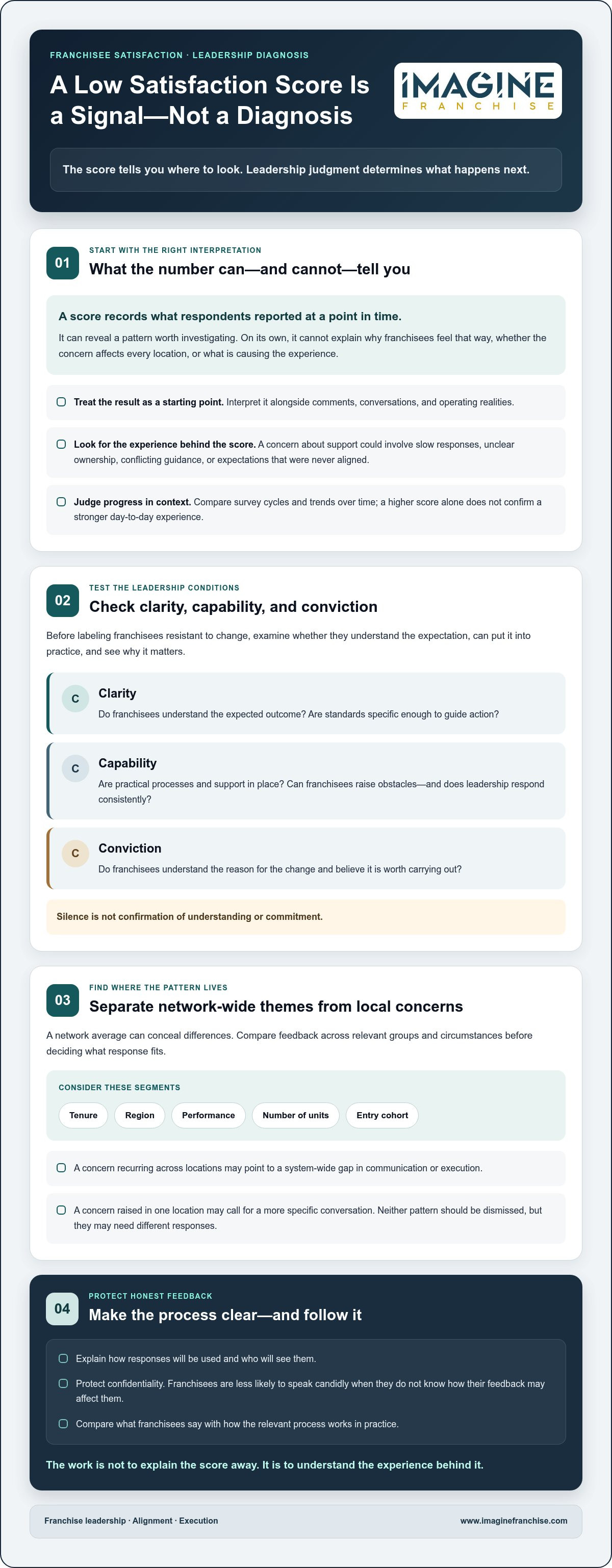
A completed survey can give your leadership team a clear result and still leave franchisees feeling unheard. A score records what respondents reported at a particular point in time. It doesn’t explain why they feel that way, whether the same issue affects every location, or what the experience means for network performance.
Collecting feedback measures the experience; it doesn’t change it. The goal of measuring franchisee satisfaction is not simply to obtain high scores. It is to assess the real health of the network, detect irritants early, and identify where to act. Improving franchisee satisfaction scores requires more than tracking movement between surveys. Interpret the number alongside franchisee comments, conversations, and operating realities. In a relationship-based model such as Franchising, the quality of the relationship affects how shared expectations are understood and carried out. Treat the score as a starting point for leadership inquiry, not a verdict on the network.
What franchisee satisfaction scores reveal, and what they leave out
A score can show how franchisees describe their experience when they respond. It can help you spot a pattern worth investigating, but sentiment is not the same as cause. A concern about support, for example, may reflect slow responses, unclear ownership, conflicting guidance, or expectations that were never aligned. The number alone can’t distinguish among them.
Nor should you assume one result represents every franchisee or location equally. Look for differences in comments and circumstances before deciding what the network needs. Compare what franchisees say with how the relevant process works in practice. The task is to understand the experience behind the score, not to explain it away.
Why a rising score is not the only sign of progress
A higher score may be encouraging, but it needs context before you call it success. Compare results with earlier survey cycles and track trends over time rather than relying on a single static score. Ask whether decisions are clearer, support is more reliable, and commitments are being followed through. If franchisees report improvement but still encounter the same operational friction, the number may not reflect a stronger day-to-day experience.
Progress should also show up in execution and trust. Are expectations understood across the network? Can franchisees see how leadership responds to concerns? Are teams giving consistent answers when franchisees ask for guidance? Those signals help you judge whether a score change reflects more than a momentary shift in sentiment.
Before deciding what to change, identify what franchisees are experiencing and where that experience breaks down. The score tells you where to look. Leadership judgment determines what happens next.
Diagnose the leadership conditions behind low franchisee satisfaction scores
A low score can tempt your leadership team to label franchisees resistant to change. That may be the wrong diagnosis. Before you defend a decision or launch another initiative, examine whether franchisees understand what you expect, why it matters, and how they can put it into practice. Dissatisfaction may reflect resistance, but it may also expose unclear direction or a system that makes execution harder than leadership realizes.
Start with recurring comments and conversations. Separate a single concern from a theme appearing across locations or over time. Then test possible causes instead of treating the score as proof. If franchisees say communication is inconsistent, for example, check whether different leaders are giving conflicting guidance, decisions are being shared without their rationale, or updates are reaching some locations later than others. The leadership condition matters because it determines the right response.
Look for gaps in clarity, capability, and conviction
Assess three things: Do franchisees understand the expected outcome? Do they have practical processes and support to deliver it? Do they understand the reason for the change and believe it is worth carrying out? A leader may assume agreement because no one objected. Silence, however, isn’t confirmation of understanding or commitment.
Clear expectations and consistent follow-through give franchisees a stronger basis for confidence. That requires more than sending instructions. Check whether standards are specific enough to guide action, whether franchisees can raise obstacles, and whether leadership responds consistently. The Harvard Business Review’s account of treating franchisees as the most important customers offers a leadership lens: franchisee experience belongs in the decisions that shape network performance, not at the edge of them.
Separate network-wide patterns from location-specific concerns
Segment survey data by tenure, region, performance, number of units, and entry cohort so network-wide averages do not conceal localized issues. Compare feedback across locations, roles, and relevant periods where the information allows. A recurring concern may point to a system-wide gap in communication or execution. A concern raised in one location may call for a more specific conversation. Neither should be dismissed, but they don’t necessarily call for the same response.
Protect confidentiality and explain how responses will be used. Full anonymity encourages honest responses, because franchisees are less likely to speak candidly if they don’t know who will see their feedback or how it may affect them. Be clear about the process, then follow it. An average or benchmark can help frame a question; it can’t establish what an individual franchisee is experiencing or why.
This is the leadership work behind improving franchisee satisfaction scores: investigate before prescribing, then match action to evidence. If your leadership team needs a clearer way to examine the conditions shaping feedback, a conversation about leadership priorities can help focus that inquiry.
Compare franchisee feedback methods by the decisions they help leaders make
No single feedback method can tell you what to change. The useful question is not which tool is best, but what decision you need to make. A survey can reveal a recurring concern. A conversation can clarify what that concern looks like in daily operations. Performance evidence can show where execution is breaking down. Each offers a different view, and none proves cause on its own.
When to use surveys, conversations, and operational evidence
Use surveys to establish a consistent baseline and see whether themes recur across the network. Go beyond general questions such as “Are you satisfied with your franchisor?” and measure the underlying drivers: quality of support, training, communication, leadership, marketing, innovation, tools, profitability, trust in management, value received for royalties, and willingness to recommend the franchise. Then use focused conversations to understand what a response means in practice. If franchisees report that a process is difficult to follow, ask where the friction occurs, what gets in the way, and what a workable alternative might require. Capture the specific step or handoff that causes difficulty, rather than relying on a general label such as “poor support.”
Operational indicators can help test assumptions, not invalidate what franchisees report. Cross-reference satisfaction metrics with retention rates, regrettable departures, reasons for exit, resale quality, and economic performance. If feedback points to inconsistent execution, compare it with the relevant operating evidence and ask where the gap appears. The data may help distinguish a capability issue from unclear expectations or conflicting direction. Improving franchisee satisfaction scores depends on combining these views carefully, not treating one as the final answer.
When external benchmarks or engagement technology can help
Franchise-specific benchmarks can give your leadership team a useful reference point. They can help you ask whether a result deserves closer attention, but systems differ in their model, support structure, and operating conditions. A benchmark can frame the question. It can’t explain what your franchisees experience or why.
Engagement platforms can help organize communications, collect responses, or monitor activity. That’s useful infrastructure, not a diagnosis. A dashboard may show where a concern is concentrated, but leadership still has to interpret the signal, talk with franchisees, and decide who owns the response. Coaching and leadership diagnosis address a different need: helping leaders clarify priorities, alignment, and follow-through. Software can support the process; it can’t make those decisions for you.
Choose the method based on the decision ahead: establish a pattern, understand an experience, test an operating assumption, or compare results with an external reference. Then combine evidence before deciding what action the network needs. If you’re weighing a difficult feedback pattern against competing leadership priorities, discuss the leadership challenge facing your network.
Turn franchisee satisfaction findings into visible action and accountability
Feedback loses credibility when franchisees can’t see what happened after they raised a concern. Your response doesn’t need to solve every issue immediately. It does need to show that leadership listened, made a decision, and assigned responsibility for what comes next. That visible discipline is what turns findings into action.
Use a clear action loop to move from feedback to follow-through:
- Acknowledge: Name the concern and confirm that leadership has heard it. Don’t minimize it because it’s difficult or inconvenient.
- Investigate: Check the feedback against conversations and relevant operating evidence. Clarify what’s happening before settling on a cause.
- Prioritize: Select a small number of shared issues that matter to franchisees and that your leadership team has the capacity to address.
- Assign ownership: Name the leader responsible for each commitment and set practical checkpoints to review progress.
- Communicate: Explain what will change, what won’t change yet, and why. Be direct about constraints and dependencies.
- Review: Check whether the action addressed the concern, then revisit the original theme in the next feedback cycle.
Build an action plan franchisees can recognize
Translate repeated feedback into commitments franchisees can observe. If comments point to conflicting guidance, for example, clarify who issues the direction, where the current version is available, and how updates reach the network. Separate network-wide improvements from issues that need individual follow-up. Set milestones your team can meet, and explain what must happen before a commitment can be completed.
Improving franchisee satisfaction scores shouldn’t become a promise to fix everything. That risks another round of disappointment. Choose actions based on evidence and leadership capacity, then make ownership unmistakable.
Close the feedback loop without overpromising
Report back on the decisions, accountable owners, progress, and unresolved concerns. Communicate the findings, and follow up with franchisees on the outcomes achieved. If leadership can’t make a requested change now, say so plainly and explain the reason. Then invite franchisees to tell you whether the response addressed the underlying issue. A completed task is not proof that the experience improved.
At the next review, compare feedback with the original themes and commitments. Have the same concerns eased, persisted, or changed? That comparison helps your leadership team distinguish activity from progress and adjust course while there’s still time to rebuild confidence.
If your leadership team needs to clarify which concerns to prioritize and who should own the response, explore a focused conversation about your network’s priorities.
Use leadership capacity to sustain better franchisee satisfaction scores
A communication campaign can explain a decision. It can’t compensate for leadership that sends mixed messages, leaves commitments without owners, or treats franchisee concerns as a temporary project. Durable improvement depends on whether your executive team can turn feedback into consistent decisions and execution across the network.
That makes improving franchisee satisfaction scores a leadership-capacity challenge. Franchisees experience your priorities through the decisions leaders make, the support teams provide, and whether commitments are carried through. When leaders are aligned and accountable, franchisees are more likely to encounter a coherent system. When they aren’t, even a well-written update can’t close the gap.
Make franchisee experience part of executive discipline
Recurring feedback needs senior ownership, especially when the response crosses departments. Assign a leader to each priority, then review progress alongside relevant network-performance and execution indicators. This keeps the work connected to how the system operates, rather than isolating it as a survey follow-up task.
Executive alignment matters just as much. Leaders should be able to explain the rationale behind priorities and trade-offs consistently. If one team promises a change another team hasn’t agreed to deliver, franchisees experience the disagreement as a lack of follow-through. Clarity at the leadership level supports trust and more consistent execution in the field.
Know when outside leadership support may help
If recurring concerns point to weak alignment, unclear accountability, or a leadership team struggling to maintain strategic focus, outside support may help you examine the challenge and strengthen execution. Define the problem first. Is the issue competing priorities, unclear decision rights, or commitments that keep losing momentum? The answer should guide the support you consider.
Imagine Franchise can support franchisors with this challenge through our Franchisor Leadership Index.
Stéphane Breault brings the perspective of a former franchise CEO with over 25 years of franchise leadership and 15 years of executive coaching experience. Imagine Franchise has coached more than 100 franchise networks since 2008. This experience can help sharpen the leadership question, not guarantee a particular outcome.
What leadership habit in your network must change so franchisee feedback leads to sustained action? Book a private exploratory session to discuss the priorities and leadership challenges in your network.
Make franchisee feedback a leadership advantage
Improving franchisee satisfaction scores isn’t a survey campaign. It’s the result of leaders who understand what feedback signals, investigate the causes, and follow through on the priorities they choose. The aim is to cultivate engaged, high-performing franchisees who believe in the model’s value, not merely satisfied ones. Scores matter, but so do the decisions franchisees experience: clear expectations, consistent execution, and visible accountability.
Your next move is practical. Choose one recurring concern, name the leader accountable for addressing it, and tell franchisees what they can expect next. Then review whether the change improved the experience, not just whether the task was completed. A question worth asking any franchisor: “What have you changed over the past 12 months as a result of your franchisees’ feedback?” That discipline builds trust and strengthens network performance over time.
If your leadership team needs sharper alignment or a clearer path from feedback to action, a focused conversation can help define the challenge. Stéphane Breault is a former franchise CEO with over 25 years of franchise leadership experience. Since 2008, Imagine Franchise has coached more than 100 franchise networks.
What would change for your franchisees if leadership followed through more consistently? Book a private exploratory session to examine your network’s priorities and identify a practical way forward. Stronger leadership can make feedback the beginning of meaningful progress.
Frequently Asked Questions
How do you improve franchisee satisfaction scores?
Improve franchisee satisfaction scores by investigating what franchisees experience, then acting visibly on the concerns leadership can address. Look for recurring themes, clarify expectations and decision rationales, and check whether franchisees have the practical support to execute agreed standards. Choose a manageable number of priorities, assign accountable owners, and report progress honestly. Scores may change over time, but the stronger test is whether trust, execution, and follow-through improve.
What causes low franchisee satisfaction scores?
Low scores can reflect unclear expectations, inconsistent communication, weak follow-through, or a gap between leadership priorities and location-level realities. They don’t identify the cause by themselves. A concern about support, for example, might point to conflicting guidance or a process that is difficult to carry out. Compare recurring comments with direct conversations and relevant operating evidence before deciding whether an issue is network-wide or specific to particular locations.
How often should franchisors survey franchisees?
Survey the entire network regularly, ideally once a year, with full anonymity to encourage honest responses. A consistent cadence helps you compare themes over time, while shorter check-ins may make sense after a significant network decision or change. Avoid asking for feedback when leadership has no capacity to review and respond. If franchisees repeatedly share concerns without seeing follow-through, another survey can weaken confidence instead of strengthening it.
Should franchisors use an independent franchisee satisfaction survey?
An independent survey can be useful when franchisees may be more candid with a third party or when you want an outside reference point. Before choosing one, clarify how responses will be handled, who will see the findings, and what decisions the results are meant to support. Independence doesn’t automatically make findings complete or explain their causes. You still need leadership to examine comments, discuss patterns, and act on what the evidence supports.
Can franchisee satisfaction scores predict franchise network performance?
Satisfaction scores can signal conditions that may affect execution, trust, and network performance, but they can’t predict results on their own. A score captures reported perceptions at a particular point in time; it doesn’t establish cause or show how every location is performing. Read it alongside relevant operating indicators and franchisee feedback. Use the combination to guide questions and decisions, not to claim that a particular score guarantees a business outcome.
What should a franchisor do after receiving negative franchisee feedback?
Acknowledge the feedback, investigate the concern, and decide what action is practical before promising a solution. Look for repeated themes, speak with franchisees where context is needed, and assign a clear owner to each priority. Then tell the network what leadership heard, what will change, and what cannot change yet. Review whether the response addressed the concern. Closing the loop matters, especially when the answer is not the one franchisees hoped for.
How can franchise technology improve franchisee engagement?
Franchise technology can make it easier to organize communications, share information, collect feedback, and monitor activity across locations. Those tools can improve visibility, but they can’t decide what feedback means or replace leadership judgment. Choose technology based on the work your network needs it to support, then make ownership clear. Engagement improves when useful tools are paired with consistent communication, responsive decisions, and follow-through that franchisees can see.

