


When an established franchisee walks into your boardroom or sends formal notice that they are exiting the network, the natural corporate impulse is to search for a single culprit. The executive team points to macroeconomic headwinds, rising minimum wages, prime commercial rents, or a candidate who "simply lacked the entrepreneurial stamina" to execute the model. In private equity board meetings across North America, Europe, and Australia, franchisee turnover is routinely dismissed as an unavoidable cost of operating at scale.
That assumption is not just flawed—it is dangerous to your network's valuation. Franchisee turnover is rarely an isolated operational accident or the consequence of a single bad quarter. Franchisee turnover is an executive leadership indicator reflecting the degree of systemic alignment between corporate strategy and unit-level economic reality. When operators leave, they do not walk away from a brand identity or an operational checklist; they exit a relationship that ceased to deliver economic viability, operational sanity, or mutual trust.
MIT Sloan research reveals a sobering metric: 75% of new franchisors disappear within 12 years. Long before a franchise brand collapses entirely, it bleeds enterprise value through silent franchisee churn. To build a resilient network capable of scaling from 50 to 100, 250, or 500 units without fracturing, franchisor CEOs must abandon surface-level remedies and confront the compounding forces driving operators to the exit door.
Why Franchisees Really Leave: The Hidden Cost of Misaligned Leadership
Every franchise exit has a pre-history. Long before formal termination notices, distressed transfers, or legal demand letters arrive at headquarters, an erosion process takes place quietly inside the unit. The visible act of an operator walking away is merely the final punctuation mark on months—often years—of compounding operational friction, financial compression, and strategic detachment.
To reduce turnover, executive leadership must first diagnose what actually creates network churn. Exits do not happen in a vacuum. They stem from interconnected breakdowns across the operational lifecycle:
- Systemic Unit Economic Compression: Top-line sales growth masking deteriorating operating margins due to unchecked food, materials, labor costs, rising occupancy expenses, debt service, and top-slice royalty obligations.
- Recruitment and Selection Failures: Awarding franchises to undercapitalized candidates, passive investors who lack operational discipline, or aggressive operators whose values conflict with system standards.
- Uncalibrated Operational Expectations: A deep divide between corporate marketing during discovery days and the brutal reality of 70-hour workweeks, prolonged timelines to break-even, and hands-on site management.
- Transactional and Ineffective Support: Corporate field visits that focus exclusively on white-glove cleanliness audits and brand compliance while offering zero actionable guidance on margin expansion or labor scheduling.
- Execution and Capability Breakdowns: Operators struggling with local team retention, basic operational discipline, or financial literacy who receive punitive notices rather than diagnostic coaching.
- Erosion of Transparency and Trust: Strategic pivots, supply chain rebate structures, or technology rollouts mandated unilaterally from head office without collaborative consultation.
- Unforgiving External Realities: Poor commercial real estate territory planning, cannibalization from neighboring territories, shifting demographics, and aggressive local competitors.
- Misunderstood Life-Cycle Transitions: Treating planned retirements, generational transfers, and profitable equity resales with the same panic as distressed operational liquidations.
Compounding Pressures: Anatomy of Network Attrition
Franchise systems do not fracture because of one poor supplier delivery or a single quarter of soft retail traffic. They break down because operational stresses compound. Consider an operator entering your system with adequate capital and high optimism. If your franchise development team awarded the license based on ambitious growth targets rather than disciplined profile matching, that franchisee may possess financial resources but lack the grit required for direct frontline leadership.
When unexpected market pressures arise—such as sharp local minimum wage increases or inflated commercial real estate buildout costs—operating margins thin immediately. If corporate's primary intervention is sending a field consultant to flag procedural non-compliance, resentment takes root. The franchisee begins questioning the royalty structure: "Why am I remitting six percent of gross revenue to head office every month when my bottom-line net profit is negative, and your corporate team cannot tell me how to stabilize my labor model?"
At that exact moment, the relationship shifts from a collaborative partnership into an adversarial contract. The operator stops answering calls from your operational directors. They miss brand wide regional calls. They quietly pull back on local marketing spend. By the time this individual announces their intent to sell or abandon the location, your executive team is left managing a brand crisis that was fully preventable twelve months prior.
The Critical Distinction: Distress Exits vs. Value Realization
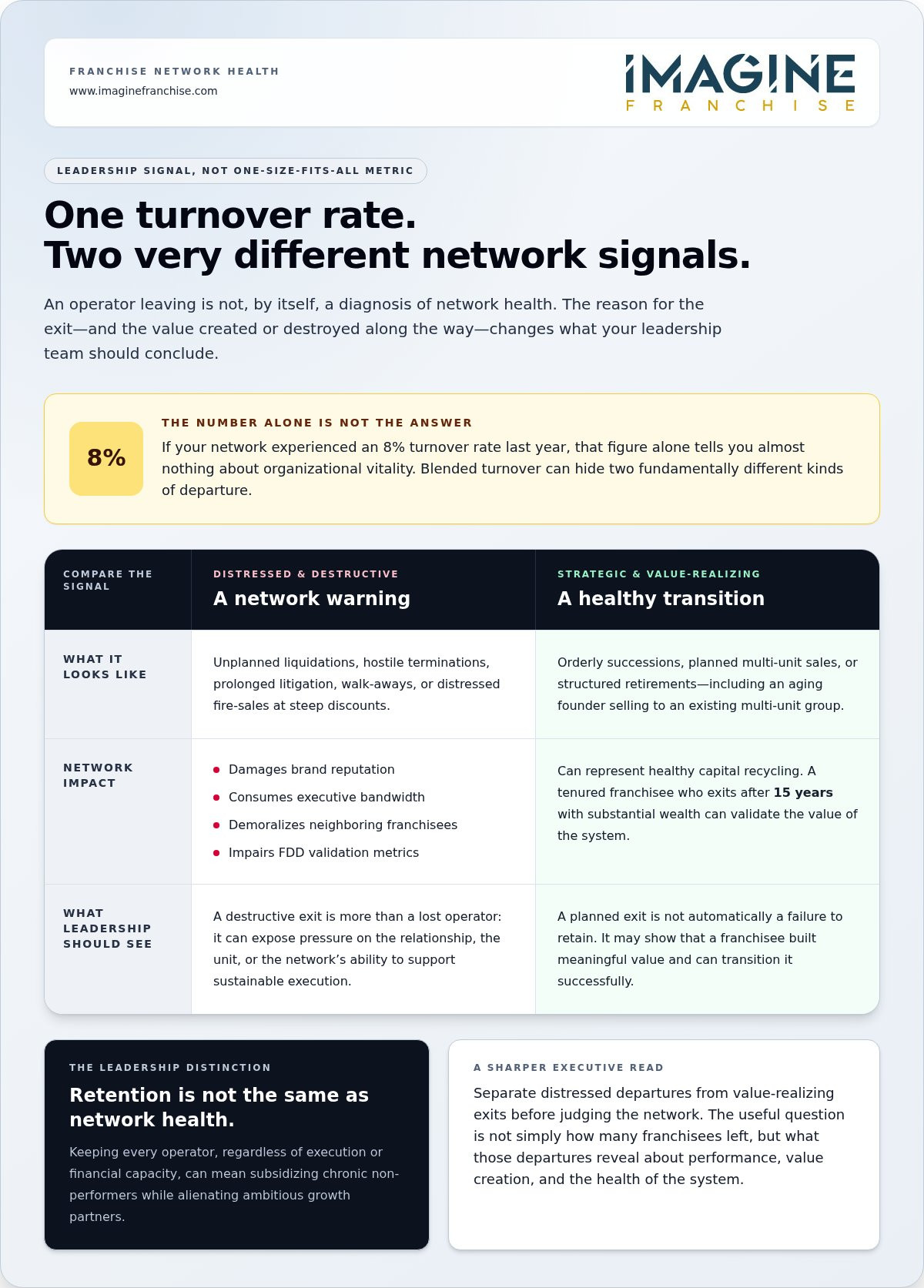
A fundamental mistake franchisor executive teams make is treating the aggregate "turnover rate" as a single metric. Blended turnover figures obscure the health of your network. If your network experienced an eight percent turnover rate last year, that figure alone tells you almost nothing about your organizational vitality.
Executive leadership must segment departures into two distinct categories:
- Distressed and Destructive Exits: Unplanned liquidations, hostile franchise terminations, prolonged litigation, walk-aways, and distressed fire-sales at steep discounts. These departures damage brand reputation, drain corporate executive bandwidth, demoralize neighboring franchisees, and directly impair your franchise disclosure document (FDD) validation metrics.
- Strategic and Value-Realizing Exits: Orderly successions, planned multi-unit sales where an aging founder realizes significant enterprise value by selling to an existing multi-unit group, and structured retirements. These transitions represent healthy capital recycling. When a tenured franchisee exits after 15 years with substantial wealth, that exit serves as the ultimate validation tool for your system.
When you aggregate these numbers without distinction, you blind your C-suite to the underlying dynamics of the network. If your team focuses entirely on keeping every single operator inside the system regardless of operational execution or financial capacity, you end up subsidizing chronic non-performers while alienating your most ambitious growth partners.
The True Financial and Cultural Cost of Churn
The true cost of distressed franchisee turnover extends far beyond the immediate loss of weekly royalty fees. For an established 100-unit system, losing three multi-unit operators controlling eight to ten locations creates an existential disruption.
First, consider the direct hit to corporate liquidity. Lost royalties compound immediately. But the secondary costs are often more severe: executive teams spend hundreds of hours managing legal disputes, negotiating workout arrangements with landlords, stabilizing shuttered sites, or running corporate buybacks to preserve customer continuity. This diversion of executive focus halts your strategic growth initiatives. Your franchise development pipeline stalls because prospective candidates speaking to existing operators during validation hear hesitation, frustration, and skepticism.
Worse still is the cultural contagion. In a franchise network, sentiment spreads rapidly across peer groups. When respected, tenured operators quietly explore exits or voice bitter resentment during peer gatherings, newer franchisees take notice. They interpret the departure of seasoned operators as a warning sign that the business model is losing relevance or that corporate leadership cannot be trusted. If you want to understand why franchisees don't follow the system, examine the psychological contract between your executive team and the field: when trust in corporate leadership erodes, operational compliance disintegrates alongside it.
Operational Support vs. Strategic Leadership: Why Traditional Fixes Fail
When franchisor executives realize that turnover is accelerating, the standard playbook is remarkably predictable: corporate publishes updated operations manuals, adds new digital checklist software, or schedules mandatory webinars. In extreme cases, leadership hires additional field compliance auditors to inspect stores more aggressively.
These tactical interventions almost always fail to stop the bleeding. In fact, they frequently accelerate it. Adding administrative overhead rarely fixes a strategic alignment crisis; it merely exhausts your best operators while doing nothing to solve the underlying economic bottlenecks.
PwC benchmark research indicates that top-quintile companies—those operating with clear strategic alignment—outperform their industry peers by 13 times in profit margin and revenue growth. Mature, high-performing franchisees do not need corporate babysitting or punitive checklist reviews. They need strategic clarity, enterprise-grade business acumen, and a franchisor leadership team focused relentlessly on protecting their unit economics.
| Operational Dimension | Traditional Compliance Policing | Strategic Growth Leadership |
|---|---|---|
| Field Support Mandate | Inspect store cleanliness, brand standards, and log manual violations. | Analyze unit P&Ls, optimize margins, and coach on capacity expansion. |
| Executive Posture | Hierarchical, contractual, and risk-averse enforcement. | Collaborative commercial partnership built on mutual economic alignment. |
| Response to Distress | Issue default notices and demand immediate operational remediation. | Deploy strategic diagnostic interventions to address unit cash flow constraints. |
| Network Governance | Unilateral corporate mandates handed down via internal portals. | Structured strategic consultation via engaged Franchise Advisory Councils. |
| Success Metric | Zero operational non-conformities logged during digital inspections. | Sustainable franchisee unit profitability and multi-unit reinvestment. |
The Trap of Administrative Support Overload
There is an enormous difference between administrative activity and franchisee enablement. Franchisors frequently mistake increased corporate motion for actual value delivery. If your central office floods operators with twenty-page memos detailing brand updates, changes in uniform trims, or mandatory marketing asset tweaks while those same operators are facing severe labor shortages and double-digit supplier cost increases, you demonstrate complete strategic detachment.
Mature franchisees deeply resent administrative interference that ignores local operating realities. When your corporate team behaves like a remote bureaucracy that only adds reporting friction without contributing to gross margin improvement, operators disengage. They stop opening corporate communications. They view head office as an expensive, mandatory tax rather than an indispensable growth partner. To break this cycle, franchisor CEOs must understand that improving franchisee profitability requires more than updating an operations manual.
Moving from Policing Compliance to Fostering Commitment
Rigid compliance audits identify visible operational defects—a burnt-out exterior sign, non-approved POS peripheral hardware, or minor maintenance gaps—while completely missing the deeper, toxic decay in operator sentiment. A location can score a pristine 98% on an operational compliance audit while its owner is actively speaking with an insolvency practitioner or a business broker.
True network retention requires shifting your culture from enforced compliance to voluntary commitment. Compliance is the minimum contractual baseline: an operator follows a standard because they fear a default notice. Commitment is fundamentally different: an operator adheres to brand standards with conviction because they understand how that standard protects their unit-level enterprise value.
You cannot audit your way to network alignment. Mutual accountability requires executive leaders who are secure enough to invite candid operational feedback from franchisees without becoming defensive or punitive. When operators know their economic reality is understood and respected at the highest corporate level, their loyalty to the brand hardens.
Core Strategies for Reducing Franchisee Turnover Across Your Network
Executing effective strategies for reducing franchisee turnover requires systemic restructuring of how executive leadership engages with unit economics, communication architectures, and wealth realization. Reducing network churn is not an HR project or a regional manager checklist; it is an overarching C-suite discipline.
Long-term franchisee retention is the direct commercial outcome of sustained unit-level profitability paired with shared strategic alignment.
To systematically eliminate destructive turnover across your network, follow this four-stage executive roadmap:
- Conduct Comprehensive Unit-Level Economic Audits: Move past gross system-wide sales reports. Analyze audited profit-and-loss statements across every operational tier to ensure bottom-line viability after labor, royalties, debt service, and operating overhead.
- Transform Franchise Advisory Bodies into Strategic Engines: Transition Franchise Advisory Councils from grievance committees into structured co-creation boards that stress-test strategic initiatives before network rollout.
- Reposition Field Operations from Auditors to Business Advisors: Retrain field consultants to conduct strategic unit business reviews focused on cash flow, labor productivity, and margin health rather than punitive checklist enforcement.
- Engineer Clear Succession and Capital Realization Protocols: Build structured internal equity transfer frameworks, multi-unit expansion pathways, and resale mechanisms that reward high-performing operators with dignified exits.
1. Prioritizing Unit-Level Economics Above Rapid Network Expansion
A franchise system cannot outrun fragile unit economics through aggressive franchise sales. If your base-level franchisees are struggling to generate healthy returns on invested capital, accelerating development only scales your vulnerabilities. Eventually, the churn catches up to the sales pipeline, leaving the franchisor with damaged reputation and mounting legal liability.
Rigorous research from InGage Consulting, examining 300 franchise brands and 24,000 participants, demonstrates that engaged franchisees are 3.7 times more profitable than their disengaged peers. Profitability and engagement operate in an unbroken feedback loop: operators who generate strong free cash flow engage deeply with the system, and highly engaged operators execute operational standards with precision, driving stronger unit economics.
As CEO, your executive focus must center on protecting unit margins against inflationary and supply chain shocks. Review your approved vendor pricing. Question your supplier rebate structures: are head office rebates artificially inflating goods costs to the point where unit margins are compromised? If so, you are taking margin away from the frontline operators who sustain your brand equity. When unit economics are robust, franchisees do not leave. They reinvest, buy adjacent territories, and recruit other high-caliber operators into your network.
2. Restructuring Advisory Councils for Meaningful Strategic Alignment
In unhealthy networks, Franchise Advisory Councils (FACs) fall into one of two traps: they become toxic complaint sessions where frustrated franchisees vent grievances, or they function as corporate rubber stamps where executive leadership presents fait accompli decisions to passive participants. Both approaches accelerate network disillusionment.
A mature franchise organization leverages its FAC as a strategic council. Involve your most respected, sophisticated operators early in the development of system-wide changes—whether that involves launching a technology overhaul, shifting menu architectures, or revising local marketing coop bylaws. When franchisees participate in stress-testing an initiative, they take personal ownership of its network-wide adoption.
Furthermore, close the feedback loop with structural discipline. When the advisory council brings systemic challenges to executive leadership—such as software instability or uncompetitive vendor pricing—corporate must provide documented, time-bound operational responses. Even when leadership decides against a recommended change, explaining the strategic business rationale transparently preserves institutional trust. To explore this dynamic further, read our guide on why compliance is the enemy of conviction in franchise network alignment.
3. Designing Clear Long-Term Wealth Creation and Succession Pathways
Many franchise exits mischaracterized as "retention failures" are actually unmanaged demographic realities. Across mature franchise networks in North America and Western Europe, thousands of franchisees who joined systems during rapid growth waves in the 1990s and 2000s are reaching retirement age without clear succession plans.
When a franchisor fails to provide structured pathways for succession, the aging franchisee becomes tired and disengages. Unit maintenance slips, customer service standards fall, and sales decline. Eventually, the operator liquidates the location or sells it to an unvetted local buyer at a depressed valuation. The network loses a location, and the brand suffers market erosion.
A sophisticated franchisor CEO anticipates these demographic shifts. Build an internal capital transition desk that matches tenured operators seeking retirement with high-performing, ambitious single-unit operators looking to expand into multi-unit ownership. Provide clear guidelines for intra-family succession, management buyouts, and institutional secondary sales. By facilitating profitable, dignified equity exits, you protect unit continuity, maintain network morale, and show younger operators that commitment to your brand builds lasting enterprise wealth.
Transforming Field Operations into a Value-Creation Engine
For the vast majority of franchisees, your corporate executive team is an abstract concept. The living, breathing embodiment of your brand's leadership is the field consultant who walks through their door every month. If that interaction is superficial, bureaucratic, or adversarial, the entire corporate leadership team is perceived as out of touch.
The industry data on this relationship reveals an alarming disconnect: 72% of franchisees believe field consultants do not understand how their businesses actually operate. When almost three-quarters of your frontline operators feel their assigned corporate business partner lacks basic commercial competence, your system has an operational credibility problem.
Shifting the Field Mindset from Auditing to Business Advising
Field consultants have historically been trained as operational enforcers: they show up unannounced with a tablet, check food temperatures, evaluate uniforms, log brand asset discrepancies, and depart within three hours after issuing a compliance score. This approach creates zero enterprise value and actively antagonizes experienced operators.
Retrain your field teams to act as executive business advisors. A high-value field visit does not begin behind the counter with a checklist; it begins in the back office with the franchisee's profit-and-loss statement. Field consultants must possess the financial acumen to analyze labor productivity metrics, evaluate local margin pressures, identify inventory waste, and diagnose capacity bottlenecks.
Consider redefining how you evaluate and compensate your field personnel. If field consultants are rewarded strictly on the volume of audits conducted and the number of infractions logged, they will behave like police officers. If they are measured and incentivized on the aggregate unit profitability, revenue growth, and retention rate of their assigned territories, their operational posture shifts immediately toward collaborative problem-solving. For practical frameworks on restructuring this function, review our analysis on training field consultants for growth leadership.
Establishing Structured Early-Warning Systems for Operator Distress
Operators rarely jump straight from peak execution to sudden failure. The trajectory toward failure is signaled by clear, predictable operational behaviors that emerge months before financial collapse:
- Reporting Latency: Delaying submission of monthly financials, royalty reports, or store-level KPI scorecards.
- Executive Absenteeism: The franchise owner stops attending regional conferences, turns off communication with corporate advisory bodies, and skips peer roundtable sessions.
- Frontline Labor Churn: Rapid turnover of store-level general managers and supervisors, signaling cultural stress and inadequate local leadership.
- Supplier Payment Friction: Struggling to meet net-30 terms with approved vendors or seeking unauthorized off-contract supply alternatives to conserve short-term cash.
- Escalating Customer Sentiment Degradation: A sustained, measurable drop in local digital reviews, customer Net Promoter Scores, or customer resolution metrics.
When your leadership team tracks these leading behavioral indicators systematically, you can intervene with constructive operational support long before an operator reaches the point of insolvency. Proactive, diagnostic intervention preserves units that would otherwise end in hostile termination or dark store closures.
Institutionalizing Retention: Scaling Leadership Capacity for Long-Term Network Stability
Network retention is ultimately a direct reflection of executive leadership capacity. As a franchise system scales from 50 to 100, 250, or 500 locations, the complexity of managing decentralized operations does not increase linearly—it compounds exponentially. Systems do not fracture because their operational playbooks lose relevance; they fracture because the CEO and executive team continue to manage a complex enterprise using the same informal tools that worked when the network was small.
Leading an established network requires a deliberate transition from hands-on operational management to systemic executive leadership. You cannot personally solve every local landlord dispute, referee every franchisee grievance, or inspect every new location. Your primary strategic duty as franchisor CEO is to build an organizational culture of mutual accountability, clear governance, and deep economic alignment.
Developing C-Suite Capacity to Match Network Growth
When network churn accelerates, many franchisor CEOs find themselves trapped in reactive firefighting. They spend their weeks managing legal confrontations, pacifying dissident franchisee factions, and trying to patch balance-sheet holes created by underperforming units. This reactive state depletes executive capacity and prevents the C-suite from steering the brand toward long-term enterprise value creation.
Scaling a franchise network requires institutionalizing leadership frameworks that balance rigorous financial governance with emotional intelligence and strategic trust. Proprietary growth methodologies, such as the Franchisexcel© framework developed across more than 25 years of franchise leadership and 15 years of executive coaching, address this specific scaling threshold. By utilizing diagnostic architectures like Franchise Performance 360©, executive teams evaluate not just their operational compliance scores, but the human, relational, and commercial health of their franchisee base.
When franchisor executives elevate their strategic posture, the nature of network conversations changes entirely. Instead of corporate policing an uncooperative network, you lead an aligned, collaborative business ecosystem where both franchisor and franchisee build enduring wealth together. Sustainable franchise retention is not built on contractual leverage; it is built on shared economic triumph.
Frequently Asked Questions
What is an acceptable franchisee turnover rate in an established network?
In mature, healthy franchise systems, an annual turnover rate of 3% to 5% is typical and often healthy, provided that turnover consists primarily of strategic value-realizing exits—such as planned retirements, generational wealth transfers, and profitable resales to existing multi-unit operators. When total turnover climbs above 8% to 10%, or when churn is dominated by distressed liquidations, abandonment, and litigious terminations, it points to systemic operational friction or severe unit economic compression.
How do you identify which franchisees are at risk of leaving before they announce it?
Franchisee disengagement follows a predictable behavioral pattern. Leading indicators of distress include delayed submission of monthly financial statements, persistent payment friction with supply chain vendors, abrupt declines in local customer sentiment scores, uncharacteristic absence from regional conferences and corporate webinars, and sudden turnover of key store managers. Tracking these operational markers allows executive leadership to deploy diagnostic business coaching before an operator reaches insolvency.
Can improved recruitment screening actually stop franchisee turnover later on?
Recruitment screening is a vital first line of defense, but it only solves half the problem. Selecting candidates who possess adequate capitalization, operational discipline, and cultural alignment prevents premature operational failures. However, even impeccably screened franchisees will eventually exit if corporate leadership fails to protect unit-level margins against inflation, allows supply chain costs to outstrip local pricing power, or enforces compliance through punitive auditing rather than collaborative coaching.
How does field support need to change to prevent franchisee turnover?
Field operations must transition from an administrative compliance inspection model to an executive business consulting approach. Field teams should spend less time verifying cosmetic checklists and more time analyzing store-level profit-and-loss statements, evaluating unit labor productivity, and diagnosing gross margin leakage. When field consultants are measured and incentivized on the financial health and profitability of their operators rather than infraction discovery rates, franchisee trust and retention rise rapidly.
What role does unit-level profitability play in franchisee retention?
Unit-level profitability is the absolute bedrock of franchisee retention. No volume of corporate communication, recognition awards, or brand conventions can compensate for fragile unit economics. Research shows that engaged franchisees are 3.7 times more profitable, highlighting the self-reinforcing link between financial performance and network alignment. If an operator is not generating an acceptable cash return on their invested capital and operational time, disengagement and eventual exit are inevitable.
How should a franchisor handle a top-performing franchisee who wants to exit?
A top performer wishing to exit should be treated as a strategic partner realizing value, not as an organizational defector. Executive leadership should proactively facilitate structured, profitable transitions—such as orchestrating an equity sale to an ambitious existing multi-unit franchisee or helping engineer an orderly internal management buyout. Celebrating and supporting a high-performer's lucrative exit demonstrates to the entire network that your franchise platform creates lasting, realizable enterprise wealth.

