


The instinct to call legal counsel when an operator pushes back is understandable, but it misdiagnoses the problem. Reaching for a default notice treats pushback as pure insubordination rather than a leadership diagnostic. If you are wrestling with how to handle difficult franchisees across your network, you already know the operational toll: endless firefighting, creeping brand dilution, and a vocal minority draining your executive bandwidth. You built this system through relentless execution, and watching consistency erode feels like an existential threat.
Contractual ultimatums do not solve operational drift; they simply burn capital and fracture system trust. You don't need heavier legal leverage. You need a sharper leadership lens. In this guide, you will discover how to transform franchisee friction into strategic alignment using a proven growth leadership framework. We will unpack why legal threats fail, how to diagnose the true root of operator resistance, and the practical moves required to restore authority and consistency across your brand.
Key Takeaways
- Reframe operator resistance as a leadership diagnostic rather than a legal dispute, pinpointing where system clarity has lagged network growth.
- Diagnose friction accurately at the unit level using the 50/50 truth to separate business fundamental failures from human leadership gaps.
- Break the support paradox, learning how over-supporting mediocre operators breeds dependency, stifles scaling, and damages system consistency.
- Master how to handle difficult franchisees through the BRAVE Model™, replacing defensive conflict management with structured leadership realignment.
- Leverage the Franchisexcel© approach to build proactive organizational discipline that magnetizes high performers and stops future friction before it starts.
The Myth of the 'Bad Apple': Why Resistance is a Leadership Symptom
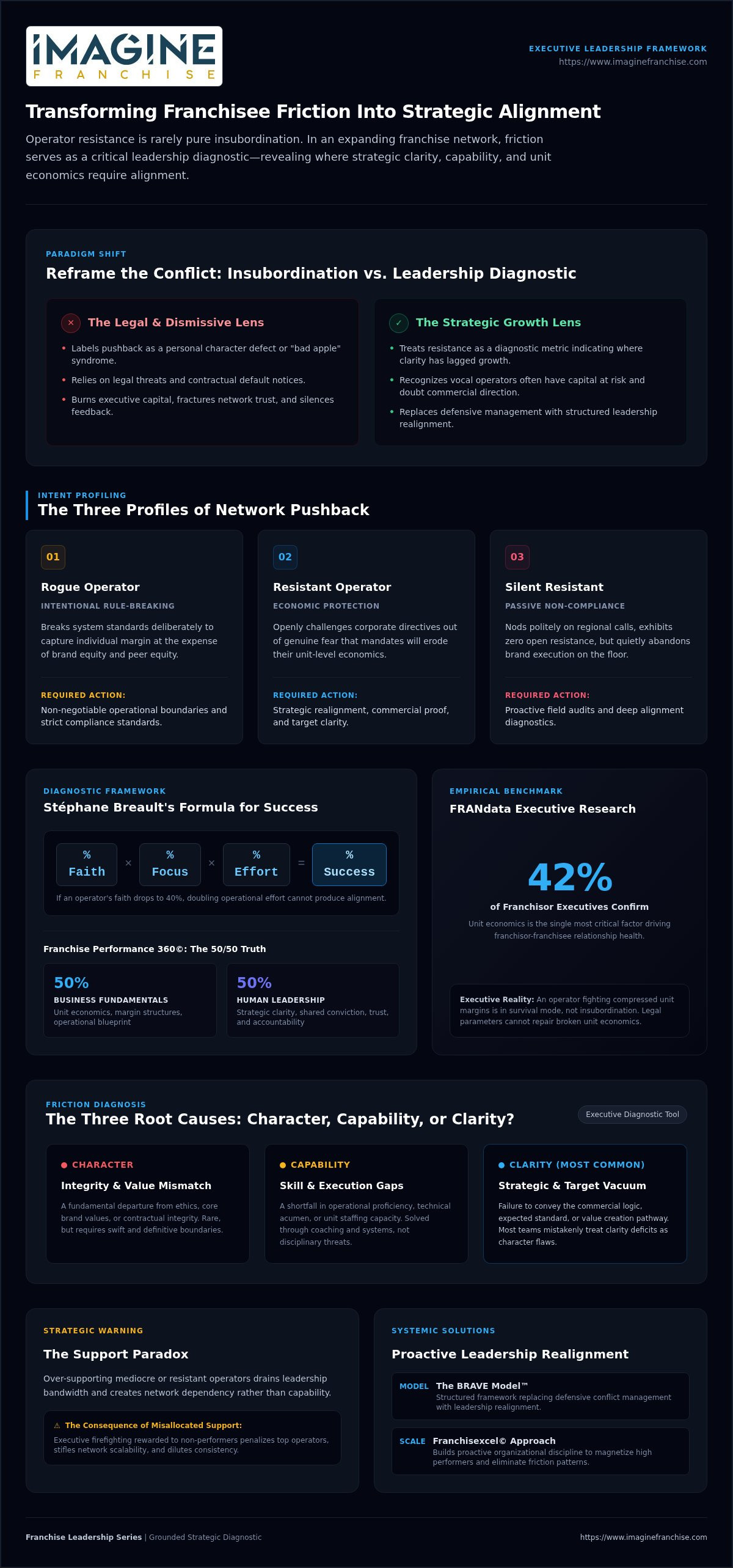
When an owner pushes back on brand standards or challenges corporate directives, the immediate executive instinct is dismissal. You label them a bad apple. It feels comforting to assume the friction stems from an abrasive personality, but that diagnosis is lazy. In the franchising business model, "difficult" is rarely a character defect. It is a leadership symptom signaling a breakdown in strategic alignment or conviction.
Network expansion accelerates this friction. Growth does not create new organizational cracks; it widens the ones that were already there. What brought your system here will not take it where you want it to go. When your team fails to articulate the commercial logic behind brand mandates, operators fill that vacuum with skepticism. Learning how to handle difficult franchisees requires shifting the mirror: resistance is rarely insubordination, but a diagnostic tool revealing where leadership clarity has stalled.
Labeling vs. Leading: The Cost of Dismissal
Writing off a franchisee lets your executive team off the hook, but it carries a severe cost. When one owner challenges system initiatives, peers watch how you respond. Dismiss them, and you telegraph to the entire network that pushback is silenced rather than resolved. That breeds cynicism. The uncomfortable truth is that vocal franchisees are often your most invested partners. They aren't passive bystanders; they are fighting because their capital is on the line, and they doubt your direction.
The Distinction Between Rogue and Resistant
You cannot address pushback without diagnosing intent. Rogue operators intentionally break system rules to capture personal margin at the expense of brand equity. Resistant operators, however, push back because they fear corporate initiatives will erode their unit economics.
Knowing how to handle difficult franchisees demands that you treat these groups differently. Rogue behavior requires non-negotiable operational boundaries. Resistant behavior requires strategic realignment. Even more dangerous is the silent resistant owner: the one who nods politely on regional calls, offers zero open resistance, and quietly abandons brand execution the moment they walk back onto the floor.
Diagnosing the Friction: Character, Capability, or Clarity?
To lead an expanding system, you need a precise diagnostic method. The Franchise Performance 360© framework approaches unit-level friction through the lens of the "50/50 truth": sustainable franchise performance is fifty percent business fundamentals and fifty percent human leadership. When tension erupts, franchisors usually attack the human element while ignoring broken fundamentals, or vice versa.
Every operational breakdown traces back to Stéphane Breault's Formula for Success: % Faith × % Focus × % Effort = % Success. If an operator's faith in the brand model drops to forty percent, doubling their operational effort will not produce alignment. Understanding how to handle difficult franchisees begins by identifying which specific variable in that formula has collapsed.
Is it a Business Fundamental or a Human Factor?
Before assuming an operator lacks character, look at their unit economics. According to FRANdata research, 42% of franchisor executives confirm unit economics is the single most critical factor driving franchisor-franchisee relationship health. An operator fighting compressed margins is not inherently rebellious; they are in survival mode. While FTC Franchise Rule compliance standards define disclosure and relationship baselines, legal parameters cannot repair broken unit economics.
A true diagnostic separates capability gaps from conviction gaps across three distinct areas:
- Character: A fundamental mismatch in values, ethics, or contractual integrity.
- Capability: A lack of operational skill, staffing capacity, or technical acumen.
- Clarity: A failure to understand the strategic target, commercial logic, or expected standard.
Most executive teams mistake a clarity deficit for a character flaw. They penalize an operator when they should be refining their own operational blueprint.
The Mirror Effect: CEO Alignment and Network Compliance
Strategic alignment is the shared conviction between the franchisor's executive team and the franchise network regarding where the brand is heading, why that destination matters, and how every unit creates measurable enterprise value. When the C-suite exhibits internal friction, the network absorbs that ambiguity instantly. Franchisees possess fine-tuned antennae for executive hesitation. If your operations vice president and marketing director deliver conflicting mandates, unit owners protect themselves by ignoring both.
If you suspect your leadership team needs deeper alignment before confronting network drag, scheduling a private 45-minute exploratory session can help pinpoint whether your resistance problem is rooted in your network or inside your boardroom.
Why More 'Support' Often Fuels More Resistance
The standard franchisor playbook says that when an operator struggles or pushes back, you deploy more field support. You send operational consultants, schedule weekly review calls, and deliver additional operational guides. Yet, the friction intensifies. Research from MIT Sloan reveals that 75% of new franchisors disappear within 12 years, largely due to structural and operational fragility. Flooding resistant operators with unstructured assistance is a direct route to that fragility. It fuels the exact hostility you are trying to extinguish.
Excessive assistance creates an insidious dynamic: the support paradox. When your corporate team repeatedly intervenes to solve store-level problems, you strip the owner of operational agency. What looks like support to your leadership team feels like patronizing micromanagement to an independent business owner. It creates learned helplessness, reinforces the "good enough" trap, and keeps underperforming units permanently dependent on corporate energy. Realizing how to handle difficult franchisees means recognizing that more resources cannot fix an absence of mutual accountability.
The Enablement Trap: When Helping Becomes Hurting
When field business consultants cross the boundary from strategic advising into hands-on problem-solving, your network suffers. They audit logs, manage vendor orders, and re-train crew members themselves. The franchisee stops leading their location and waits for corporate intervention. The psychological posture degrades from an enterprising business owner to an entitled subordinate.
Breaking this cycle requires transforming your field operations from tactical firemen into strategic leadership coaches:
- Stop solving operational symptoms; require the franchisee to propose the commercial solution.
- Establish defined operational benchmarks before deploying any corporate field personnel.
- Tie support resources to demonstrable franchisee accountability and personal capital execution.
Accountability is a Form of Respect
Tolerating continuous defiance from vocal, resistant operators damages your relationship with top performers. PwC research shows that the top 20% of companies outperform peers by 13 times in profit margin and revenue growth. Your highest-performing operators notice when a resistant minority consumes eighty percent of your executive bandwidth while dragging down the collective brand equity. Understanding why franchisees stop following the system reveals that selective enforcement breeds widespread cynicism.
Determining how to handle difficult franchisees requires protecting your brand's enterprise value through strict, non-negotiable operational baselines. Tolerating non-compliance is not empathy; it is executive neglect. Holding an owner firmly to network standards respects their capability as an independent business leader and safeguards the asset value built by the rest of your system.
The BRAVE Framework for Franchisee Realignment
When leadership teams ask how to handle difficult franchisees, they typically seek dispute de-escalation tactics. That impulse misfires. You don't need conflict management; you need structured leadership realignment. Conflict management simply manages tension; realignment restores direction. The BRAVE Model™ provides a peer-to-peer framework designed to resolve friction between executive leadership and operators without resorting to administrative threats.
Skipping stages in this sequence guarantees operational relapse. Attempting to enforce execution before securing shared conviction always breeds passive resistance. The BRAVE Coaching Method™ moves methodically through five critical phases, transforming friction into system momentum.
Baseline and Realignment: Finding the Common Ground
The intervention begins by stripping out emotion:
- Baseline: Establish current reality using objective unit-level metrics, customer scores, and operational data. Remove personal narratives and focus strictly on operational facts.
- Realignment: Clarify the strategic gap between current unit performance and system standards. Adopting the Franchise Leadership Catalyst™ mindset means framing this gap around commercial outcomes and brand equity rather than corporate authority.
When both sides examine an unvarnished baseline together, defensive posturing evaporates. The conversation shifts from personal friction to commercial reality.
Activation, Validation, and Execution
Once the gap is identified, the focus shifts to operational recovery. Activation requires the operator to co-author their action plan. When franchisors dictate the tactical steps, they retain psychological ownership of the outcome. When the franchisee defines how they will hit brand standards, they own the execution.
Next comes Validation. You must establish transparent, quantifiable milestones over a sixty- to ninety-day window. If service delivery or margin targets do not shift, the difficulty has not resolved. Finally, Execution establishes consistent operational discipline through rigorous follow-through rather than sporadic crisis meetings.
If you want to master how to handle difficult franchisees while upgrading your executive team's capability, take the next step. Schedule a private leadership consultation with Stéphane Breault to install this realignment discipline across your brand.
Scaling Smarter: Preventing the Next 'Difficult' Pattern
Stopping friction permanently requires more than resolving current flare-ups; it demands systemic prevention. As your franchise footprint expands from twenty to fifty or two hundred locations, your leadership capacity must grow faster than your unit count. If you rely on early-stage relational goodwill to keep operators aligned, scale will overwhelm you. You end up trapped in chronic firefighting. The Franchisexcel© system shifts franchisors away from this reactive trap, establishing organizational discipline that magnetizes high performers to your vision while weeding out misaligned candidates before contracts are signed.
Network stability also requires external executive perspective. Participating in a dedicated franchisor and multi-location CEO-Peer advisory group allows you to pressure-test expansion strategies with peers navigating identical friction points. Instead of improvising how to handle difficult franchisees during an operational crisis, you build proactive governance structures that eliminate ambiguity across every tier of your network.
Building Leadership Capacity in Your Network
Preventing friction begins with an internal evolution: shedding the founder mindset to adopt the discipline of an enterprise CEO. Founders manage through personal relationships and ad-hoc concessions. Enterprise CEOs lead through structured systems, clear non-negotiables, and transparent operating frameworks.
This discipline directly transforms franchise recruitment:
- Stop qualifying candidates strictly on liquid capital and net worth; vet them ruthlessly for cultural and operational alignment.
- Clarify non-negotiable brand operating standards before collecting franchise fee deposits.
- Leverage the annual multi-unit franchisees summit as a strategic engine to reinforce network unity, share benchmark performance, and realign operators around enterprise value.
The Path to a 10x Network
Resolving friction with a vocal, resistant minority is the non-negotiable prerequisite for reaching top-tier system growth. According to research from FranConnect and InGage Consulting across 300 brands, engaged franchisees are 3.7 times more profitable than disengaged peers. Leaving disengaged operators unaddressed caps your network's valuation and drains your team's energy. Realignment unlocks the strategic focus required to scale sustainably.
Transforming your network's culture starts with elevating your own executive capability. How you conduct difficult conversations sets the operational tone for your C-suite and field operations. Discover how the Franchisexcel© program can align your network for growth, equipping you with the executive framework needed to master how to handle difficult franchisees and build lasting enterprise value.
The Leadership Shift: From Legal Threats to Strategic Alignment
Default notices and legal ultimatums don't build enduring brands. They simply drain capital, fracture culture, and signal that executive clarity has broken down. Knowing how to handle difficult franchisees is not a matter of legal leverage; it is a test of your leadership capacity. When you strip away emotion, evaluate unit economics honestly, and replace unstructured support with rigorous accountability, resistance transforms into alignment.
With over 35 years of franchise leadership experience, author of For Franchise Leaders’ Eyes Only, and creator of the proprietary Franchisexcel© system, Stéphane Breault helps franchisor CEOs navigate the friction of scaling. You built a valuable enterprise. Now your leadership framework must expand to match your ambition.
Take control of your network's trajectory. Book a Strategic Alignment Session with Stéphane Breault to turn operator pushback into lasting system momentum and protect your enterprise value.
Frequently Asked Questions
How do I know when a difficult franchisee is no longer worth the effort?
You know an operator is no longer viable when the issue stems from character rather than clarity or capability. If an owner demonstrates ethical violations, intentional bad faith, or active sabotage of system standards, realignment cannot succeed. When an operator rejects mutual accountability and refuses to acknowledge factual operational baselines, continued coaching becomes enablement. At that stage, prolonged executive effort protects a single operator while destroying network equity.
Is it better to terminate a difficult franchisee or try to realign them?
Realigning is almost always the superior commercial move before considering termination. Understanding how to handle difficult franchisees requires weighing the true costs of separation. Litigation averages over $150,000 per party and spans up to three years, creating severe network distraction. More importantly, roughly 20 U.S. jurisdictions mandate strict relationship statutes and cure periods. Termination should be an absolute last resort reserved for bad-faith operators, not an operational shortcut for leadership friction.
How can I prevent a vocal minority of franchisees from influencing the whole network?
Neutralize a vocal minority by establishing absolute transparency around system performance data. Discontent spreads when there is an executive information vacuum. Publish objective operational benchmarks and celebrate operators executing the model profitably. Engage your high performers directly through multi-unit summits and advisory councils to anchor network culture. When leadership communicates clear commercial logic directly to the system, vocal dissenters lose their platform to distort network sentiment.
What is the first step a CEO should take when a top-performing franchisee becomes difficult?
The first step is to listen deeply to uncover the commercial friction threatening their profitability. Top operators rarely push back out of malice. Usually, their friction indicates that a new corporate policy, supply chain change, or tech rollout is undermining unit margins. Approach them peer-to-peer. Validate their contribution to system equity, review the unit-level data together, and distinguish whether their pushback is a valid critique of system execution or an isolated operational preference.
Can technology like FranConnect help in managing difficult franchisee relationships?
Yes, technology platforms like FranConnect replace subjective emotional arguments with empirical operational data. Solutions like FranConnect Field Ops and Command Center centralize audit logs, compliance tracking, and unit performance metrics. This shifts difficult interactions away from personal friction and toward objective facts. Technology creates the shared operational baseline required for strategic realignment, ensuring field teams and operators discuss verified numbers rather than conflicting opinions.
How does the BRAVE Model™ differ from standard conflict resolution techniques?
The BRAVE Model™ is a leadership realignment framework, not a conversational de-escalation tool. Standard conflict management focuses on soothing tension and reaching compromises that often dilute brand standards. The BRAVE framework (Baseline, Realignment, Activation, Validation, Execution) is built specifically for franchisors. It treats friction as a diagnostic issue, systematically securing franchisee conviction, co-authoring execution plans, and establishing measurable operational accountability without compromising system consistency.
Should I involve my legal team as soon as a franchisee stops following the system?
No, reaching for legal counsel at the first sign of friction usually escalates operational misalignment into an adversarial standoff. Knowing how to handle difficult franchisees means leading through strategic clarity first. Consult legal counsel privately to understand your contractual boundaries and statutory cure requirements, but keep them in the background. Leading with legal default notices signals executive weakness and destroys trust. Use structured leadership coaching to realign the operator before deploying legal leverage.
How do I handle a franchisee who refuses to participate in a realignment plan?
When an operator flatly refuses structured realignment, you must transition immediately from coaching to formal contractual governance. Leadership requires offering every opportunity for strategic alignment, but it also demands protecting brand equity. Document their refusal clearly against established operational standards. Present the commercial choice plainly: commit to the system standard or execute an orderly, professional exit. Refusing to realign is a definitive decision, and leadership must treat it with decisive operational finality.

