


The Alignment Trap: Why Your Franchisees Aren’t Following the System
You have a proven model. You’ve documented the systems, built the operations manual, and invested in a support team. Yet, when you look across your network, you see inconsistency. You see top performers who seem to operate on an entirely different plane and a frustrating number of franchisees who treat the playbook like a list of suggestions.
This is the alignment trap. It’s the gap between the strategy debated in your boardroom and the execution happening on the front lines. And the conventional wisdom for closing this gap—tighter controls, more detailed manuals, stricter compliance checks—is not only ineffective; it’s often the cause of a deeper problem.
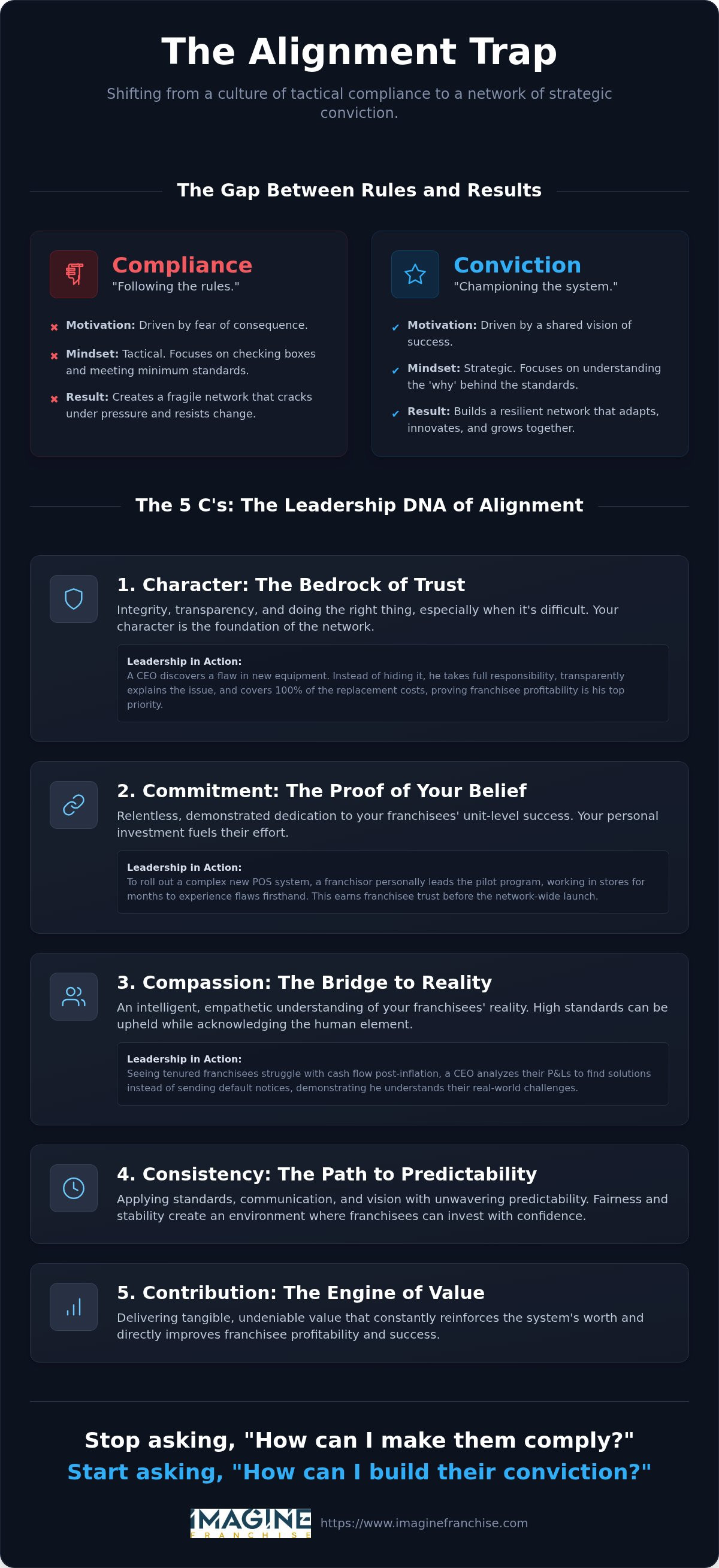
Franchise network alignment isn’t about getting people to follow rules. That’s compliance. Compliance is the floor, the bare minimum you expect to avoid a default notice. True alignment is about building shared conviction. It’s the unshakable belief within your franchisees that your vision, your strategy, and your system represent their single best path to success. When you have conviction, they don’t just follow the system; they champion it.
The hard truth is this: if your franchisees aren't aligned, the problem isn't their motivation. It's the clarity and quality of your leadership. The strategies that got you to 50 units relied on personal relationships and direct oversight. Scaling to 100, 200, or 500 units is a different game—one that requires a more intentional and scalable form of leadership.
The Difference Between Compliance and Conviction
Many franchisors spend their careers chasing compliance. They create bigger manuals, more complex audits, and stricter franchise agreements. But this only creates a culture of rule-followers, not performance leaders. Franchisees do just enough to stay out of trouble.
- Compliance is tactical. It’s about checking boxes and meeting standards. It’s driven by fear of consequence.
- Conviction is strategic. It’s about understanding the ‘why’ behind the standards and believing in the destination. It’s driven by a shared vision of success.
A network built on compliance is fragile. It cracks under the pressure of market shifts, new competition, and internal friction. A network built on conviction is resilient. It adapts, innovates, and grows, because everyone is pulling in the same direction, motivated by a common purpose. This is why you must stop asking, “How can I make them comply?” and start asking, “How can I, as a leader, build their conviction?”
The 5 C’s: The Leadership DNA of True Alignment
If manuals and audits don’t create conviction, what does? The answer lies in your leadership. Not in abstract theories, but in tangible behaviors. Through 35 years of working with over 100 franchise systems, I’ve found that franchise network alignment is a direct reflection of five core leadership attributes. I call them the 5 C’s: Character, Commitment, Compassion, Consistency, and Contribution.
These aren’t soft skills. They are the hard-edged, value-creating assets that determine whether your franchisees trust you enough to follow you into the future. They are the DNA of alignment.
1. Character: The Bedrock of Trust
Character is the foundation upon which your entire network is built. It’s about integrity, transparency, and doing the right thing, especially when it’s difficult or expensive. In franchising, your character as a CEO is constantly under a microscope. Every decision you make sends a message to the network about what you truly value. When franchisees trust your character, they will give you the benefit of the doubt during tough times. Without it, every new initiative is met with suspicion.
Real-Life Example: The CEO of a national home services franchise discovers a flaw in a new piece of equipment rolled out to the entire network. It doesn’t pose a safety risk, but it reduces efficiency by 10%, impacting franchisee profitability. Instead of hiding the issue or waiting for complaints, he immediately sends a network-wide communication. He takes full responsibility, explains the technical problem transparently, and announces that the corporate office will cover 100% of the cost to replace the faulty component. The short-term financial hit is significant, but the long-term gain in trust is immeasurable. He demonstrated that franchisee profitability was more important than protecting the bottom line, proving his character through action, not words.
2. Commitment: The Proof of Your Belief
Commitment is your demonstrated, relentless dedication to the network’s success. It’s not about the words in your annual address; it’s about where you spend your time, energy, and resources. Franchisees need to see that you are as invested in their unit-level success as you are in the corporate P&L. Are you in the field? Do you understand their daily challenges? Does your leadership team show the same level of dedication? Your personal commitment is the fuel for their effort.
Real-Life Example: A fast-casual restaurant franchisor wants to implement a complex new point-of-sale and inventory management system. She knows it will be a painful transition but is critical for future growth. Instead of delegating the launch to the IT department, she personally leads the pilot program. For three months, she spends two days a week working in the pilot locations, taking orders, talking to staff, and experiencing the system’s flaws firsthand. She hosts weekly town halls with the pilot franchisees to troubleshoot issues in real-time. By the time the system is ready for a network-wide rollout, she has earned the franchisees’ trust. They saw her commitment and knew she wouldn’t ask them to do something she wasn’t willing to do herself.
3. Compassion: The Bridge to Reality
Compassion in a business context isn't about being soft; it's about having an intelligent and empathetic understanding of your franchisees' reality. They have invested their life savings. They are navigating local labor markets, demanding customers, and personal challenges you may never see. A compassionate leader builds policies and strategies that reflect this reality. You can hold people to high standards while still acknowledging the human element of the business. When franchisees feel understood, they are more willing to embrace the system’s demands.
Real-Life Example: Following a period of intense inflation, a fitness franchise CEO sees that several of his most tenured franchisees are struggling with cash flow, despite having strong membership bases. The royalty structure, based on top-line revenue, is squeezing them. Instead of sending default notices, he instructs his team to analyze the P&Ls of the 20 most-affected units. He discovers a systemic issue with rising utility and labor costs. He convenes a special advisory council and, with their input, institutes a temporary, tiered royalty relief program tied to specific EBITDA margins. This act of compassion not only saved several franchisees from failure but also created a wave of goodwill. It showed he was a true partner, focused on their net profit, not just his gross revenue.
4. Consistency: The Cure for Chaos
Consistency is the enemy of confusion. As a CEO, you are pulled in a dozen directions, tempted by new trends and opportunities. But for a franchise network, predictability is paramount. Franchisees thrive when the vision is clear, the priorities are stable, and the rules of the game don’t change every quarter. Inconsistent leadership—launching flavor-of-the-month initiatives or sending mixed messages—creates uncertainty and erodes confidence. It trains franchisees to ignore new directives, assuming they will be replaced by something else next month.
Real-Life Example: A retail franchise was suffering from "initiative fatigue." A brilliant but impulsive CEO had launched and abandoned three major strategic shifts in two years. Franchisee engagement was at an all-time low. A new CEO is brought in. In her first 90 days, she does nothing but listen. Then, she presents a simple, clear “Back to Basics” 24-month plan focused on just three things: supply chain efficiency, in-store customer experience, and local marketing. For the next two years, she ruthlessly says “no” to every idea, no matter how good, that doesn't directly support those three pillars. Her unwavering consistency was a calming force. It allowed franchisees to finally focus, invest with confidence, and execute with excellence. Alignment returned not because of a brilliant new idea, but because of the disciplined execution of a consistent one.
5. Contribution: The Power of a Shared Mission
Finally, the most successful franchise networks are united by more than a desire for profit. They are bonded by a sense of contribution—a shared purpose that gives meaning to the daily grind. As a leader, it is your job to define and champion this mission. Why does your brand exist beyond making money? What impact do you have on your customers and communities? When franchisees believe they are part of something bigger than themselves, their conviction deepens. They become brand ambassadors in the truest sense, driven by a purpose that compliance checklists can never capture.
Real-Life Example: The founder of a senior home care franchise noticed that as the network grew, the conversation became dominated by billing rates and scheduling software. The original passion for helping families was getting lost. He launched the "Family First" initiative. A portion of the national marketing fund was reallocated to a new foundation that provided grants for community programs supporting Alzheimer's caregivers—a cause nominated and voted on by franchisees. He also changed the annual awards from being purely sales-based to include a prestigious "Community Contributor of the Year" award. This shifted the network’s focus from a purely transactional service to a meaningful social contribution, re-energizing veteran franchisees and attracting a new profile of mission-driven owners.
Diagnosing Your Leadership Gap
Reading about the 5 C’s is one thing. Objectively measuring them within your own leadership and organization is another. Most underperformance in a franchise network isn't caused by "bad" franchisees; it's a symptom of a leadership gap at the corporate level. You cannot fix a problem you cannot see. This is why a systematic, honest diagnosis is the first step toward building true alignment.
This requires moving beyond simple franchisee satisfaction surveys, which often measure happiness but not alignment. You need a deeper diagnostic tool, like our Franchise Performance 360©, to identify the invisible friction in your network. Such a tool separates the daily operational ‘noise’ from the strategic ‘signal’ by assessing key areas:
- Leadership Clarity: Do franchisees clearly understand the ‘North Star’? Can they articulate the strategic priorities for the next 12-18 months? Or is there a gap in Consistency?
- Perceived Value: Do they see the royalties and fees they pay as a high-ROI investment in their success, or as a tax on their business? Is there a gap in Commitment or Character?
- The Franchisor-Franchisee Relationship: Is the relationship built on mutual trust and respect, or is it adversarial? Is there a lack of Compassion?
An honest 360° evaluation will reveal your blind spots. It will show you where your leadership is creating conviction and where it is unintentionally causing confusion or mistrust. Only with this clarity can you move from reactive problem-solving to proactive, strategic leadership.
Building a Culture of Conviction Over Compliance
Once you’ve diagnosed the gaps, the work of building a culture of conviction begins. This isn’t a quick fix; it’s a sustained, disciplined effort to embed the 5 C’s into the rhythm of your organization.
The goal is to create a system where the franchisees themselves become the guardians of the brand standards because they believe in them. This starts with your top performers. Too often, franchisors focus their energy on the bottom 20%. Instead, you should partner with your top 20%—your most aligned and successful franchisees—to co-create solutions and lead change. They are your greatest evangelists.
This process transforms accountability. It stops being a stick wielded by the corporate office and becomes a mirror held up by peers. When a high-performing franchisee council is involved in setting standards, they have a vested interest in seeing them upheld. This creates a powerful culture of peer-to-peer accountability, which is far more effective than any compliance officer.
Your annual summit becomes a critical moment to reset the alignment clock. It should be less about corporate presentations and more about reinforcing the mission (Contribution), celebrating wins born from the system (Commitment), and having honest conversations about the future (Character). It’s where you, as the leader, demonstrate your unwavering Consistency and Compassion, year after year.
Scaling Smarter: Aligning Your C-Suite for the Future
Franchise network misalignment rarely begins with the franchisees. It begins in the boardroom. If your executive team is not in lockstep, you cannot expect the network to be. A marketing department pushing a discount strategy while operations is focused on a premium service experience sends conflicting, trust-eroding messages to the field.
Before you can achieve network-wide alignment, you must first achieve executive unity. This means your entire C-suite—Marketing, Operations, Finance, and Development—must operate under a single, integrated growth leadership system. The 5 C’s apply just as much to your internal team as they do to your franchisees.
Your role as CEO must also evolve. You must transition from being the 'Chief Problem Solver,' who is pulled into every daily fire, to the 'Chief Alignment Officer.' Your primary function is to maintain the clarity of the vision and ensure that every part of the organization—from the C-suite to the field support team—is reinforcing the culture of conviction.
This is the ultimate test of franchise leadership transformation. It’s about building an organization that can scale its culture right alongside its unit count. It is the only way to ensure the brand you’ve built not only grows, but grows stronger, more profitable, and more unified for years to come.
If you are ready to move beyond the endless cycle of chasing compliance and start building a network fueled by deep conviction, the work begins with you. It begins with an honest assessment of your leadership and a commitment to closing the alignment gap.
Ready to see where your network is leaking value?
Secure your 45-minute private exploratory session to discuss your network's future.

