


Picture the planning session. Two days offsite, a clean whiteboard, a leadership team that leaves energized and sure it finally has the plan. Six months later, the operations VP is buried in field issues, the marketing rollout is half finished, and three franchisees have asked why the company keeps changing direction. Nobody missed a meeting. Almost nothing moved.
So here is the question worth sitting with: is your leadership team failing to execute your strategy, or are you failing to lead its execution? Most franchisor strategic plans don’t fail because the strategy is wrong. They fail because leadership never makes the difficult decisions required to execute it. Market shifts and tight unit economics are real constraints, and they make those decisions harder. They don't make them optional.
This article is for owner-led franchisors with roughly 25 to 250 franchises. It covers how to pick a few priorities, tie them to franchisee profitability, measure results instead of activity, and run the follow-through after everyone goes home.
Key Takeaways
- Plans usually stall on indecision, vague expectations, and tolerated non-performance, not on a bad strategy.
- Pick about three priorities and say out loud which initiatives stop.
- Judge every initiative by what it does to franchisee profitability and daily operations.
- Track outcomes in the units, not corporate activity.
- The CEO's real work starts when the planning session ends.
Your Strategic Plan Isn't the Problem. Your Leadership Might Be.
You built a network that works. That took judgment and nerve. But what carried the system to its current size, mostly your direct attention and fast calls, rarely carries it through the next stage. Each new unit adds people, handoffs, and decisions that no longer pass through you. A plan that depended on your presence starts to fray.
Franchisor strategic planning is choosing where the network will focus, naming who owns each choice, and making sure the units can act on it. A budget spreads money. A wish list collects intentions. Daily troubleshooting puts out fires. None of them is a strategy, and when the choices aren't explicit, urgent problems keep winning the calendar.
Three leadership habits that stall a good plan
The first is indecision. A team knows the plan calls for dropping a legacy program or changing a field consultant's role, and everyone waits for someone to say it. Months pass. The delay is itself a decision, and the team reads it as permission to keep doing everything.
The second is vague expectations. "Improve franchisee performance" tells a director of operations nothing. Does it mean royalty growth, fewer units under a margin floor, or faster openings? Without a number, a date, and a name, people fill the gap with their own version of success.
The third is tolerated non-performance. If a missed milestone produces no conversation, the team learns the plan is optional. The same goes for a franchisee who ignores a core standard with no follow-up. Everyone sees what you let slide, and it becomes the real policy.
None of this means you have been a poor leader. Growth changed the job faster than the habits changed. A strategic plan is only as real as the decisions and follow-up behind it. You can read more on this theme in Franchise CEO Leadership: Why Your Past Success Is Blocking Your Future Growth.
If Everything Is a Priority, You're Not Making Choices
Start with an honest look at the network as it is. Review unit performance, where franchisees are struggling, what your field team actually spends its time on, and how much your leaders can take on. Be careful about symptoms. Falling unit margins might come from a weak process, unclear expectations, or franchisees who were never trained on a new standard. Each needs a different fix.
Compare what the numbers say with what franchisees tell you and with what your own team believes. When they disagree, find out why before you commit resources. Franchise Performance 360© is one structured way to look at both the business and human dimensions of franchise leadership, as an assessment lens alongside your operating data and franchisee input.
Narrow to about three
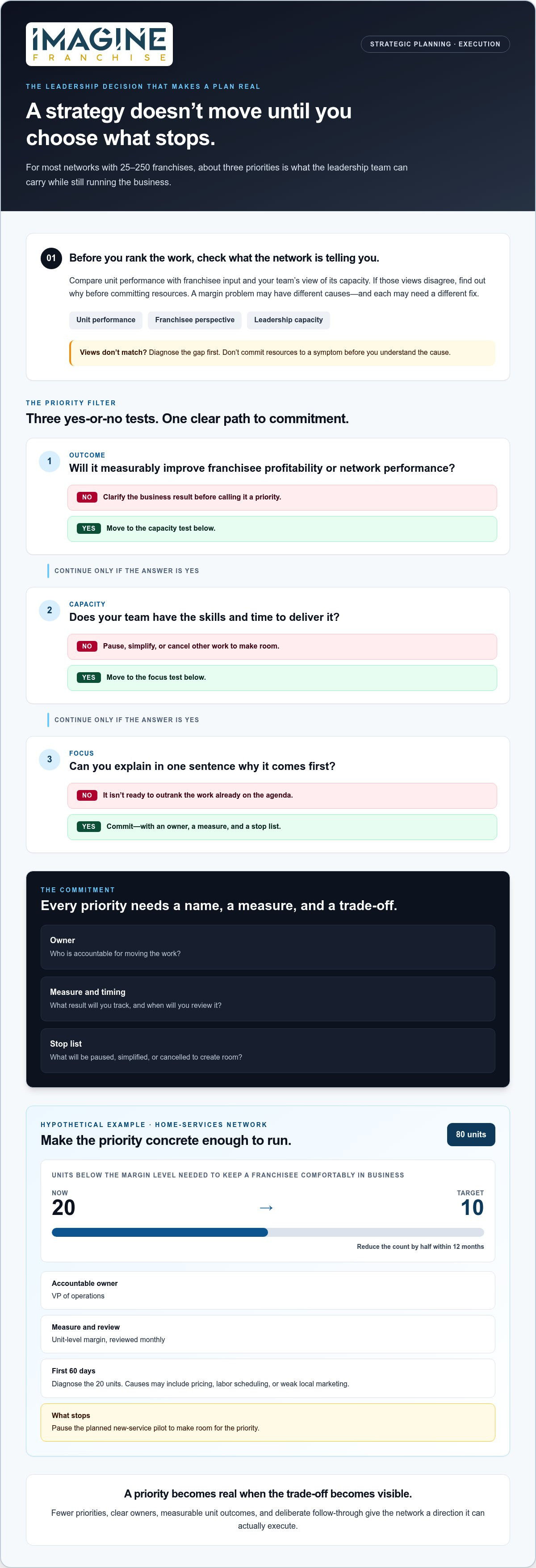
For most networks in the 25 to 250 range, three priorities is about what your leadership team can carry while still running the business. Test each candidate with three questions. Does it move franchisee profitability or network performance in a way you can measure? Does your team have the skills and time to deliver it? Can you say in one sentence why it comes first?
Then do the part most plans skip: name what stops. If the plan adds a loyalty program, a new training track, and a technology rollout, something must be paused, simplified, or cancelled to make room. Write the stop list next to the priority list and share both. Fewer priorities with real owners tend to outperform a long agenda, because people know where to put their effort.
A hypothetical: fixing weak units
Take a hypothetical home-services network with 80 units. Leadership finds that 20 units run below the margin level that keeps a franchisee comfortably in business. One priority becomes: reduce those 20 units to 10 within 12 months. The owner is the VP of operations. The metric is unit-level margin, reviewed monthly. The first 60 days go to diagnosing the 20 units, because the causes differ: pricing, labor scheduling, weak local marketing. To make room, the team pauses a planned new-service pilot. That pause is the hard decision. Without it, the priority is a slogan.
Be just as clear about who decides what. You set network direction. Franchisee input matters most where decisions touch unit economics and daily operations. Consultation should shape the decision, not blur who owns it. For help with those trade-offs, see The Franchisor Business Model Canvas: Strategic Planning for CEOs Who Scale.
Your Franchisees Don't Execute Your PowerPoint. They Run Businesses.
Franchisees are independent operators with payroll, rent, and customers waiting. They don't read a strategy slide and ask how to support it. They ask what it costs them, what it earns them, and who will cover the extra work. If your plan can't answer those three questions in plain terms, expect polite silence and slow adoption.
Alignment means franchisees understand the goal, the reason, their role, and how progress will be judged. It does not mean every operator agrees. Silence is not commitment, so ask what is unclear or hard to carry out, and ask early enough that the answers can change the plan.
A hypothetical: the rollout that cost franchisees
Imagine a 120-unit food-service brand that launches a new loyalty app. Corporate sees data and repeat visits. Franchisees see a point-of-sale integration fee, a required staff training hour per shift change, and a discount that cuts into thin margins on slow days. Within weeks, half the network is using the app inconsistently. Corporate calls it a compliance problem.
It is a planning problem. Had leadership asked a dozen franchisees to walk through the cost per unit before launch, it would have found the integration fee and the training burden, and could have phased the rollout, shared the cost, or adjusted the discount. Before any initiative leaves headquarters, put numbers on its effect on franchisee margin, labor hours, and cash.
Use a plain table to check each initiative before it reaches the network.
| Question to answer | Weak version | Execution-ready version |
|---|---|---|
| What does it change for the unit? | "Improves the customer experience." | Names the daily task that changes, the hours it adds, and the cost per unit. |
| What is the payoff? | "Better brand consistency." | States the expected effect on sales or margin and when franchisees should see it. |
| Who helps? | "Franchisees will adapt." | Names the corporate owner, the support offered, and the follow-up date. |
For practical ways to bring franchisees in early, read How to Get Franchisee Buy-In for New Initiatives. And hold yourself to the same standard you set for them: accountability without the resources and clear guidance to deliver is just pressure.
Stop Confusing Activity With Progress
Webinars held, manuals updated, field visits completed, and tools rolled out are activity. They are easy to count and they fill a quarterly report nicely. Progress is a change in the units: lower labor cost as a share of sales, fewer units below the margin floor, faster ramp-up for new franchisees, higher repeat customers.
Many leadership teams report the first kind because the second kind takes longer to move and exposes whether the plan is working. Pick a small set of measures tied to each priority. Pair early signs that the work is happening, such as the percentage of units using a new process, with the business results you ultimately want, such as unit margin. The early signs tell you when to help. The results tell you whether the strategy is right.
A hypothetical: onboarding
Consider a 45-unit retail network. Its priority is to get new franchisees to break-even faster. Leadership sets a target: cut the average time to break-even from 14 months to 11 across the next 12 openings. The owner is the director of franchise development. The early signal is how many new franchisees finish the first 90-day plan on schedule. The result is break-even timing. If the early signal is green and the result is not, the assumption is wrong, and the team revisits it instead of adding more training sessions.
Keep the dashboard short. If nobody knows which number needs attention, there are too many. And when a result moves, find the cause before you change direction. A drop might come from execution, a flawed assumption, or a market shift outside your control. Each calls for a different answer.
For more on collecting franchisee evidence that feeds these measures, see Beyond the Survey: Building a Franchisee Feedback System That Drives Execution.
The CEO's Job Begins When the Planning Session Ends
The planning session is the easy part. The job is the next 90 days: checking that each priority has one owner, one next step, and a date; clearing the obstacles those owners hit; and holding the conversation when a milestone slips. If you delegate the plan and then stay out of it, you will be surprised in six months.
Build a simple routine
Hold a strategic review on a fixed schedule, separate from the operations meeting. Operations meetings fix this week's disruptions. The strategic review asks whether the three priorities are moving, what is blocking them, and whether the assumptions still hold. Record each decision, owner, and follow-up date, or the same issue returns next month as a new agenda item.
When an owner is stuck, ask what you can remove. It may be a competing project, a missing budget, or a decision only you can make. Check capacity before you confirm a commitment. A deadline does not create time.
When milestones slip without consequence, address it directly and fairly. Find out whether the problem is the person, the resources, or the plan, and then act. Keep the direction steady when it is sound and change the actions that no longer fit.
The 15-Minute CEO Test
Do this with your leadership team. Give each person a blank page and ten minutes to answer three questions alone, without talking:
- What are our top three priorities for the next 12 months?
- Who owns each one, and what is the measure and deadline?
- What did we stop doing to make room?
Spend the last five minutes comparing answers. If the lists differ, the plan was never shared. If nobody can name what stopped, you have a wish list. If owners or measures are fuzzy, there is no accountability yet. Fix the gaps this week, while the discussion is fresh.
Where outside support fits
An outside coach can help you test assumptions, pressure-test your priorities, and keep follow-through honest. The decisions stay yours, and results depend on the leadership work your team does. Stéphane Breault is a former franchise CEO with 25+ years of franchise leadership and 15+ years of executive-coaching experience, and Imagine Franchise has coached more than 100 franchise networks since 2008. Its Franchisexcel© Growth Leadership System and tailored executive coaching support franchisor leaders in aligning priorities and following through.
Make Your Next Strategic Choice Easier to Execute
Franchisor strategic planning works when a few clear choices become named owners, measured results, and regular follow-through. The plan matters less than the decisions you are willing to make and keep making. Ask yourself which single decision would make your next priority easier for the network to carry out. It might be a project to stop, a number to define, or a hard conversation you have postponed.
If you would like to talk through your priorities and execution challenges with a peer who has led a franchisor, you can book a private 45-minute exploratory session.
Frequently Asked Questions
What is franchisor strategic planning?
It is the leadership work of choosing where the network will focus, assigning an owner to each priority, and making sure franchisees and corporate teams know what happens next. It differs from a budget or a list of initiatives because it forces trade-offs.
How many priorities should a franchisor have?
About three works for most owner-led networks. More than that, and attention and resources get divided. Write down what you are stopping so the three have room.
How often should a franchisor review its strategic plan?
Set a fixed schedule that suits your network and keep it separate from operations meetings. Use each review to check progress, blockers, and assumptions, and record decisions and owners.
How do you get franchisees aligned with a strategic plan?
Explain the goal, the reason, and what it changes in their business, including cost and labor. Ask for their input before launch, and make expectations, support, and measures explicit. Agreement from everyone is not the goal. Shared understanding is.
What is the difference between a franchise business plan and strategic planning?
A business plan describes the model and financial direction. Strategic planning decides which priorities come first and who carries them out. A detailed business plan can still sit alongside unclear ownership.
How can a franchisor measure whether its strategy is working?
Choose a few measures per priority: early signs that the work is happening and business results in the units, such as margin or time to break-even. Set owners and review dates before tracking starts.
Can executive coaching help with franchisor strategic planning?
Yes, it can help a CEO and leadership team test assumptions, clarify priorities, and stay accountable for follow-through. The CEO still makes the decisions, and results depend on the leadership work itself.

