


Beyond the Dusty Binder: Why Traditional Franchise Strategic Planning Fails
Let's be direct. That 50-page strategic plan sitting on your shelf is a monument to good intentions and a tombstone for execution. You and your C-suite spent a quarter building it. Now it collects dust. A paperweight. Because planning is not leadership. Binders don't scale your network; conviction does.
This is the ‘shelfware’ trap. A beautifully formatted document, full of consultant-speak and five-year projections, that is fundamentally disconnected from the daily reality of your franchisees. It ignores the operator who is trying to make payroll, the multi-unit owner who can’t find good managers, and the new franchisee struggling with the POS system. This disconnect is why your network’s execution never matches your boardroom’s vision.
The solution isn’t a better binder. It's a radical shift from static documentation to dynamic strategic visualization. A tool that forces brutal honesty and creates alignment on a single page.
The Symptom vs. The Root Cause in Franchise Strategy
When you see franchisee resistance, lagging KPIs, or compliance issues, your first instinct is to diagnose a franchisee problem. A training problem. A motivation problem. But these are almost always symptoms of a deeper issue: a lack of strategic clarity at the top.
Your vision is crystal clear to you, but it gets distorted as it travels through your leadership team and down to the front lines. The gap between your strategic intent and your network’s operational capacity widens with every new unit you add. This is where most franchise systems plateau.
Why CEOs Plateau During the Planning Phase
The very success that got you to 50 units can stall your growth to 100. Founders, in particular, fall into the trap of relying on instincts and relationships that worked for a smaller system. But scale demands a different operating system. It demands a structure for your strategy.
Without a framework that forces peer-level challenge and intellectual honesty, your planning sessions become echo chambers. The result is strategic inertia: the silent killer of franchise growth, where a system continues to move in the same direction despite clear signals that the environment has changed. It’s the slow, quiet drift into irrelevance.
The Franchisor Business Model Canvas: A 9-Block Framework for Scale
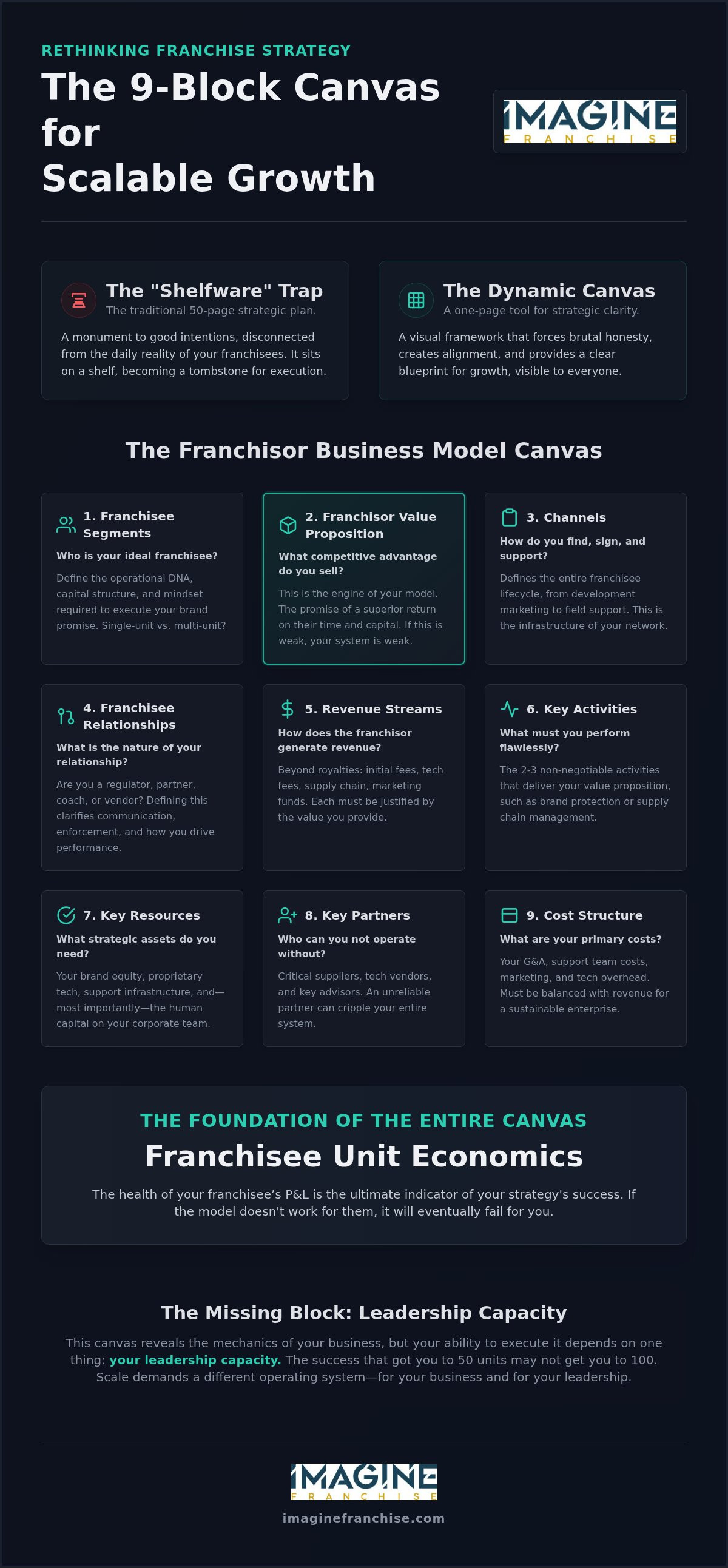
Forget the 50-page document. Your entire franchise strategy can—and should—fit on a single page. By adapting the classic Business Model Canvas by Alexander Osterwalder, we can create a powerful tool specifically for the unique franchisor-franchisee relationship. It’s not just a diagram; it's a diagnostic tool, a communication framework, and a blueprint for growth.
It forces you to answer the nine essential questions that define your business. Get these right, and you create alignment. Get them wrong, and you create chaos.
- Franchisee Segments: Who is your ideal franchisee? Not just who can write the check, but who has the operational DNA, the capital structure, and the mindset to execute your brand promise at the local level. Are you targeting single-unit owner-operators or multi-unit empire builders? The answer changes everything.
- Franchisor Value Proposition: What are you really selling to a franchisee? It’s not a business-in-a-box. It's a competitive advantage. This is the engine of your entire model—the promise of a superior return on their time and capital compared to going it alone. If this is weak, your system will be weak.
- Channels: How do you find, sign, train, and deliver ongoing support to your franchisees? This block defines the entire lifecycle, from franchise development marketing to the field support consultant who visits their location. It’s the infrastructure of your network.
- Franchisee Relationships: What is the nature of your relationship with your network? Are you a regulator, a partner, a coach, or a vendor? The tension between these roles is constant. Defining it clarifies how you communicate, enforce standards, and drive performance.
- Revenue Streams: How does the franchisor generate revenue? This goes beyond the obvious royalty stream. It includes initial franchise fees, technology fees, supply chain revenue, marketing funds, and transfer fees. Each stream must be justified by the value you provide.
- Key Activities: What are the most critical activities you must perform flawlessly to deliver your value proposition? This isn't a list of everything you do. It’s the 2-3 things that are non-negotiable, such as system development, brand protection, or supply chain management.
- Key Resources: What strategic assets do you need to execute your key activities? This includes your brand equity, proprietary technology, support infrastructure, and—most importantly—the human capital on your corporate team.
- Key Partners: Who are the strategic partners you cannot operate without? This includes critical suppliers, technology vendors, marketing agencies, and legal or financial advisors. An unreliable partner in this block can cripple your entire system.
- Cost Structure: What are the primary costs of running the franchisor entity? This includes your G&A, the cost of your support team, marketing expenditures, and technology overhead. This block must be in balance with your revenue streams to ensure the franchisor itself is a profitable, sustainable enterprise.
Underpinning this entire canvas is one critical metric: franchisee unit economics. The health of your franchisee’s P&L is the ultimate indicator of your strategy's success. If the model doesn't work for them, it will eventually fail for you.
Refining Your Franchisor Value Proposition: The Engine of Alignment
Of the nine blocks, the Value Proposition is the one that most CEOs get wrong. They mistake a list of services for a value proposition. They believe "more support" is always better.
Here’s a contrarian truth: more "support" often creates more franchisee dependence, not more growth. Value is not a 20-point list of services you provide. It is the tangible competitive advantage you deliver to the franchisee, enabling them to win in their local market. A weak value proposition is the root cause of compliance issues, royalty disputes, and a disengaged network.
Your C-suite must be able to articulate this value proposition in a single, high-conviction sentence. If they can't, you don't have an aligned leadership team.
Support vs. Empowerment in Your Strategy
Audit your activities. How many of your "support" services are low-value tasks that enable franchisee helplessness? Your strategy should focus on building systems that empower franchisee autonomy and profitability, not create a welfare state. This requires a leadership shift from playing "police officer" to becoming a "strategic architect"—designing a system so robust that it naturally produces the results you want.
The Brand Alignment Test
Does your canvas reflect the brand the end-customer experiences, or the one you sell to the franchisee? These are often two different things. Effective franchise strategic planning for CEOs must include a brutal reality check from the field. Your strategy document might be perfect, but if it doesn't align with the reality in a Tuesday afternoon rush, it's worthless. Remember, brand consistency is a byproduct of strategic clarity, not just thicker operations manuals.
Executing Your Franchise Scaling Strategy: From Canvas to Cash Flow
A completed canvas is not the goal. It’s the starting line. The objective is to translate this one-page strategy into network performance and increased cash flow. This requires a disciplined, rhythmic process of execution and review, not an annual "set it and forget it" exercise.
- Audit Your Current Canvas: Map your current business model against the 9 blocks. Be ruthlessly honest about how you've performed in each area over the last 12 months. Where are the cracks?
- Identify the Bottleneck Block: Find the single block that is holding back your growth. Is it a weak Value Proposition? Inefficient Channels? A broken Cost Structure? All your strategic energy should be focused here first.
- Align C-Suite KPIs: Your executive team’s key performance indicators must map directly to the 9 blocks. Your VP of Ops owns Key Activities. Your CMO owns Channels. Your CFO owns the financial blocks. This creates unambiguous accountability.
- Communicate to Franchisees: Translate the strategy for franchisees through the lens of their profitability. Don't show them the canvas. Show them how your focus on a specific block will help them make more money.
- Review and Pivot: Strategy is a quarterly conversation, not an annual event. The canvas is a living document. Review it every 90 days with your leadership team to track progress, call out failures, and adjust to new realities.
Bridging the Executive Execution Gap
Your C-suite team often works in functional silos, even with a "strategic plan" in place. The canvas demolishes those silos. It creates a common language for leadership meetings, forcing a holistic view of the business. The VP of Marketing can now see how their initiatives impact the Cost Structure, and the Head of Operations can see how their work directly delivers the Value Proposition. This shared context is the foundation of real accountability.
Strategic Offsites That Actually Work
Your annual offsite needs to move beyond trust falls and vague "visioning" exercises. Use the canvas to facilitate a hard-hitting operational analysis. Where is our model weakest? Which block will break if we add 50 more units? What is the most uncomfortable truth about our business right now?
The CEO’s role is to force these conversations and protect them from comfortable consensus. To do this effectively, you often need an external, peer-level perspective to challenge your assumptions and hold your team to a higher standard. Someone who has seen inside dozens of other franchise systems and knows where the skeletons are buried. For more on this, consider reading about how to select the right franchise CEO advisor.
Leadership Capacity: The Missing Block in Your Strategic Canvas
There’s an unofficial tenth block that isn’t on the page: your leadership capacity. The most brilliant strategy in the world is useless if the CEO and the C-suite lack the capacity to drive it through the organization. The plan is only as good as the leader's conviction and the team's ability to execute.
Strategic alignment doesn’t start on a whiteboard. It starts with the CEO's personal clarity and courage. The Franchisexcel© approach is built on this principle: we build the leadership muscle required to sustain the strategy. Before you can scale your network, you must first scale your leadership.
The CEO as the Strategic Anchor
There is a profound difference between "managing the system" and "leading the network." Managing is about preserving the status quo. Leading is about driving evolution. This requires a high degree of intellectual honesty to evaluate your own leadership and identify where you are the bottleneck. This is precisely the work we do in franchise CEO coaching—accelerating strategic execution by first elevating the leader's capacity.
Transforming Your C-Suite for Scale
As you grow, your executive team must evolve from a "founder-led" group of loyalists to a "strategy-led" team of accountable leaders. This is often the most painful transition a founder-CEO makes. It requires building the organizational capacity to handle rapid growth, which means having the right people in the right seats, all aligned around the same one-page plan.
Is your current strategy a dusty binder or a dynamic tool? Challenge your assumptions. Put your model to the test with a Franchisexcel© audit and build a strategy that actually drives results.
Frequently Asked Questions
What is a franchisor business model canvas?
It is a one-page strategic management tool that adapts the traditional Business Model Canvas to visualize the nine core components of a franchise system. It helps CEOs align their leadership team around a single, coherent strategy for scaling the network.
How does the franchisor canvas differ from the standard business model canvas?
The primary shift is in focus. The "customer" in the franchisor canvas is the franchisee. Blocks like "Customer Segments" become "Franchisee Segments," and "Customer Relationships" become "Franchisee Relationships," forcing a strategic focus on the health and profitability of the network operators.
Why do traditional strategic plans fail for franchise systems?
They fail because they are static documents created in a corporate vacuum. They lack the flexibility to adapt to market changes and are often disconnected from the operational reality of franchisees, leading to poor execution and a lack of buy-in from the network.
How often should a franchise CEO update their strategic canvas?
The canvas should be formally reviewed with the leadership team every quarter. Strategy is not an annual event; it's a continuous, iterative process of execution, learning, and adaptation.
Can the business model canvas help with franchisee compliance?
Yes, indirectly but powerfully. Compliance issues are often a symptom of a weak or poorly communicated Franchisor Value Proposition. When franchisees clearly understand and believe in the value you provide for their royalty dollars, they are far more likely to comply with system standards.
What is the most important block on the franchisor canvas?
The Franchisor Value Proposition. It is the heart of the entire model. If the promise you make to your franchisees isn't compelling, unique, and profitable for them, every other block in your canvas will eventually fail.
How do I introduce the canvas framework to my existing C-suite team?
Position it as a tool for clarity and action, not another bureaucratic exercise. Start with a workshop where you collectively map out your *current* business model on the canvas. This diagnostic step reveals misalignments and creates an immediate appetite for building a more coherent future-state canvas.
Should franchisees be involved in the strategic planning process?
No, not directly in creating the franchisor's canvas—that is the leadership team's responsibility. However, their reality, feedback, and unit-level economics are the most critical inputs into the process. Use your Franchise Advisory Council and field team to gather the "ground truth" that informs your strategy.

