


Your franchise network was built on a proven model. It worked. For years, you saw consistent growth, enthusiastic franchisees, and a brand that stood for something. Now, something is different. The momentum has stalled. Royalties are flat, franchisee calls are less about wins and more about frustrations, and the energy that once fueled your growth has been replaced by a quiet, grinding tension.
You tell yourself it’s the market. It’s a difficult economy. It’s a few disgruntled franchisees poisoning the well. But if you’re being honest, you know it’s something deeper.
The hard truth is that a struggling franchise network is almost never a franchisee problem. It isn’t a sign that your model is suddenly wrong. It’s a symptom of a leadership model that has reached its limit. The very thinking that got you to 50, 100, or 200 units is now the primary barrier to reaching 500.
This isn’t about finding a new marketing tactic or a better CRM. This is about confronting the fact that your network's performance is a direct reflection of your leadership capacity. And to fix the network, you must first be willing to transform the way you lead.
The Anatomy of a Struggling Franchise Network in 2026
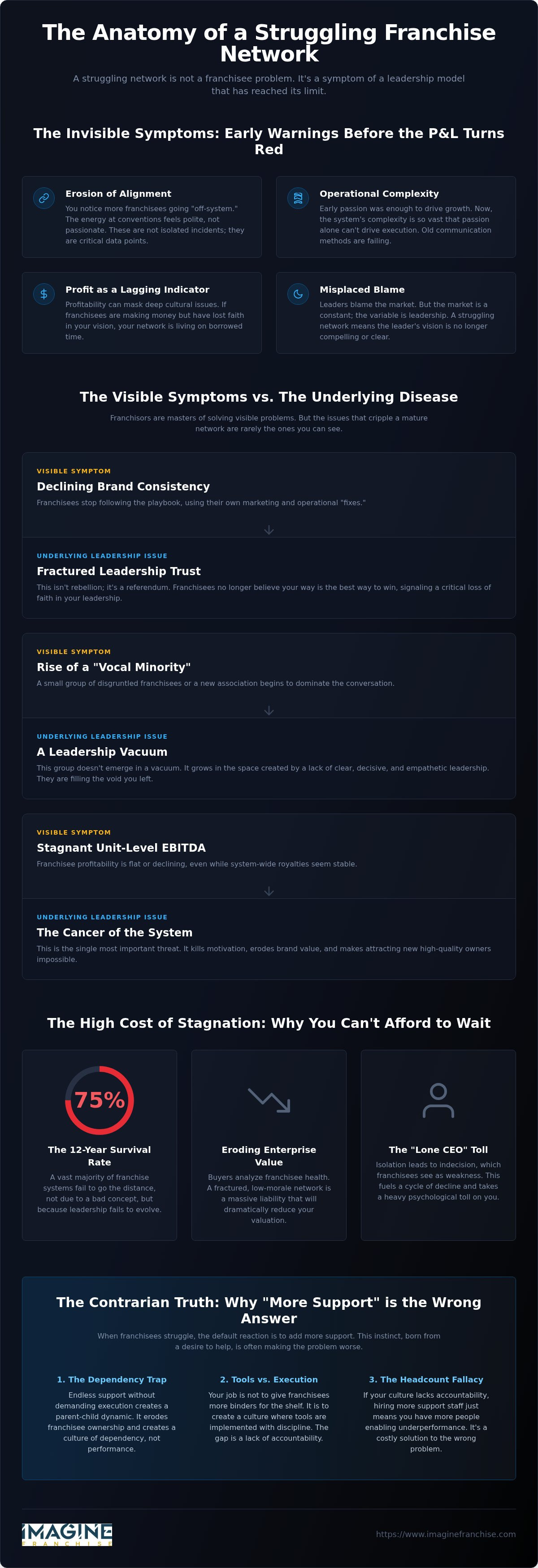
The most dangerous part of a struggling franchise network isn't the sudden drop in revenue; it's the slow, almost invisible erosion of alignment and conviction that happens long before the numbers turn red. You feel it in your gut before you see it on the P&L statement.
- Recognizing the 'invisible' symptoms of stagnation before the P&L reflects them. You notice more franchisees going "off-system" with their marketing or operations. The energy at the annual convention feels more polite than passionate. These are not isolated incidents; they are data points.
- The shift from the 'honeymoon period' to the 'brick wall' of operational complexity. Early on, your passion was enough. Now, the system has grown so complex that passion alone can’t drive execution. The old ways of communicating and managing are breaking down.
- Why profit alone is a lagging indicator of a healthy franchise system. Profitability can mask deep-seated cultural issues. If franchisees are making money but have lost faith in your leadership and vision, your network is living on borrowed time.
- Moving from blaming the 'market' to assessing leadership clarity and conviction. The market is a constant. The variable is leadership. A struggling network is a sign that the leader's vision is no longer clear, compelling, or consistently communicated enough to overcome external pressures.
The Visible Symptoms vs. The Underlying Disease
Franchisors are masters of solving visible problems. A dip in sales? Launch a promotion. A supply chain issue? Find a new vendor. But the issues that cripple a mature network are rarely the ones you can see.
- Declining brand consistency as a sign of fractured leadership trust. When franchisees stop following the playbook, they aren't being rebellious. They are signaling a loss of faith. They no longer believe that your way is the best way to win, and this is a direct referendum on their trust in your leadership.
- The rise of the 'vocal minority' and franchisee associations. A vocal minority doesn't emerge in a vacuum. It grows in the space created by a lack of clear, decisive, and empathetic leadership. They aren't the problem; they are the symptom of a leadership vacuum they have decided to fill themselves.
- Why stagnant unit-level EBITDA is your network's biggest threat. Stagnant franchisee profitability is the cancer of a franchise system. It kills motivation, erodes the value of your brand, and makes it impossible to attract high-quality new owners. It is the single most important metric for the long-term health of your network.
The Cost of Stagnation: Why You Can't Afford to Wait
The temptation is to wait it out. To hope the market turns or the problem franchisees sell their locations. But stagnation isn’t a phase; it’s a terminal condition if left untreated.
- The 12-year survival rate: Why 75% of franchisors fail to go the distance. Research highlighted by institutions like MIT Sloan has pointed to a sobering reality: a vast majority of franchise systems don't survive long-term. They don't fail because of a bad concept, but because their leadership fails to evolve ahead of the network's complexity.
- How a struggling network erodes your enterprise value for a future exit. Potential buyers don't just look at your revenue; they analyze the health of your franchisee relationships, the consistency of your operations, and the clarity of your vision. A fractured, low-morale network is a massive liability that will dramatically reduce your valuation.
- The psychological toll of the 'Lone CEO' problem on decision-making. As the network struggles, the weight on your shoulders grows. You feel isolated, second-guessing decisions you once made with confidence. This isolation leads to indecision, which franchisees interpret as weakness, further fueling the cycle of decline.
Why 'More Support' Is Often the Wrong Answer
When franchisees are struggling, the default franchisor reaction is to add more support. More field consultants, more training, more marketing materials. But what if this instinct, born from a desire to help, is actually making the problem worse?
- Defining the 'Dependency Trap': When support replaces franchisee accountability. Providing endless support without demanding execution creates a parent-child dynamic. Franchisees learn that if they complain enough, corporate will solve the problem for them. This erodes their ownership mentality and creates a culture of dependency, not performance.
- The difference between providing tools and ensuring execution. Your job is not to give franchisees more binders to put on a shelf. It is to create a culture where the tools are implemented with discipline. The gap is rarely a lack of resources; it's a lack of accountability.
- Why adding headcount to your support team rarely fixes a broken culture. If your culture lacks accountability, hiring more support staff just means you have more people enabling underperformance. It's a costly solution to the wrong problem.
- Reframing the franchisor-franchisee relationship from 'parent-child' to 'peer-to-peer'. Successful franchisees are business partners. They don’t need a parent; they need a leader who sets a clear standard, provides the strategy to win, and holds them accountable for their part of the bargain.
Support vs. Accountability: The Strategic Divide
The tension between support and accountability is where most franchise leaders get stuck. You want to be liked, to be seen as the "good guy," but your primary responsibility is to protect the health and integrity of the entire system.
- Why franchisees stop following the system despite having the manuals. They stop following the system when they stop believing in the person who wrote it. Compliance is a byproduct of conviction. If they aren't convinced by your vision and your strategy, no manual will ever be thick enough.
- The danger of 'over-servicing' your bottom-performing franchisees. A shocking amount of a franchisor's resources are often consumed by the bottom 10% of performers. This starves your top performers of the strategic attention they need to grow and sends a clear message to the network: the squeaky wheel gets the grease, not the high-performer.
- The 'Accountability Gap' in modern franchising is the chasm between what the franchisor provides and what the franchisee is required to execute in return.
The Myth of the 'Proven Model'
Your model was proven—for a 10-unit network. Or a 50-unit network. The mistake is believing that the same model, the same leadership style, and the same assumptions will work at 100 or 500 units. The laws of physics change as you scale.
- Why a model that worked at 10 units fails at 100. At 10 units, you can manage through personal relationships. At 100, you must lead through systems, processes, and a deeply embedded culture. What was once an asset—your personal touch—becomes a bottleneck.
- The evolution of the 'Value Proposition' as the network scales. Early franchisees signed on because of you. The 100th franchisee signs on because of the system's economic model and brand power. Your value proposition must evolve from personal charisma to systemic excellence.
- Alignment: The CEO's primary job in a complex system. In a mature network, your most important job is no longer operations or marketing. It is creating, maintaining, and relentlessly reinforcing strategic alignment across the entire organization—from your C-suite to the frontline employee at a franchisee's location.
The Leadership Plateau: Your Success Is Your Barrier
Here is the most difficult truth for any successful founder or CEO to accept: the skills and mindset that built the company are now limiting its growth. You have become the bottleneck. Your success has created a leadership plateau, and the entire network is stuck on it with you.
- Understanding that what got you here won't get you there. The hard-charging, do-it-all mentality of a startup founder becomes a liability in a large network. You must evolve from being the chief problem-solver to the chief architect of a system that solves its own problems.
- The 'CEO Capacity' ceiling: How your leadership style limits network growth. Every organization's growth is ultimately capped by the capacity of its leader. If you have not invested in your own strategic thinking, communication, and leadership skills, you have inadvertently set a ceiling on your network's potential.
- Confronting the V.U.C.A. reality: Volatility, Uncertainty, Complexity, Ambiguity. The world is more complex than ever. A command-and-control leadership style is too slow and brittle to survive. You need to build an organization that is resilient, agile, and aligned—and that starts with your own leadership approach.
- Why 100% responsibility is the only path to a turnaround. The moment you stop blaming franchisees, the market, or your team, you reclaim your power to change the situation. The turnaround of a struggling franchise network begins when the CEO accepts 100% responsibility for the current reality.
Character, Commitment, and Compassion in Leadership
A turnaround isn't just about strategy; it's about rebuilding trust. And trust is built on the character of the leader. In my book, For Franchise Leaders Eyes Only, I detail how the most effective leaders embody specific traits that create followership.
- The five C's of franchise leadership: Character, Commitment, Compassion, Consistency, Contribution. These are not soft skills. They are the foundational elements of a leader who can inspire belief and drive execution across a distributed network of independent owners.
- Why trust is a driver of execution, not a 'soft' HR metric. Trust is a performance multiplier. When franchisees trust your intentions and your competence, they execute with speed and precision. When they don't, they hesitate, question, and customize, creating drag on the entire system.
- Evaluating your C-suite team's alignment with your vision. It’s not just about your leadership. Does your executive team speak with one voice? Are they fully aligned with the vision and the non-negotiable standards you've set? Any crack in the leadership team's alignment will become a chasm at the franchisee level.
The Formula for Success
Growth is not an accident. It's the result of a deliberate formula that high-performance leadership teams apply with discipline. We call it the Formula for Success, and it governs the results of every organization.
- Applying % Faith × % Focus × % Effort = % Success to your leadership team. Your network's success is a product of these three variables. Faith is the belief in the vision. Focus is the clarity of the strategic plan. Effort is the quality of execution. A weakness in any one of these areas cripples the final result.
- Identifying where 'Focus' is leaking in your strategic planning. Most leadership teams are not suffering from a lack of effort. They are suffering from a lack of focus. They are chasing too many priorities, creating confusion and diluted results. The key is to do less, but better.
- Internal Link: The journey to elevate your leadership capacity and apply this formula effectively often requires a dedicated guide. Learn more about how to start that process with Franchise CEO Coaching: Unlocking Your Leadership Potential.
A Strategic Framework for a Network Turnaround
Pulling a struggling franchise network out of a nosedive requires more than a pep talk. It requires a structured, disciplined system for transforming the way the entire organization thinks, communicates, and executes. It requires a shift from fragmented efforts to unified action.
- Introducing the Franchisexcel© six-stage system for leadership transformation. This isn't a collection of tips; it's a proven methodology for rewiring the leadership operating system of a franchise network, moving from the top down.
- Moving from clarity of action to collective unity across the network. The goal is to get the entire network—from the executive team to every franchisee—rowing in the same direction with conviction and purpose.
- How to implement the Franchise Performance 360© assessment. You cannot fix what you do not measure. This proprietary tool provides an unvarnished, 360-degree view of your network's health, identifying the specific gaps in leadership, alignment, and execution that are holding you back.
- Restoring business discipline and accountability at the unit level. A turnaround is cemented when new standards of performance are not just introduced, but enforced with consistency and fairness. This is about re-establishing the operational excellence that made the brand successful in the first place.
Stage 1: Clarity and Structured Leadership
The first step is always to stop the chaos. This means creating absolute clarity at the leadership level about where the network is going and what it will take to get there.
- Defining the 'One Truth' for the network's future. The leadership team must agree on and commit to a single, powerful vision for the future. This "One Truth" becomes the north star for every decision, communication, and action that follows.
- Aligning the C-suite on non-negotiable performance metrics. What are the 3-5 metrics that truly define success for your network? The leadership team must be ruthlessly aligned on these metrics and how they will be measured and reported.
- Pruning the strategy: Why doing less leads to achieving more. A turnaround strategy is defined more by what you stop doing than what you start. This stage involves eliminating the distracting initiatives and "sacred cows" that are draining resources and focus. Need help with this? Consider using a framework like The Franchisor Business Model Canvas.
Stage 2: Rebuilding Trust and Magnetism
With clarity established, the work of rebuilding the human element begins. This is about translating the new vision into a message that resonates with the hearts and minds of your franchisees.
- How to win back the hearts and minds of your franchisees. This requires vulnerability, honesty, and a clear plan. It means acknowledging past missteps and demonstrating through consistent action that the future will be different.
- The 'Magnetism' factor: Attracting the right talent by being the right leader. A-player franchisees and executives are not attracted to chaos. They are drawn to clarity, conviction, and a culture of excellence. As you transform your leadership, you will naturally begin to attract and retain the right people.
- Accountability as an act of respect, not a punishment. Holding people to high standards is one of the greatest forms of respect. It communicates that you believe in their potential and are committed to helping them achieve it. This reframes accountability from a negative consequence to a positive catalyst for growth.
Executing the Shift: From Struggling to Thriving
A plan is not enough. The difference between a network that stays stuck and one that achieves exponential growth is the discipline of execution. This is where a proven system and an experienced guide become invaluable.
- The power of a proven growth leadership system like Franchisexcel©. You don't have time for trial and error. A proven system accelerates your learning curve and provides the tools, frameworks, and accountability to ensure the transformation sticks.
- Why peer advisory groups are essential for the modern franchise CEO. The "Lone CEO" problem is real. Surrounding yourself with a confidential group of non-competing franchise leaders provides the perspective, challenge, and support necessary to navigate complex decisions.
- Setting the 3-to-5-year horizon for exponential results. A turnaround doesn't happen in a quarter. It's a sustained effort. But with the right system and leadership, you can achieve a 3-to-5-year transformation that fundamentally changes the trajectory of your business.
- Your next move: Clarity, conviction, and the courage to lead. The path forward requires you to choose. You can continue with the status quo, or you can make the courageous decision to lead in a new way.
The Role of Executive Coaching in Turnarounds
You can't see the picture when you're inside the frame. Even the most talented and successful CEOs have blind spots. The right executive coach or advisor doesn't give you the answers; they provide a strategic mirror, helping you see your own leadership and your business with a new level of clarity.
- Why even the most successful CEOs need a strategic mirror. An external perspective is critical for challenging your assumptions, identifying limiting beliefs, and holding you accountable to your highest potential. For a deeper look at this, explore our guide on selecting the right franchise CEO advisor.
- The Franchisexcel© methodology: Delivering 3-to-10-fold growth. Our work with clients like Choice Hotels Canada and The UPS Store Canada isn't theoretical. It's a track record of implementing this system to produce measurable, transformational results in network performance and enterprise value.
Shape Your Network’s Future
The future of your franchise network will be determined in the next 90 days. Not by what the market does, but by the decisions you make. The Formula for Success—Faith, Focus, and Effort—is waiting to be applied.
- The 'Formula for Success' applied to your next 90 days. What is the one strategic priority you can commit to with unwavering focus? How will you build faith in that vision with your team and your franchisees? What disciplined effort is required to ensure execution?
- A final call to action: Lead with clarity or accept the decline. There is no middle ground. The choice is stark, but it is yours. A thriving, aligned, and profitable network is possible, but it requires a new level of leadership. Your leadership.
- CTA: Shape Your Network’s Future With A Proven Growth Leadership System.

