


Headquarters sends an email on Monday: every location must switch to the new scheduling procedure by the first of the month. The open rate is 78 percent. On the second, you check, and about a third of your franchisees did it, a third did it their own way, and a third never touched it. Your team plans a reminder. Before you send it, ask the question that matters: Was the decision clear, did franchisees understand why it mattered, and did anyone check whether it happened?
If you have to keep repeating the same message to your franchisees, your problem may not be communication. It may be leadership. A franchise communication plan is not a message calendar. It is how you get a decision understood and carried out, and that is a different job from sending it.
People don't act on a decision for different reasons: the decision was poor, the timing was bad, nobody trained them, they disagree, or they simply refuse. Reminders fix none of those. Below is how I would build franchisor communication that finds out which one you have.
Key Takeaways
- Repeating a message is a signal to examine the decision, not to send another reminder.
- Franchisees are business owners. They act when they see the reason and the impact on their sales and margins.
- Every decision needs one owner, one next step, and proof that it happened.
- Use the franchise communication plan template below, then run the 10-minute check with three franchisees.
More Communication Won't Fix Unclear Leadership.
When a decision keeps getting missed, CEOs tend to reach for more email, more webinars, more reminders. But if your own team can't say in one sentence what the decision is and why you made it, no amount of franchisee communication will carry it. Unclear in, unclear out.
Look inside headquarters first. Do two departments give franchisees conflicting priorities in the same week? Does a decision pass through three approvals and reach the field team only after franchisees have already seen it? Do your field consultants hear about changes first, so they can answer the phone? And be honest about the difference between “we told them” and “they did it.” Only the second one counts.
Your Franchisees Aren't Employees Waiting for Instructions.
An employee can be told to change a procedure. A franchisee owns the business, signs the payroll, and watches the margin. They will ask what the change does to their labor cost, their sales, and their week. If your message doesn't answer that, they will decide for themselves.
That is why non-compliance has several possible causes: a poor decision, bad timing (say, a new procedure during peak season), no training, honest disagreement, or flat refusal. Each needs a different response. Fix the decision, move the date, train, listen, or hold the line. Resending the email does none of these.
A Read Receipt Is Not Execution.
Open rates tell you the email was seen. They don't tell you whether a location changed its schedule, updated its pricing, or met the brand standard. Measure what the decision was supposed to change, and ask for proof you can check.
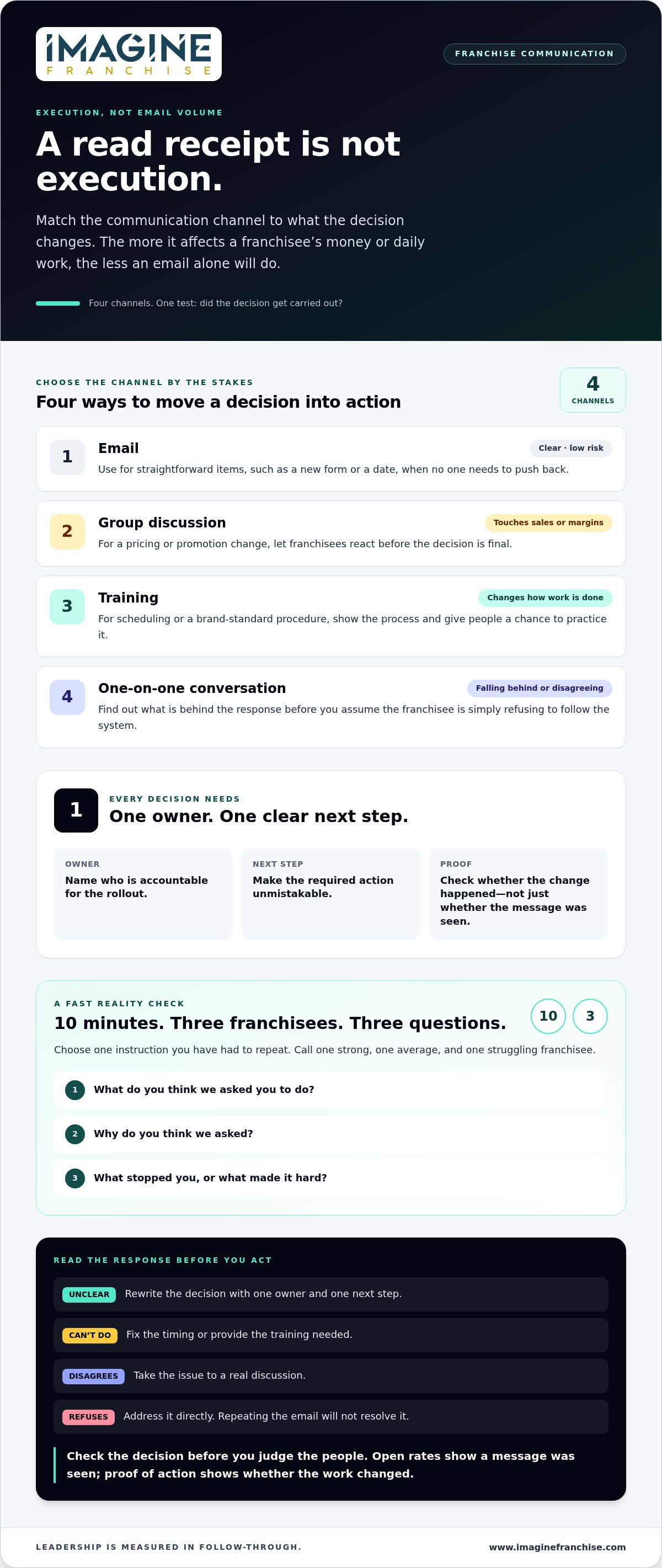
- Email: clear, low-risk items, such as a new form or a date. Fine when no one needs to push back.
- Group discussion: anything that moves franchisee margins or sales, like a pricing or promotion change. Let people react before it is final.
- Training: anything that changes how work is done, such as scheduling or a brand-standard procedure. Show it, practice it.
- One-on-one conversation: a franchisee who is falling behind or disagreeing. Find out why before you assume anything.
Pick the channel by what is at stake
The more a decision touches a franchisee's money or daily routine, the less an email alone will do. Use the higher-touch channel when the stakes are higher.
One Decision. One Owner. One Clear Next Step.
Here is a franchise communication plan template, one you can fill out on your phone in five minutes. One page per decision. If you can't complete a field, the decision isn't ready to send.
Example: a new scheduling procedure for a network of about 100 locations (hypothetical).
| Field | Completed example |
|---|---|
| Decision | All locations use the new weekly scheduling procedure. |
| Business reason | Overtime is eating margin, and peak hours are understaffed. |
| Audience | Franchisees and general managers. |
| Mandatory or information only | Mandatory: submit the first schedule using the new format. Information only: the reasoning behind it. |
| Owner | VP of Operations. |
| Channel | Live training session, then a short email with the steps. |
| Deadline | First schedule due the 1st; training held by the 15th of the month before. |
| Contact person | Your assigned field consultant. |
| Proof of action | Field consultant confirms the schedule was submitted by the 3rd. |
Scenario one: the same rollout, two ways
Version one: a 60-location franchisor emails a new opening procedure with a start date. Nobody owns questions, the field team learns of it the same day, and no one checks. Six weeks later, half the locations still do it the old way. Version two: the COO owns it, field consultants are briefed a week ahead, a short training walks through the steps, and each consultant confirms every location is using it by the deadline. The procedure didn't change. The ownership and the follow-up did.
The fix is not harder enforcement. It is naming one person, giving one clear step, and checking the result.
Scenario two: ask before you announce
A 150-location franchisor plans a required equipment upgrade. Before announcing anything, the CEO validates the change and its budget and pre-tests both with the field, so the plan reaches the network already proven. The CEO calls five franchisees and asks what the upgrade would cost them and what it would do to their daily operations. The real question is how to make sure the entire network adopts the change, so the CEO also tests the timing, the messaging, and the rollout strategy with them.
Two point out that the install would close them during their busiest weeks, and one has a cheaper supplier. The company moves the deadline, offers an install window, and approves the supplier. The rollout goes out already fixed, and nobody has to be chased.
Stop Blaming Franchisees Before Examining the Decision.
When a decision stalls, the easy story is that franchisees won't follow the system. Sometimes that is true, and it needs a direct conversation. Often, though, the decision was unclear, badly timed, or never explained. Check the decision before you judge the people. I wrote more on this in why franchisees don't follow the system.
The 10-Minute Communication Reality Check.
Pick one instruction you have had to repeat. Then call three franchisees, one strong, one average, one struggling, and ask:
- What do you think we asked you to do?
- Why do you think we asked?
- What stopped you, or what made it hard?
If their answers differ from what you meant, the decision was unclear: rewrite it with one owner and one next step. If they understood but couldn't do it, fix the timing or the training. If they understood and disagree, take it to a real discussion. If they understood, could do it, and still refuse, that is a one-on-one conversation for you.
Start With One Decision
Don't rebuild everything. Take your next decision, fill out the template, and ask for proof it happened.
If you want a second set of eyes on the leadership side, I'm glad to talk it through.
Frequently Asked Questions
What should a franchise communication plan include?
The decision, the business reason, the audience, what is mandatory versus information only, the owner, the channel, the deadline, a contact person, and proof of action.
Does franchisee communication need a different approach than employee communication?
Yes. Franchisees run their own businesses, so they need the reason and the effect on their numbers, and a chance to raise problems before the decision is final.
How often should a franchise communication plan be reviewed?
Review it after any decision that needed repeating, and whenever a deadline passes with weak results.
We're sending plenty of messages. Now I know how to find out why people aren't acting on them.

