


As a franchise leader, you spend your days focused on the hard numbers: royalty streams, unit-level economics, EBITDA, and enterprise value. You have a proven model, a comprehensive operations manual, and a support team dedicated to franchisee success. Yet, you feel like you’re pushing a rope. Inconsistent execution plagues your network, franchisees drift from the system, and the alignment you fought so hard to build is eroding.
The problem isn’t your business model. It’s your culture.
Most franchisors dismiss culture as a “soft” asset—a vague concept of happiness and community that’s nice to have but impossible to measure. They are dangerously wrong. Your franchise network culture is not your softest asset; it is the operating system that drives every financial metric you care about. It is either your single greatest driver of profitable growth or the invisible liability bleeding your network of its potential.
The disconnect between your strategic goals and your network’s daily execution is a cultural failure. And it’s a failure that begins in the C-suite. It’s time to stop mistaking harmony for health and learn to build a high-performance culture that creates conviction, drives discipline, and turns your network into a force for scalable growth.
The Happiness Myth: Why a "Nice" Culture Is Killing Your Growth
Let’s start by dismantling a dangerous misconception. Franchise network culture is not about how much your franchisees like you. It’s not about holiday parties, friendly emails, or a conflict-free relationship with your support team. Those things are pleasant, but they are not the engine of performance.
Too many franchisors fall into the trap of cultivating “artificial harmony.” They avoid difficult conversations and prioritize being liked over being effective. This “nice” culture feels good in the short term, but it breeds complacency and fosters the “good enough” mindset that quietly suffocates growth. When franchisees are comfortable, they stop striving. When your team is focused on avoiding friction, they stop demanding excellence.
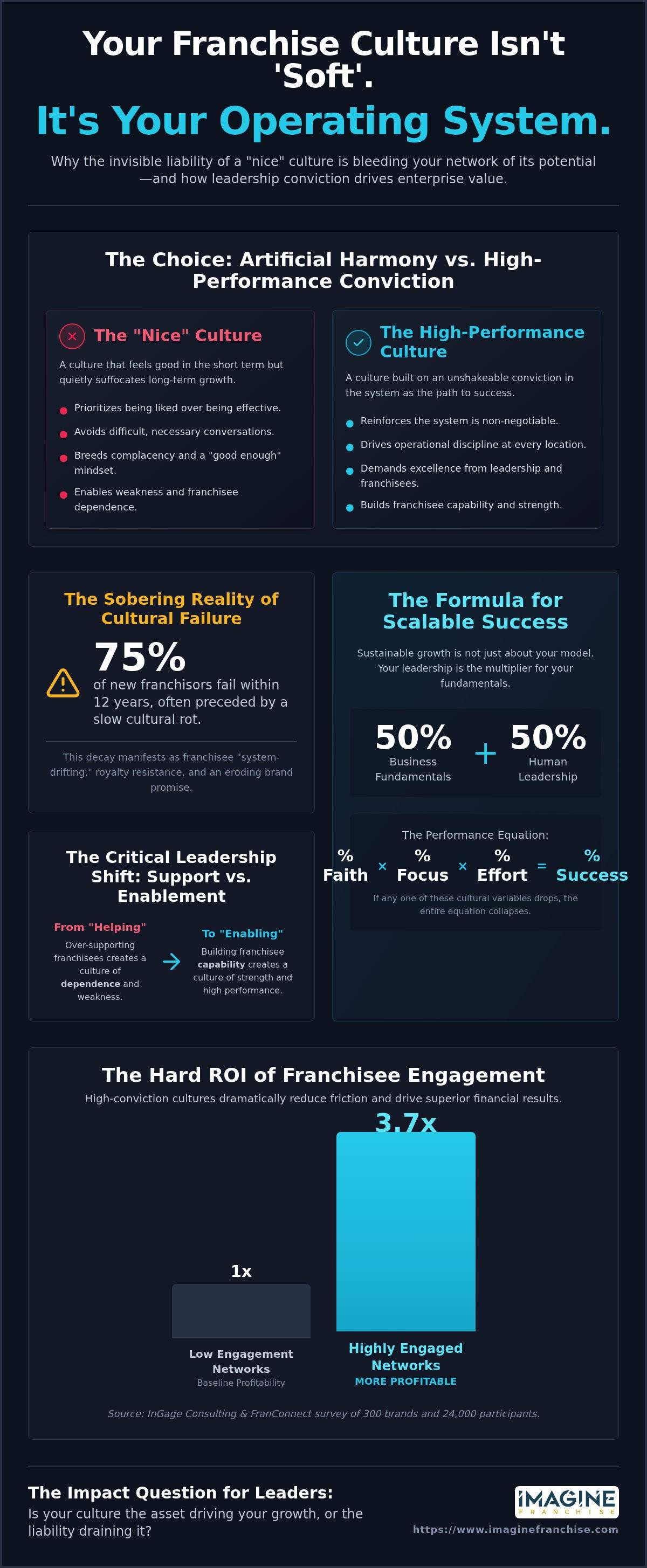
The real definition of a high-performance franchise culture is this: It is the shared, unshakeable conviction that following the system is the only path to collective and individual success. Culture isn’t a feeling; it is the operational discipline of a network, born from leadership clarity and reinforced by every decision you make.
When "Support" Becomes a Crutch
One of the first places a well-intentioned culture turns toxic is in the support department. You built a team to help franchisees succeed, but when does that help become a crutch? Over-supporting your owners—rushing to solve every problem for them, answering the same questions repeatedly, and shielding them from the consequences of their own inaction—creates a culture of dependence. It trains them to look outward for solutions instead of mastering the system you built for them.
The critical leadership shift is moving from “helping” to “enabling.” A great support team doesn’t just provide answers; it builds franchisee capability. It enables high performance by coaching, challenging, and holding owners accountable to the model. The moment your support team becomes an excuse for franchisee underperformance—"I was waiting for a call back from corporate"—is the moment you know your culture is enabling weakness, not building strength.
The High Cost of Cultural Misalignment
When your culture lacks the conviction that the system is paramount, the financial consequences are severe. According to MIT Sloan Management Review, a staggering 75% of new franchisors disappear within 12 years. While market forces play a role, many of these failures are preceded by a slow cultural rot.
This decay manifests as “system-drifting,” where franchisees cherry-pick parts of the model they like and discard the rest. It shows up as royalty resistance, where owners begin to see their fees as a cost rather than an investment in a shared system. This isn't because they are "difficult people"; it's because leadership has failed to cultivate a culture where the value of the system is non-negotiable. Ultimately, franchise culture is the operational discipline that protects your brand promise at every single location.
The 50/50 Formula: Why Leadership Conviction Dictates EBITDA
At Imagine Franchise, our central thesis is that sustainable franchise success is governed by a simple formula: it’s 50% business fundamentals and 50% human leadership. You can have a perfect business model—flawless products, optimized supply chains, and brilliant marketing—but it will fail to scale in a low-trust, low-conviction environment. Your leadership is the multiplier for your fundamentals.
We see this in our “Formula for Success”: % Faith × % Focus × % Effort = % Success. If any one of these variables, all of which are driven by culture, drops to zero, the entire equation collapses. A franchisee who has lost faith in the system will not apply focused effort, and results will inevitably suffer. This isn’t a soft metric; it’s the mathematical reality that links the health of your culture directly to your enterprise value and ability to scale.
The ROI of Franchisee Engagement
If you still believe culture is a soft topic, the hard data says otherwise. A landmark study by InGage Consulting and FranConnect, surveying 300 brands and 24,000 participants, found that franchise networks with highly engaged franchisees are 3.7 times more profitable than those with low engagement. This isn't a minor correlation; it's a massive performance gap.
Why? Because a culture of high trust and engagement dramatically reduces the “friction tax” on every initiative you launch. When franchisees believe in your leadership and the direction of the brand, new technology is adopted faster, marketing campaigns are executed with enthusiasm, and operational changes are implemented smoothly. Furthermore, your most engaged franchisees become your most powerful and credible recruitment tool, lowering your cost of acquisition and attracting higher-caliber candidates.
Leadership as the Primary Growth Lever
As a founder or CEO, you must transition from “managing” a collection of small businesses to “leading” a network of independent, invested owners. This requires a profound shift in mindset and skill. Your role is to set the cultural baseline—the non-negotiable standards of performance and belief that define your network. At Imagine Franchise, we use our proprietary BRAVE Model™ to guide this process, but the principle is universal: your network will never grow faster or stronger than your own leadership capacity.
If you are frustrated with your network’s execution, the first place to look is in the mirror. Your franchisees’ behavior is a direct reflection of the clarity, conviction, and consistency of your leadership. Read more about this critical dynamic in our guide, Why Your Franchise Growth Strategy is Failing: The Leadership Capacity Gap.
Compliance vs. Commitment: Why Your Manual Cannot Buy Alignment
Many franchisors operate under the “Manual Fallacy”—the belief that a comprehensive set of rules will automatically create the results they desire. They invest thousands of hours and dollars into creating the perfect Franchise Operations Manual, only to find themselves policing compliance and battling franchisees who view the system as a set of restrictive rules rather than a blueprint for success.
Here’s the hard truth: franchisees follow the system when they believe in the brand, not when they fear the audit. Compliance is temporary and transactional. It’s what people do when you’re watching. Commitment, on the other hand, is durable and emotional. It’s what people do because they are bought into the mission. The strategic shift for a scaling franchisor is to stop policing compliance and start inspiring commitment. When you succeed, “Operational Excellence” ceases to be a chore and becomes a shared growth strategy.
The Limits of Command and Control
A top-down, command-and-control leadership style might work when you have 10 or 20 units. The founder’s passion can carry the day. But once you pass the 50-unit mark, that model breaks. You cannot be everywhere at once. Your culture must transition from being “Founder-led” to “System-led.”
This is where your field support team becomes critical. Are they culture ambassadors or are they auditors? If their primary function is to show up with a checklist and point out flaws, you are reinforcing a culture of compliance. If, however, they are trained to coach, to connect operational tasks back to the brand’s “why,” and to build the business acumen of each franchisee, they become powerful agents of a commitment-based culture.
Commitment as a Competitive Advantage
Building a culture where the “why” is as clear as the “how” is your ultimate competitive advantage. This requires a deep understanding of your network’s current state. Tools like our Franchise Performance 360© assessment are designed to measure the true level of commitment and alignment, giving you a clear-eyed view of the gap between your vision and the reality on the ground.
When you build this level of strategic alignment, you create a network that is more agile, more resilient, and more profitable. To put it in a single sentence: compliance has the shelf-life of an audit report, while conviction has the longevity of a shared legacy. For a deeper dive into this crucial distinction, see our article on Franchise Network Alignment: Why Compliance Is the Enemy of Conviction.
The Capacity Bottleneck: Diagnosing Leadership Failures in Scaling Networks
For many franchisors, your past success is the biggest threat to your future culture. The strategies and leadership style that got you to 50 units are often the very things that will prevent you from reaching 250. As the network grows, complexity increases, and the C-suite can lose touch with the front lines. We call this “Leadership Drift.”
Are you experiencing it? Here are five signs your own leadership capacity is becoming the bottleneck stifling your network’s culture and growth:
- You find yourself solving the same problems over and over again.
- You blame franchisee performance on their "bad attitude" or lack of motivation.
- Your leadership team meetings focus more on fighting fires than on strategic growth.
- You feel increasingly isolated and believe no one understands the pressure you’re under.
- Your vision for the future feels inspiring to you, but it isn’t translating into action in the field.
These are symptoms of a leadership team operating in a state of V.U.C.A. (Volatility, Uncertainty, Complexity, Ambiguity) without a clear framework to restore clarity and alignment.
The Lone CEO Problem
Franchise CEOs often plateau because they lack a trusted peer advisory group or executive coach who understands the unique challenges of the franchise model. You are surrounded by employees, suppliers, and franchisees, but true strategic partners are rare. This isolation leads to echo chambers where your own assumptions go unchallenged and your leadership development stagnates.
Investing in Executive Leadership Development isn’t a luxury; it’s a prerequisite for scaling a healthy culture. You cannot expect your network to evolve if your own leadership approach remains static. A coach or advisor provides the external perspective and accountability needed to break through performance ceilings. If you feel like you're leading alone, it may be time to explore how targeted guidance can help. Learn more in our post, Your Guide to Selecting the Right Franchise CEO Advisor.
The BRAVE Method™ for Cultural Realignment
Changing an established culture is not about a single motivational speech or a new incentive program. It requires a systematic, disciplined approach. Our proprietary BRAVE Coaching Method™ (Baseline, Realignment, Activation, Validation, Execution) provides a roadmap for this journey. The first three steps are foundational:
- Baseline: Start with a brutally honest assessment of where your culture actually stands today, not where you wish it were. Use tools and candid conversations to get an objective measure of trust, conviction, and alignment.
- Realignment: Clearly define the high-performance culture you need to achieve your strategic goals. Identify the specific leadership behaviors, communication rhythms, and accountability structures required to close the gap between your vision and the network’s current reality.
- Activation: Develop a concrete action plan to move the network from passive agreement to active engagement. This involves equipping your leadership team and field consultants with the tools and skills to lead the cultural shift on the ground.
Scaling Smarter: Moving from Brand Recognition to Network Magnetism
The ultimate goal of building a high-performance culture is to create what we call “Network Magnetism.” This is the state where your culture is so strong, your vision so clear, and the success of your franchisees so evident that your network automatically attracts and retains high-performing owners. You spend less time selling and more time selecting the right partners.
This is the outcome we drive with the Franchisexcel© Growth Leadership System, a framework designed to help established networks triple, quintuple, or even tenfold their results in three to five years. It’s not about growing heavier with more units; it’s about growing stronger with more alignment, agility, and unity. This becomes your network’s true unfair advantage. We saw this firsthand with clients like Poulet Rouge, who leveraged this focus on alignment to grow from approximately 20 to 100 units in under three years.
Your Next Leadership Move
Your franchise network culture is already producing a result. The question is whether it’s the result you want. As you look toward the future, don’t ask if your franchisees are on board. Ask the more important impact question: Is my current culture capable of supporting our 5-year growth goal?
If the answer is no, or even if you’re unsure, the responsibility for change rests with you. Leading a cultural transformation is the most challenging and most rewarding work a franchise CEO can undertake. A guided journey, like our Franchise Leadership Catalyst™ program, can provide the structure and support to ensure that transformation is successful and sustainable.
Your culture can be a powerful financial asset that multiplies the value of your brand, or it can be a silent liability that erodes it from the inside out. The choice is yours.
Lead Boldly. Scale Smarter. Book a consultation with Stéphane Breault today.
Frequently Asked Questions About Franchise Network Culture
How do you fix a toxic franchise network culture?
Fixing a toxic culture begins with leadership accountability, not franchisee blame. It requires a systematic process: 1) A brutal, honest assessment (Baseline) of the current reality. 2) A clear redefinition of the desired culture, linked to performance (Realignment). 3) A disciplined execution plan (Activation) led from the C-suite down, where leaders model the desired behaviors relentlessly. It is not a quick fix; it is a strategic turnaround of the human dimension of your business.
What is the difference between franchise brand and franchise culture?
Your brand is your promise to the customer. Your culture is your ability to deliver on that promise consistently across every single location. Brand is the external perception; culture is the internal operational discipline. A strong brand with a weak culture will eventually break, as inconsistent execution will damage the brand promise you worked so hard to build.
Why do franchisees stop following the system as the network grows?
Franchisees drift from the system for two primary reasons, both rooted in leadership. First, the franchisor's vision and the "why" behind the system have become diluted or unclear. Second, the culture has shifted from one of commitment to one of compliance, where the system is seen as a set of rules to be skirted rather than a path to success to be embraced. It is almost always a symptom of a leadership and culture gap, not a "bad franchisee" problem.
How much does network culture impact the resale value of a franchise system?
Immensely. Sophisticated buyers and private equity firms look beyond the P&L. They conduct due diligence on the health of the franchisor-franchisee relationship, franchisee validation call scores, and rates of system adoption. A network with a toxic, low-trust culture is a significant liability, as it signals high operational friction, potential litigation risk, and difficulty in executing future growth initiatives. A strong culture is a key indicator of a sustainable, scalable business and directly increases enterprise value.
Can a franchisor change the culture of an established network?
Yes, but it is the most difficult work a leader can do. It cannot be delegated to HR or the support team. The CEO and senior leadership must lead the charge with unwavering conviction and consistency. It requires a clear vision, a structured plan, and the courage to make difficult decisions—including potentially parting ways with those who are unwilling to align with the new cultural standards. It is a long-term commitment, not a short-term project.
Is franchise culture the responsibility of the CEO or the field support team?
It is the responsibility of both, but it starts with the CEO. The CEO sets the vision, the standards, and the non-negotiables for the culture. The field support team is then responsible for translating that vision into action on the front lines. If the CEO is not clear and consistent, the field team cannot succeed. They are ambassadors of the culture, but the CEO is its architect.
How do you measure the ROI of investing in franchise culture?
You measure it through hard business metrics. Look for improvements in: franchisee profitability (the 3.7x metric is a key benchmark), speed of new initiative adoption, reduction in support calls for recurring issues, lower franchisee turnover, higher validation scores during the sales process, and ultimately, faster and more predictable system-wide revenue growth. Culture is not an expense; it is an investment in the operational efficiency of your entire network.
What are the red flags of a failing franchise culture?
The red flags include: an "us vs. them" mentality between franchisees and corporate, the formation of dissident franchisee associations, resistance to new technology or brand initiatives, high turnover of both franchisees and corporate support staff, and a growing number of franchisees who are "vocally compliant" but "operationally defiant"—they say yes in meetings but do their own thing back in their territory.

