


If you lead a franchise network with 25 to 250 locations, you know the pattern: another decision lands on your desk, a franchisee needs an answer, and your leadership team is waiting for direction. At this stage, the goal is not to make yourself more available. It is to build leadership capacity so the network can move without depending on you for every decision. Executive coaching for franchisors can help when it improves priorities, accountability, and follow-through.
You have already built a valuable business. The next challenge is making sure the leadership habits that helped you reach this stage can support a larger network. With limited head-office resources, competing franchisee needs, and pressure to protect franchisee economics, uneven direction can create more than internal frustration. It can slow growth and weaken confidence across the system.
This article explains how executive coaching can help franchisor CEOs and leadership teams make better decisions, align around network priorities, and lead growth without creating more dependence on the CEO. Coaching is a perspective and decision-making tool, not a replacement for operational consulting. The question is whether your leadership capacity is growing at the same pace as your franchise network.
Key Takeaways
- For owner-led franchisors with 25 to 250 locations, executive coaching connects leadership decisions to franchisee economics, network priorities, and execution.
- Inconsistent execution, franchisee resistance, and CEO overload can point to gaps in clarity, capability, decision rights, or leadership alignment.
- Choose support based on the problem: coaching strengthens leadership perspective and follow-through, while consulting, peer advisory, and technology serve different needs.
- A practical coaching process helps leaders assess what is happening, align priorities, assign ownership, act, and validate progress across the network.
- Coaching creates value only when leaders apply the decisions and actions discussed.
Why executive coaching for franchisors is different
What built your network may not be enough to lead its next stage. The judgment, pace, and personal involvement that helped you establish the business can become constraints when every major decision still depends on you. Growth adds more than locations. It adds coordination across a lean head office, franchisees, operating priorities, and the standards that protect the brand.
General business coaching may help an executive reflect on goals or personal effectiveness. That can be useful, but a franchisor’s decisions travel through independently operated businesses with their own economics and local realities. A change in priorities can affect head-office workload, franchisee profitability, what your team emphasizes, and how consistently franchisees experience the brand. Executive coaching for franchisors needs to account for that reach.
Executive coaching for franchisors connects the CEO’s decisions and behaviors to network priorities, leadership capacity, franchisee relationships, and execution. It does not replace implementation or make decisions for you. It gives you a structured way to examine how you lead, decide what needs to change, and take responsibility for putting that change into practice.
Why a franchise network changes the coaching question
Consider a decision to prioritize a new operating initiative. If leaders interpret it differently, franchisees may receive mixed direction or struggle to see how the change fits their business. If the CEO remains the only person who can resolve questions, execution slows and head-office capacity tightens. The issue is not simply whether the decision was sound. It is whether your leadership team can carry it through with clarity and consistency.
As your network grows, coordination demands grow with it. More locations mean more leadership conversations, competing franchisee needs, and opportunities for local interpretation. Your capacity as CEO is not measured only by how much you can personally handle. It is measured by whether your leadership team can make sound decisions, protect system priorities, and follow through without constant escalation.
What coaching should help a franchisor examine
Start with where your attention goes. Urgent franchisee and operational issues can consume the time needed for strategic leadership, especially when a lean head-office team has learned to bring unresolved decisions back to you. Coaching can help you distinguish where your involvement adds value from where it unintentionally limits other leaders’ ownership.
Then test the gap between what you say matters and what your actions reinforce. If network priorities are repeatedly displaced by the latest urgent request, your team and franchisees will take their cues from that pattern. Alignment weakens, execution becomes uneven, and important decisions can get judged only by short-term pressure rather than by their effect on the network and franchisee economics.
The work should move beyond insight. Examine the leadership pattern, choose a practical action, establish accountability, and reassess what changed. A useful coaching process keeps the discussion tied to real decisions: who owns the next step, what the leadership team will prioritize, and how you will know whether follow-through is improving.
Find the leadership issue beneath network symptoms
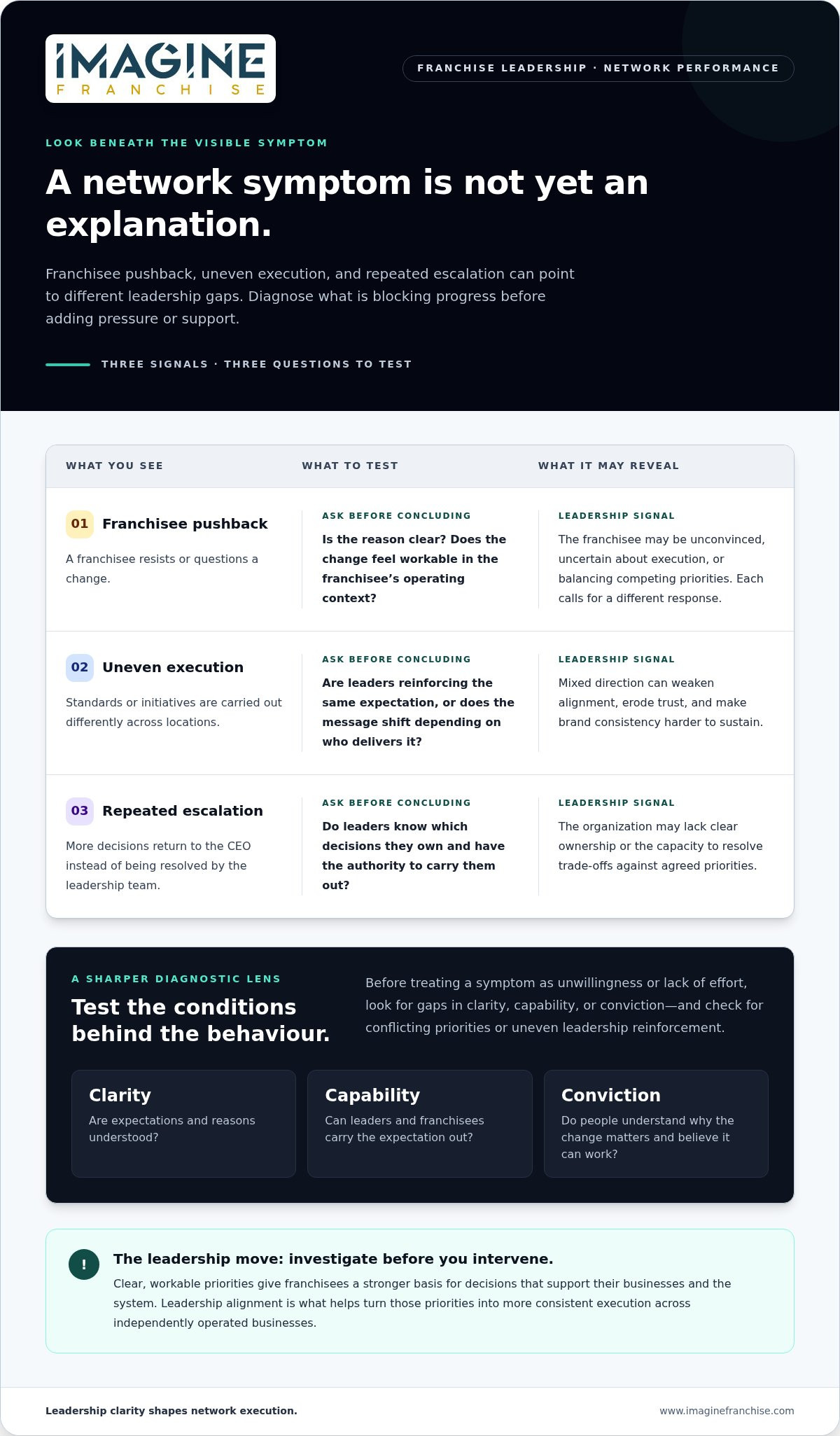
A franchisee pushes back. Execution varies from one location to another. Your team brings more decisions to you than it should. These are visible symptoms, not explanations. Treating each one as a franchisee problem can lead you to add pressure or support before you understand what is blocking progress. In a growing network, the cause may sit in leadership alignment, decision rights, communication, or the practicality of the request for franchisees.
Ask diagnostic questions instead. Are expectations clear? Do leaders have the capability and authority to carry them out? Does the change make sense in a franchisee’s operating context and economics? Do franchisees understand why it matters and believe it can work in their businesses? The answers may point to gaps in clarity, capability, conviction, or leadership reinforcement. Investigate those possibilities before settling on a conclusion.
Leadership alignment turns a franchisor’s priorities into consistent execution across independently operated businesses. For an owner-led franchisor with 25 to 250 locations, that alignment directly affects how limited head-office resources are used, what franchisees hear, and how decisions affect franchisee economics. Clear, workable priorities give franchisees a stronger basis for decisions that support their businesses while protecting the consistency and value of the network.
When franchisee resistance may signal a leadership gap
Before labeling resistance as unwillingness, test the conditions around the request. Have your leaders explained why the change matters to the network and to franchisee economics? Is the expectation workable with the people, cash flow, and operating capacity available at the location? Are leaders reinforcing the same standard, or does the message shift depending on who delivers it? A franchisee may be unconvinced, uncertain about execution, or balancing competing priorities. Each situation calls for a different leadership response.
The International Franchise Association’s article on executive coaching places leadership development in a franchising context. It reinforces a useful distinction: the franchisor’s task is not simply to demand compliance, but to create the clarity and leadership conditions that make consistent action possible.
When CEO overload points to limited organizational capacity
Repeated escalation is worth examining, especially when a lean head office is supporting a growing network. Do leaders know which decisions they own? Can they resolve trade-offs against agreed priorities, or are they waiting for your approval because accountability and decision rights remain unclear? If every difficult issue returns to the CEO, the network’s capacity is tied too tightly to one person and limited head-office resources are pulled away from higher-value work.
Coaching can help you test these patterns rather than assume their cause. Franchise Performance 360© assesses the business and human dimensions of franchise leadership. The Franchisor Leadership Index is a product that can accompany franchisors facing this challenge. Both can support reflection on where leadership work is needed; neither replaces operational analysis, implementation, or the decisions leaders must make.
Executive coaching, consulting, or peer support: which fits the franchisor’s need?
Not every leadership challenge needs another plan, tool, or meeting. As a CEO, you may need specialist help with a defined operational problem, perspective on a difficult decision, or a candid look at how your leadership is affecting execution. Start by identifying what is actually stuck, then choose support that fits the problem and the resources your head office can commit.
| Approach | Best suited to | Practical role |
|---|---|---|
| Executive coaching | A leadership decision, behaviour, or accountability challenge | Helps you clarify priorities, examine your choices, and follow through on action across the network. |
| Consulting | A defined strategic or operational problem requiring expertise | Provides analysis, recommendations, or implementation support, depending on the engagement. |
| Peer advisory | Perspective from leaders facing comparable franchise decisions | Creates space to test assumptions and learn from others’ experience. |
| Technology | A process or information need that can be supported by a system | Helps organize information or workflows. It cannot resolve unclear ownership or leadership disagreement by itself. |
These approaches can work together. A consultant might help solve a defined operational or strategic problem, while coaching helps you and your leadership team make the decisions and maintain the discipline needed to act on it. Peer input can broaden your perspective, and technology can support a process once ownership is clear. Coaching is a decision-making and perspective tool, not a replacement for operational consulting. Match the support to the constraint.
What executive coaching can, and cannot, do
Executive coaching for franchisors is tailored work on leadership choices, strategic priorities, and accountability in the context of a franchise network. It helps you examine how decisions are made, how your team shares ownership, and how priorities reach franchisees. It does not implement an operating solution or replace operating expertise, legal advice, or financial advice. Its practical value is helping leaders make clearer decisions and follow through on them.
That is what makes coaching practical rather than abstract. A coaching conversation should connect to real decisions: which priority comes first, who owns the next step, what franchisee or head-office constraints must be considered, and when the leadership team will review progress. The framework supports that work; the CEO and leadership team remain responsible for carrying it into the network.
How to recognize a coaching need
Recurring strategic drift, unresolved leadership-team misalignment, or CEO overload can be prompts to examine your role in the pattern. Ask whether the constraint is a leadership-capacity issue, a missing process, or a lack of operational resources at head office. Coaching is relevant when your decisions and behaviour are part of the performance equation. It is not a substitute for fixing a staffing, systems, franchisee economics, or operating problem that requires specialist implementation.
Turn coaching insight into alignment, accountability, and execution
Insight has little value if it stays in the coaching conversation. For an owner-led franchisor, it must change what the CEO prioritizes, how the leadership team makes decisions, and what franchisees experience as a result. A practical process gives that work a path from reflection to action without adding unnecessary layers to a lean head office.
Build the coaching process around the decisions in front of you
For an owner-led franchisor with 25 to 250 locations, the right starting point is usually a decision that is already affecting the network: where to invest limited head-office resources, how to protect franchisee economics while growing, or who owns a priority that keeps returning to the CEO. Executive coaching for franchisors should work from that reality rather than from a generic development agenda. Franchise Performance 360© assesses the business and human dimensions of franchise leadership, providing an assessment lens for deciding where attention is needed.
The BRAVE Coaching Method™ and BRAVE Model™ structure the work through five stages:
- Baseline: Establish what is happening now, including the leadership challenge, its effect on execution, and its impact on franchisees and head-office capacity.
- Realignment: Clarify what matters most and align the CEO and leadership team around a focused set of priorities.
- Activation: Translate those priorities into actions, owners, and practical measures of progress.
- Validation: Test whether leadership behaviours and decisions are changing in practice, and whether the intended work is moving forward across the network.
- Execution: Embed follow-through into leadership routines so accountability continues beyond the coaching conversation.
The sequence should produce a small number of meaningful priorities with clear ownership. That matters when the head office is lean and every new initiative competes for attention with franchisee support, network growth, and day-to-day operating issues. Focus helps leaders see what they own and lets the CEO assess whether the work is moving forward without creating another layer of activity.
Create follow-through without making the network more dependent on the CEO
Coaching should strengthen the leadership team’s ability to act, not make you the permanent center of every decision. Agree on actions and review points leaders can sustain within their existing work. Then ask practical questions: Are decisions being made at the right level? Are priorities still visible in leadership conversations? Are franchisees receiving consistent direction? Is follow-through becoming more reliable?
The answers may require adjusting an action, clarifying ownership, or addressing a barrier that affects franchisee economics or execution. The purpose is not to manufacture activity. It is to build the capacity to make and carry out aligned decisions without constant escalation to the CEO.
When Imagine Franchise’s executive coaching is the right next step
Executive coaching may be the right next step when your network’s priorities are clear on paper but your leadership team is not carrying them through consistently. For a growing franchisor, the constraint may be the way decisions are made, ownership is assigned, or follow-through is reinforced as the network adds locations and franchisee needs become more varied.
Imagine Franchise works with franchisor CEOs and leadership teams on the connection between leadership behavior and network performance. Through tailored coaching and the proprietary Franchisexcel© Growth Leadership System, the focus is on helping leaders align priorities and follow through. It provides structure for the leadership work; your team still has to make the decisions and carry them into the network.
What makes the Imagine Franchise approach franchise-specific
Franchisor leadership affects both business priorities and the human realities of leading through a network. Franchise Performance 360© assesses the business and human dimensions of franchise leadership, giving leaders an assessment lens for examining their context. The Franchisor Leadership Index is a product that can accompany franchisors facing leadership challenges. Neither substitutes for the decisions and actions leaders must take.
Stéphane Breault brings 25+ years of franchise leadership experience and 15+ years of executive-coaching experience. Imagine Franchise has coached more than 100 franchise networks since 2008. That experience informs the work; its value for you depends on whether the coaching addresses the leadership constraints your network is facing now.
Take the next step with a focused leadership conversation
Start by naming one constraint: a priority losing momentum, unclear ownership across the leadership team, or too many decisions returning to you. A focused conversation can help you examine the issue, your priorities, and whether executive coaching fits the work ahead. If you want to discuss it, schedule a private 45-minute exploratory session.
Build the leadership capacity for your network’s next stage
If you lead an owner-led franchise network with 25 to 250 locations, growth changes the job. You are no longer solving every issue personally; you are building a leadership team that can make sound decisions, protect franchisee economics, and execute with limited head-office resources. When progress stalls, look beyond the visible symptom. The leadership conditions beneath it may need attention.
Executive coaching for franchisors helps you examine decisions, clarify priorities, and strengthen follow-through across the leadership team. It is a perspective and decision-making tool, not a substitute for operational consulting, financial expertise, or additional head-office capacity when those are the real needs. The value comes from matching the support to the challenge and then doing the leadership work required to act on it.
Frequently Asked Questions
What does executive coaching for franchisors involve?
Executive coaching for franchisors is focused leadership work grounded in the realities of your network. It helps you examine strategic clarity, leadership behaviour, alignment across your team, and follow-through on decisions that affect franchisees and head-office capacity. Unlike generic business coaching, it considers how your choices travel through independently operated businesses. It does not deliver operational implementation for you; it helps you lead the decisions and accountability required to move the work forward.
How can executive coaching help a franchisor improve franchise network performance?
Coaching can help you clarify priorities, align your leadership team, and strengthen accountability for agreed actions. In a growing network, that can support more consistent execution, clearer communication, and decisions that better account for franchisee economics. Franchise Performance 360© assesses the business and human dimensions of franchise leadership, providing a lens for examining where leadership attention is needed. The value comes from what you and your team do with that insight.
Is executive coaching different from franchise consulting?
Yes. Executive coaching focuses on your thinking, decisions, leadership behaviours, and follow-through. Franchise consulting typically brings expertise or recommendations to a defined strategic or operational challenge. The approaches can complement each other: a consultant may address a process or franchisee-economics issue while coaching helps you lead the decisions, alignment, and accountability needed to act. For an owner-led franchisor with limited head-office resources, the starting question is whether the constraint is leadership capacity, specialist expertise, or both.
When should a franchisor consider executive coaching?
Consider executive coaching when priorities repeatedly lose momentum, your leadership team remains misaligned, too many decisions return to you, or strategic plans struggle to become consistent action across the network. These patterns are especially important to examine as an owner-led franchisor grows from 25 to 250 locations. Coaching is relevant when your decisions, leadership capacity, or accountability habits are part of the challenge and you are ready to act on what you learn.
Can executive coaching improve franchisee relationships?
Coaching can help you examine how your leadership affects clarity, consistency, trust, and accountability in franchisee relationships. Are expectations communicated consistently? Does the leadership team explain why a change matters and account for its effect on franchisee economics? The work helps you lead clearer expectations and more productive conversations; it does not replace the operational or relationship work required with individual franchisees.
How long does executive coaching for franchisors take?
The appropriate engagement depends on your context, priorities, and the leadership work needed to turn insight into follow-through. There is no standard duration for every franchisor. The important test is whether the work gives you enough space to examine the challenge, take action between conversations, and reassess what is changing. An exploratory conversation can help clarify whether coaching fits the leadership issue you are facing.
What should a franchisor look for in an executive coach?
Look for relevant franchise leadership experience, an understanding of network-level challenges, a practical approach to accountability, and the ability to connect business priorities with the human side of leadership. For a growing franchisor, the coach should understand the tension between network growth, franchisee economics, limited head-office resources, and the need for leadership alignment. Coaching should help you clarify priorities and follow through, not rely on generic motivation.

