


You built a recognizable brand, signed owners who believe in it, and watched locations open under one name. So why does a simple priority still land differently in every market? Head office repeats the direction, chases follow-through, and settles gaps that never should have opened. The signs outside look united. Inside, the network is not yet acting like a team.
Most franchisors assume that a shared brand, a franchise agreement, and good operating standards will bring a team together over time. They will not. Franchisees are independent business owners, not employees, and they carry their own payroll, cash flow, and local pressures. A franchise network is not a team just because it shares a brand. It is the franchisor's responsibility to create and develop the network team. It does not happen by itself.
That is not a criticism of what you have built. It is a description of the next job. What brought your network to its current size may not be enough to take it where you want it to go.
Key Takeaways
- Brand standards create recognition. Shared priorities, clear ownership, and visible follow-through create a team.
- Uneven execution is a symptom. Look first for unclear priorities, unclear ownership, or limited capacity before blaming franchisees.
- Trace one priority from head office to local action to find where it stalls.
- Test the change, its timing, and its budget with franchisees before you announce it.
- Measure progress by observable completion of agreed work, not by meeting attendance or verbal agreement.
Why a Franchise Network Is Not a Team Just Because It Shares a Brand
Your locations carry one name, follow recognizable standards, and make a common promise to customers. Yet one franchisee may act quickly on a new priority while another waits for more direction. A location manager may read the same instruction a third way. From the street, the network looks united. Behind the counter, ownership and execution vary.
A franchise network is a group of connected, independently owned businesses operating through one system. A team shares commitments and follows through on work that affects a common outcome. The franchising business model explains the legal and commercial relationship. It does not build the commitments. That work belongs to the franchisor.
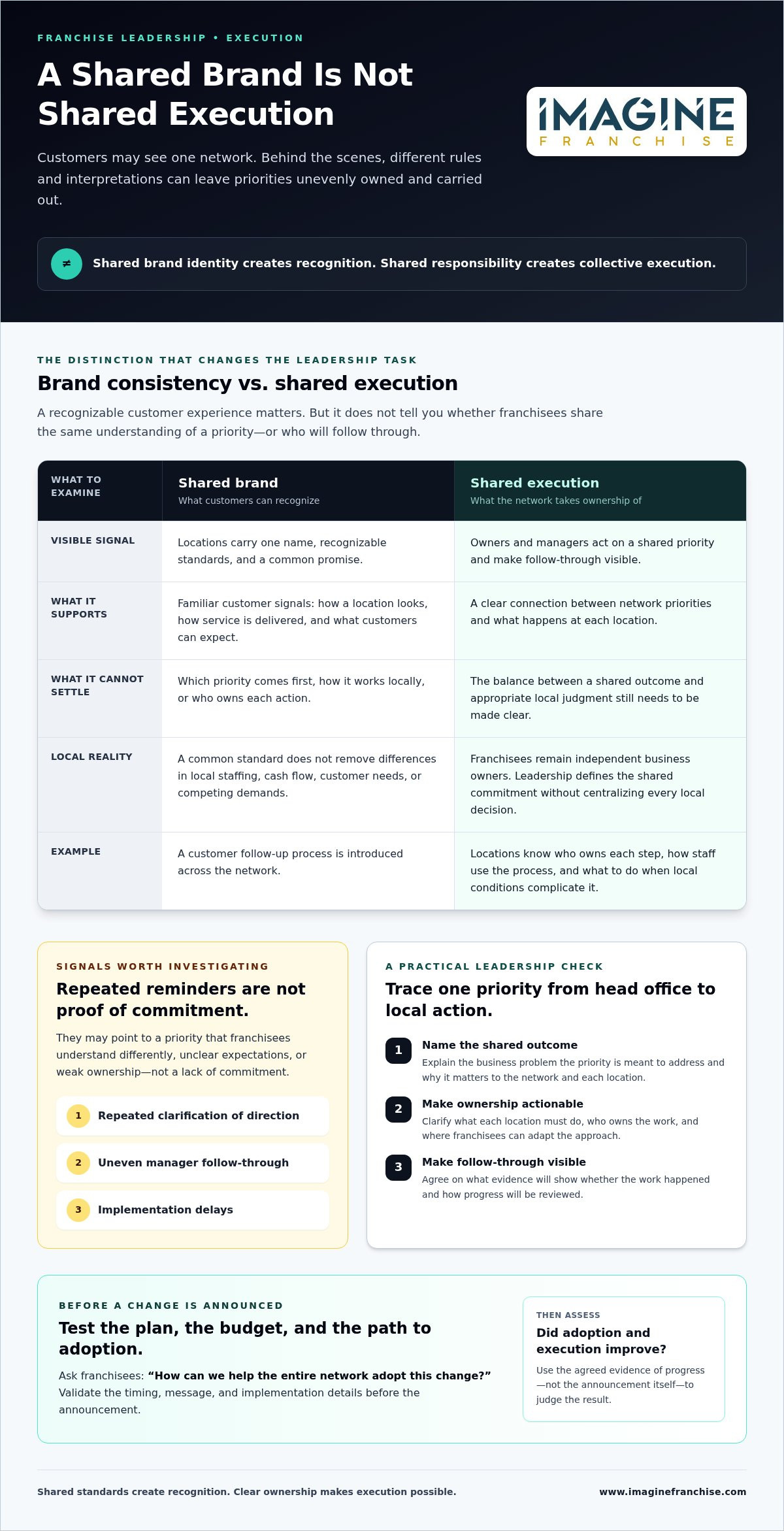
Shared brand identity creates recognition; shared responsibility creates collective execution.
What a shared brand creates, and what it does not
Brand standards give customers familiar signals: how a location looks, how service is delivered, what the product promises. That consistency matters. It reduces confusion and protects trust.
It does not settle what deserves attention first or how a priority should work in a local market. Say head office introduces a customer follow-up process. Franchisees may all agree that retention matters, yet differ on who owns each step, how staff should use it, and what to do when a busy week gets in the way. That gap does not mean every location should decide identically. It means the shared outcome and the room for local judgment were never made clear.
The leadership assumption that keeps networks fragmented
The risky assumption is that owners who chose the same brand will naturally behave as one group. They may share an interest in the network's success without agreeing on how to reach it. Each weighs staffing, cash flow, customers, and competing demands. If leadership has not explained the business reason and the expected contribution, different choices are predictable.
Growth makes the gap harder to carry. More locations mean more interpretations, more managers to guide, and more follow-up for a head office with limited capacity. A reminder can clarify an instruction. Repeated reminders will not fix a priority that owners understand in different ways.
Weak unit economics, market conditions, or a flawed operating model can also drive uneven results, and no amount of team building repairs those. Rule them out first. Then ask the harder question: does your network know what it has committed to do, and who is responsible for doing it?
How Franchise Leadership Turns Network Membership Into Shared Execution
A network priority matters only when it changes what happens at a location. An announcement does not do that. Your leadership team has to connect the priority to a business reason, define what franchisees can decide locally, and make follow-through visible. Shared execution depends on clear priorities and accountable follow-through.
Consider a hypothetical example. A franchisor with a few dozen locations decides to improve new-hire readiness. Head office announces the goal but leaves owners to guess which training steps count, who owns them, and when progress will be reviewed. Each location responds differently, and service and staffing pressure follow. The cause may not be unwillingness. The expectation may not have been clear enough to act on.
Clarity and conviction matter more than another announcement
Franchisees already juggle staffing, local customers, costs, and daily operations. A long or shifting list of "top priorities" gives them no basis for deciding what comes first. Before you ask for action, explain the business problem the priority addresses and what it means for each location.
Agreement in a meeting is not commitment. An owner may nod because the direction sounds reasonable and then leave unsure how it applies to the business. Make room for practical questions before launch. What must each location do? Where can owners adapt? What support will implementation need? Mark which parts are fixed and which are open to local judgment.
Those answers help you see what you are really facing: disagreement, limited capacity, or doubt about the payoff. Each calls for a different response. Another announcement will not fix a conviction problem, and tighter control will not make an unclear priority easier to carry out.
Accountability must work across independent businesses
Accountability starts with an expectation people can act on, a named owner, and a review that shows whether the work happened. In the hiring example, you would define the readiness steps, identify who at each location carries them out, and agree on what evidence shows completion. The franchisee remains responsible for running the business. Head office remains responsible for making the shared request clear and workable.
When follow-through varies, find the cause before you act. Is the direction unclear, are demands competing, or has an owner who understands the expectation chosen not to act? Coaching a manager may help one location. Revising the process may help all of them. Set a review date and look for fewer open questions, more consistent completion, and movement in the intended business result. Do not add controls just because results differ.
The practical test is simple. Does the agreed work continue without head office chasing every location?
Brand Consistency Is Not the Same as Franchise Network Unity
Customers may get the same experience in every location while owners remain divided on what the network should do next. They can present the same brand, meet the same standards, and still decide based on different assumptions about what matters most. To judge whether your network acts together, look beyond what customers see.
These four ideas describe different parts of network performance. Treating them as interchangeable hides the leadership work still to be done.
| Concept | What it means | What it does not prove |
|---|---|---|
| Brand consistency | Customers recognize common standards and a familiar experience across locations. | Franchisees trust one another or share ownership of network-wide priorities. |
| Compliance | A location follows defined operating expectations. | The owner understands the reason behind a decision or is committed to improving it. |
| Collaboration | Franchisees contribute knowledge and work together on shared challenges. | Every owner agrees with every proposal or makes the same local choices. |
| Shared accountability | Owners and leaders take responsibility for agreed work and review its progress. | Head office can rely on brand presentation alone as evidence of follow-through. |
Visible agreement can sit on top of conflicting local priorities. Owners may support an initiative in a meeting, then give it different attention back at locations with different staffing, managers, and pressures. That variation may be reasonable. But if nobody surfaces it, head office mistakes polite agreement for commitment and finds the gap only when execution stalls.
Compliance can protect standards without creating commitment
Operating standards set a clear floor for how locations represent the brand and serve customers. They cannot create trust, initiative, or shared responsibility on their own. A location may meet a requirement while its owner holds back concerns and contributes no ideas. The standard is met. Durable execution is still unproven.
As CEO, separate what a location has completed from whether the network can sustain the work. Check whether managers understand the purpose, whether owners raise obstacles early, and whether useful practices travel between locations. Compliance shows a standard is being followed. It does not measure commitment.
Unity allows disagreement before the network commits
Franchisee disagreement can expose a cost, a staffing issue, or a customer impact you have not considered. Make room for that input before you finalize a decision. Then state what has been decided, what stays local, and how owners will carry it out. Unity does not require unanimity. Franchisee input informs your decision. It does not replace it.
If disagreement continues after the decision, do not dismiss it as attitude, and do not demand identical behavior everywhere. Find out whether the rationale, the local consequences, or the ownership remain unresolved. A network that can raise real concerns, decide, and act together passes a harder test than consistent presentation.
How to Diagnose Whether Your Franchise Network Acts Like a Team
Repeated reminders can look like a franchisee problem. They can just as easily point to a leadership problem: the priority was announced but not understood, resourced, or assigned clearly enough to reach each location. Before you label uneven execution as resistance, which you cannot do without evidence, trace one important initiative from the decision at head office to the work on the ground.
Do not ask whether people feel aligned. Follow a specific priority, such as completing a customer follow-up step or preparing managers for a new process, and examine the evidence in four moves.
- Pick one priority that affects network performance.
- Compare how leaders and franchisees describe it.
- Trace it from decision to local action and review.
- Name the leadership decision that follows, and set one measure.
Test whether franchisees understand the same priority
Ask your leadership team and a cross-section of franchisees to describe the priority in practical terms. What should happen at a location? Who owns the work? By when? What would show it is working? Compare the answers before you send another reminder.
If one person describes a required action and another describes an optional suggestion, you have a clarity gap. If owners agree on the action but not the timing or the measure of success, the decision still needs definition. Restate the priority in language a location manager can act on. Do not demand consistent execution against different interpretations.
Find where decisions stop becoming action
Trace the initiative through its actual steps: decision, communication, local assignment, manager follow-through, and review. Look for the stall. Repeated clarification points to an unclear message. Uneven manager follow-through may signal a capability or supervision gap. Recurring delays may reflect thin staffing or competing demands. An owner who understands a clear expectation, can meet it, and repeatedly does not calls for direct accountability.
Keep the diagnosis specific. Ask franchisees and managers what happened at the location, what got in the way, and what they understood their responsibility to be. The goal is not to excuse missed commitments. It is to separate a willingness problem from something leadership can fix with clearer ownership, better preparation, or a more workable plan.
Then choose one indicator tied to the priority, such as whether the agreed step is complete by the review date. Record the starting point, name who checks progress, and set the date. If questions decline, ownership sharpens, and more locations complete the work as agreed, your change is helping. If not, revisit the diagnosis before adding reminders or controls.
Build Franchise Network Teamwork Through Better Leadership Decisions
If an initiative keeps slipping, another reminder is probably not the answer. Before you announce a network-wide change, decide whether the plan is workable, whether its budget supports the result you want, and what each location will need to do. A change that looks sound at head office can strain owners and managers if its cost, timing, or process do not fit daily operations.
Keep the move focused. Name one shared priority, explain its business reason, assign ownership, and define what progress looks like. Then ask franchisees for input while the plan can still change. For related reading, see how to get franchisee buy-in for new initiatives.
Involve franchisees before a network-wide change is announced
Ask franchisees, "How can we get the entire network to adopt this change?" Their answers can expose timing conflicts, unclear messages, and practical barriers you could not see during planning. Validate the timing, the message, the process, and the budget before you announce. You still make the decision. Their input helps you make one that locations can carry out.
After launch, review whether locations understood the change, started the agreed work, and followed through. If adoption falters, adjust the plan or clarify ownership. The measure is observable implementation, not agreement in a meeting.
Choose leadership support that keeps ownership with the CEO
As your network grows, competing demands and limited head-office capacity make it harder to keep priorities tied to execution. Imagine Franchise's Franchisexcel© Growth Leadership System and tailored Executive Coaching support franchisor leaders in aligning priorities and following through. Coaching helps you test assumptions, prepare for hard conversations, and keep your commitments. You keep ownership of the direction and the work.
Results depend on the leadership work itself. Judge it by whether your chosen priority has a clear owner, a workable plan, and visible progress across locations. For a wider view, read C-Suite Coaching for Franchises: Why Your Leadership Team Is the Ceiling of Your Growth.
Make Shared Execution Your Next Leadership Test
Your next step is not to convince every franchisee to think alike. Choose one network priority and examine whether your leadership has made it clear, workable, and worth owning. If head office stopped chasing it tomorrow, would owners and managers still know what to do next? The answer tells you more about your execution than a shared logo can.
Franchisees stay responsible for their businesses. You are responsible for building the conditions in which they act on meaningful commitments. Stéphane Breault, a former franchisor CEO and executive coach, brings over 35 years of experience and has supported more than 100 franchise networks in Canada and worldwide.
If you want to talk through where your network's execution stalls, book a call to discuss your leadership and execution challenges.
Frequently Asked Questions
Can franchisees remain independent business owners and still function as part of a team?
Yes. Owners can make commitments that support shared network outcomes while keeping their independence. For example, they might agree on a common customer handoff standard and decide locally how to train staff and schedule coverage. Teamwork shows when owners understand the shared result and honor their part without giving up sound local judgment.
Does a franchise network need every franchisee to agree before a decision can move forward?
No. Aim for informed input, not unanimity. Invite franchisees to identify operational risks before the decision, then clarify who decides, what feedback changed, and what each location must do. If a concern remains afterward, address it directly rather than reopening the decision by default.
How can a franchisor tell whether franchisees understand a new priority?
Ask franchisees to explain the priority in their own words, then describe what they would do in a realistic situation, such as a busy shift or a manager's absence. Listen for differences in the expected action, timing, and decision owner. A confident "yes" is weak evidence. A clear description of the next step is stronger.
What should a franchisor do when franchisees raise concerns about a network-wide change?
Separate practical barriers from disagreement with the goal. Ask, "How can we get the entire network to adopt this change?" and use the answers to test the plan, budget, timing, message, and process before announcing. Then explain what you changed and what remains expected, and review implementation after launch.
What is the CEO's role when franchise managers do not follow through on agreed priorities?
Make sure the franchisee owner understands the commitment and its business reason, then hold the owner accountable for closing gaps within the location. You may not manage a franchisee's staff directly, but you can clarify the expected outcome and discuss what support the manager needs. If the owner understands and still does not act, treat it as an accountability issue.

