


Why Traditional "Relationship Management" Fails Growing Franchise Networks
As a franchise CEO, you’ve been told that the key to network harmony is communication, support, and relationship management. You’ve invested in support staff, hosted conferences, and maintained an open-door policy. Yet, the friction remains. Franchisees resist new initiatives, compliance feels like a constant battle, and the trust that once defined your network feels strained.
The problem isn’t your effort. It’s the framework. Traditional approaches to franchisee relations often create the very problems they’re meant to solve.
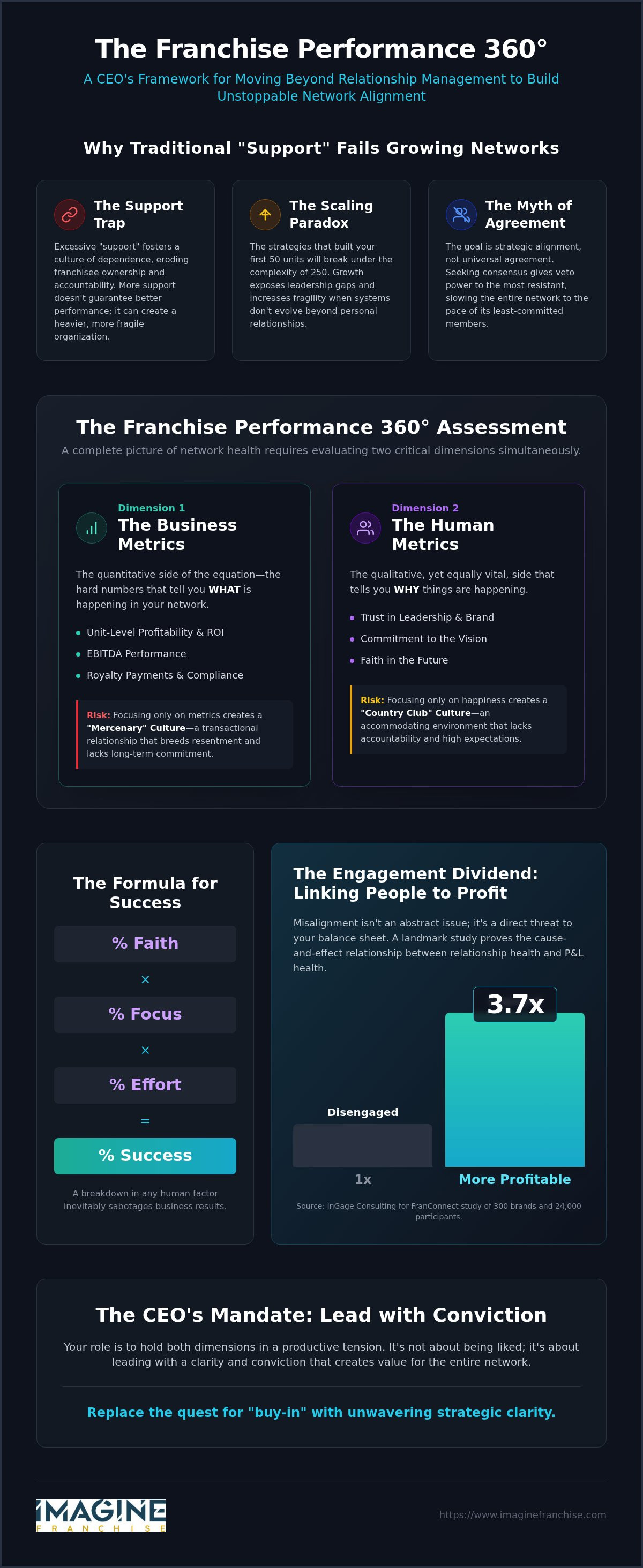
- The "Support Trap": When "support" becomes the primary tool, it can inadvertently foster a culture of dependence. Franchisees learn to wait for corporate to solve their problems, eroding their sense of ownership and accountability. More support doesn't always lead to better performance; sometimes, it just creates a heavier, more fragile organization.
- The Scaling Paradox: The strategies that built your first 50 units will not get you to 250. Growth doesn’t just make a network bigger; it makes it more complex. What worked through personal relationships and direct oversight now breaks under the strain of scale, increasing fragility and exposing leadership gaps.
- Moving Beyond "Niceness": A healthy franchisor-franchisee dynamic isn’t a "parent-child" relationship built on accommodation. It’s a peer-to-peer advisory relationship built on mutual respect, high expectations, and radical accountability. Your role isn't to be liked; it's to lead with a conviction that creates value for everyone.
- Leadership Capacity vs. Management: If your franchisees have stopped following the system, it's rarely because they are defiant. It's often a symptom of a deeper issue: a gap in leadership capacity at the corporate level. When strategic clarity is weak, execution at the unit level will always be inconsistent. For a deeper dive into this, explore why franchisees don’t follow the system.
The High Cost of "Good Enough" Relations
Tolerating mediocre franchisee relations is one of the most expensive decisions a CEO can make. This isn't a "soft" HR issue; it's a direct threat to your balance sheet and future growth. Misalignment quietly erodes enterprise value by creating operational drag, inconsistent brand delivery, and a culture that repels high-performing multi-unit operators. When prospective buyers or private equity firms conduct due diligence, a fractured and complacent network is a major red flag.
This complacency doesn't just infect the franchisees; it often mirrors a plateau at the leadership level. A network that has lost its ambition is a direct reflection of a CEO who has stopped challenging the status quo. The cost isn't just stagnant growth—it's the slow decay of the brand's potential.
The Contrarian Truth: Alignment is Not Agreement
Many leaders mistakenly believe their job is to achieve consensus. They spend countless hours trying to get every franchisee to "buy in" to a new strategy, only to be met with endless debate and passive resistance. This is a leadership mistake. In a high-performance franchise system, the goal is not agreement; it is strategic alignment.
Seeking consensus gives veto power to your most vocal or resistant franchisees, slowing the entire network down to the pace of its least-committed members. The solution is to replace the quest for "buy-in" with unwavering strategic clarity and conviction from the top. When the vision is clear, the standards are non-negotiable, and the "why" is compelling, you create a powerful force for alignment. This is Leadership Magnetism: the ability to attract alignment without coercion.
The Franchise Performance 360©: A Dual-Dimension Assessment
To improve franchisee relations, you must first stop guessing what’s wrong. The most common error is to focus exclusively on business metrics while ignoring the human factors that actually drive them, or vice versa. The Franchise Performance 360© is an assessment framework designed to provide a complete, unvarnished picture of your network’s health by evaluating two critical dimensions simultaneously.
- Dimension 1: The Business Metrics. This is the quantitative side of the equation—the hard numbers that define performance. It includes unit-level profitability, ROI, EBITDA, and royalty payments. These metrics tell you what is happening in your network.
- Dimension 2: The Human Metrics. This is the qualitative, yet equally vital, side. It measures the levels of Trust, Character, Commitment, and Faith franchisees have in the brand and its leadership. These metrics tell you why things are happening.
These dimensions are inseparable. They are governed by what we call the "Formula for Success," which states that % Faith × % Focus × % Effort = % Success. A breakdown in any one of these human factors will inevitably sabotage your business results.
Measuring What Matters: Hard Data vs. Soft Sentiment
Linking the human dimension to profitability isn't theoretical; it's a proven business reality. A landmark study by InGage Consulting for FranConnect, surveying 300 brands and 24,000 participants, found that engaged franchisees are 3.7 times more profitable than their disengaged peers. This isn't a correlation; it's a cause-and-effect relationship between the health of the relationship and the health of the P&L.
A proper assessment allows you to look past the noise. In every network, a "vocal minority" can dominate the conversation, masking the true sentiment of the "silent majority." By systematically measuring both business and human metrics, you can identify where your real challenges and opportunities lie, creating measurable roadmaps for strategic alignment that address root causes, not just symptoms.
The CEO’s Real Job: Balancing the Two Dimensions
As CEO, your primary function is to hold these two dimensions in a productive tension. Focusing only on business metrics creates a "mercenary" culture where franchisees feel like numbers on a spreadsheet. This transactional relationship breeds resentment and encourages corner-cutting, as there is no deep-seated commitment to the brand's long-term vision.
Conversely, focusing only on human factors—keeping everyone happy—creates a "country club" franchise. In this environment, underperformance is tolerated, standards are inconsistently enforced, and difficult conversations are avoided. While pleasant, this culture ultimately leads to brand erosion and financial stagnation. The sweet spot is achieving elite Unit-Level Performance, where high standards and strong profitability are the direct result of a high-trust, high-conviction relationship between you and your franchisees.
Shifting from Compliance to Commitment: A Culture Transformation
If you find yourself constantly policing brand standards, your problem isn't your franchisees—it's your culture. A network built on compliance is fragile and expensive to maintain. A network built on commitment, however, is resilient and self-policing. The shift from one to the other is the most critical transformation a growth-stage franchisor can undertake.
This begins by reframing a core concept: operational excellence is a growth strategy, not a compliance checklist. It's about demonstrating that the system isn’t a set of arbitrary rules, but the most reliable path to greater profitability and success. When franchisees see the standards as a tool for their own growth, their motivation shifts from obligation to ambition.
This requires breaking the "Good Enough" trap that snares so many mature franchisees. You must reignite their ambition by connecting operational discipline to their personal and financial goals. This is the 50/50 Truth: sustainable success is 50% brilliant business fundamentals and 50% courageous human leadership. Your job is to build a culture of organizational discipline that franchisees want to be part of because it makes them stronger.
The BRAVE Coaching Method™ for Executive Alignment
This cultural shift cannot be delegated. It must start with your C-Suite. The BRAVE Coaching Method™ is designed to transform your leadership team, moving them from a mindset of control to one of conviction. It’s about coaching your executives to lead in a way that inspires commitment rather than demands compliance.
The method focuses on eliminating the "Execution Gap"—the all-too-common space between corporate strategy and unit-level reality. A key part of this is transforming your field consultants. Too often, they operate as "compliance police," a role that inherently creates an adversarial dynamic. Through this coaching, they are repositioned as performance coaches, equipped to diagnose business challenges and guide franchisees toward higher profitability using the system, not just enforcing it.
Creating a Magnetism That Scales
When your leadership team operates with strategic clarity and conviction, something powerful happens: your network becomes magnetic. It starts attracting the right kind of franchisees—ambitious, high-performing multi-unit operators who are drawn to your high standards and clear vision. They aren't looking for an easy system; they are looking for a superior one.
This magnetism is what reduces franchisee friction at scale. It’s not about everyone sharing the same brand; that's just a licensing agreement. It's about a network of business owners sharing the same deep conviction in the mission, the model, and the leadership. That is what makes a team.
Implementing the BRAVE Model™ for Relationship Turnaround
Transforming a strained or stagnant franchise network requires more than good intentions; it requires a disciplined, sequential process. The BRAVE Model™ provides a clear roadmap for leadership to guide this turnaround, moving from honest assessment to network-wide execution. It’s a framework for accountability without alienation.
- Step 1: Baseline (B). The process begins with a brutally honest assessment of your current reality. Using the Franchise Performance 360©, you must establish a clear, data-driven baseline of both business performance and the state of trust across the network.
- Step 2: Realignment (R). With the baseline established, the next step is to redefine the vision and strategic priorities with your leadership team. This is not about seeking consensus but about achieving unwavering alignment and securing a unified commitment to the new direction.
- Step 3: Activation (A). A strategy without action is just a document. This phase involves launching the new alignment strategy with clear, measurable goals and communicating it to the network with conviction. The rollout must be decisive and unambiguous.
- Step 4: Validation (V). As the strategy is activated, you must obsessively monitor progress and gather feedback. This phase is about validating that the new approach is working and immediately addressing any resistance or execution gaps. It’s about proving the model works with early wins.
- Step 5: Execution (E). Once the model has been validated with a pilot group or in a specific region, the final step is to scale the success across the entire network, embedding the new standards and behaviors into your organizational DNA.
Navigating Resistance to Change
Change, even positive change, will always be met with resistance. "Legacy" franchisees, who may be comfortable with the old way of doing things, are often the most vocal. The BRAVE Model™ provides a framework for engaging these detractors constructively. By focusing on the "Validation" phase, you can use data and peer success stories to demonstrate that the new direction leads to higher profitability, turning skeptics into advocates.
When faced with stubborn resistance, ask the ultimate Impact Question: What is the real cost—to you and to the network—of staying exactly where you are for another three years? This shifts the conversation from the fear of change to the undeniable pain of stagnation. For leaders facing deep-seated issues, this model can be the key to a full franchise system turnaround.
Accountability Without Alienation
Holding franchisees accountable is one of the most challenging aspects of franchise leadership. The key is to set non-negotiable standards while simultaneously maintaining a high-trust environment. This is achieved by linking accountability directly to the shared goal of increased unit-level profitability. The "Validation" phase is crucial here, as it provides concrete proof that adherence to the system creates better financial outcomes for everyone. The BRAVE Model™ isn’t a compliance tool; it is a roadmap for leadership transformation that makes accountability a positive, value-creating force.
Scaling Smarter: The Franchisexcel© Approach to Sustainable Unity
Improving franchisee relations is not a one-time fix; it is the outcome of a superior leadership system. For networks poised for significant growth, the challenge is to scale without collapsing under the weight of increased complexity. The Franchisexcel© Growth Leadership System is designed for this exact purpose.
This proprietary system is built on over 25 years of franchise leadership and 15 years of executive coaching. It provides a proven framework to help franchisors achieve 3-to-10-fold network growth in 3 to 5 years, not by working harder, but by leading smarter. It's about building a leadership capacity that allows your network to grow without becoming heavier, more dependent, or more fragile.
A critical part of this is navigating the personal evolution required of you as a leader. The skills that made you a successful Founder are not the same skills required to be a CEO of a large, complex network. Your leadership must evolve for the network to thrive.
The 12-Month Strategic Leadership Acceleration
The Franchise Leadership Catalyst™ is a 12-month journey designed to install this growth leadership capacity in you and your team. It moves beyond theory to focus on real-world application, strategic execution, and personal leadership transformation. A core component of this journey is the use of peer advisory groups, which break the "Lone CEO" isolation that so many franchise leaders experience. By connecting you with other high-growth CEOs facing similar challenges, you gain perspective, accountability, and next-level strategies for positioning your network for its next stage of growth, whether that be international expansion or a high-value exit.
Lead Boldly. Scale Smarter.
As you look to the future, the most important question isn't about your business plan; it's about your leadership. So, ask yourself this final impact question: Is your current leadership team capable of successfully managing a network five times your current size?
If the answer gives you pause, it’s a sign that your next investment shouldn't be in more support staff, but in the executive leadership capacity required to maintain network unity during rapid scale. Executive coaching isn't a remedial action; it's a strategic imperative for any CEO committed to building an enduring brand.
To assess your network's alignment and discover how to unlock its true potential, schedule a private strategy session with Stéphane Breault.

