


Why Most Franchise Conflict Resolution Strategies Fail (The Leadership Debt)
Franchise conflict is never about just one thing. A dispute over a new technology fee, a marketing campaign, or a supply chain change is rarely the real issue. It’s a symptom. The real issue is almost always a breakdown in leadership that has been accumulating over time.
As a franchise CEO, you see it as friction, resistance, or non-compliance. But what if you reframed it? That conflict is a signal. It’s your network telling you that the leadership style that got you to 50 units is breaking down on the way to 150. You’ve scaled your system, but not your leadership capacity. This gap is what I call “leadership debt,” and the interest payments are franchisee dissent, stalled growth, and endless fire-fighting.
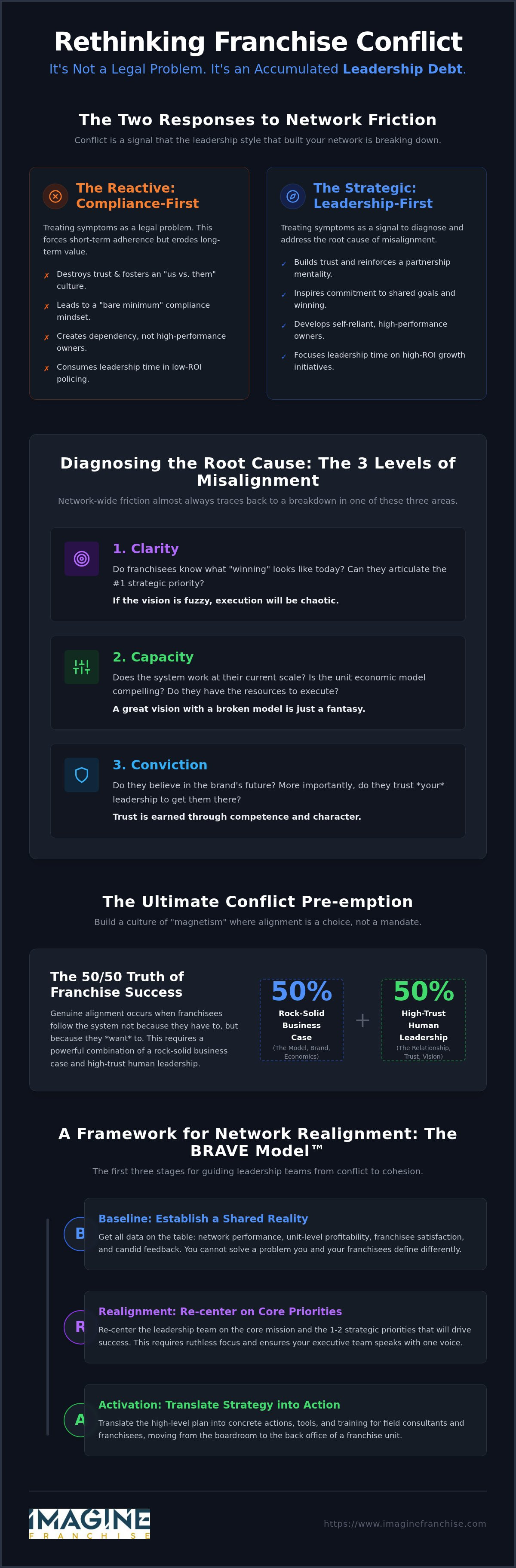
Most franchisors respond by doubling down on the franchise agreement. They send breach notices, hire lawyers, and treat the conflict as a legal problem. This compliance-first approach almost always backfires. It may force short-term adherence, but it destroys long-term trust and reinforces the very “us vs. them” mentality you’re trying to overcome. You end up with a network of franchisees who do the bare minimum to avoid a lawsuit, not a network of partners committed to winning.
This problem is often compounded by the “Lone CEO” dilemma. When you’re isolated at the top, making decisions without a deeply aligned executive team, you create a leadership vacuum. Franchisees, especially experienced ones, will fill that vacuum with their own agendas, creating factions and organized resistance.
The High Cost of Compliance-First Management
Are you and your team spending more time policing your network than leading it? Chasing down non-compliant franchisees is a low-ROI activity. It consumes your best people’s time and energy, shifting their focus from driving unit-level profitability to enforcing rules. This creates the “Good Enough” trap, where mediocre performance becomes the norm and high-achievers feel held back by a system designed for the lowest common denominator. This is a common reason why franchisees stop following the system; they no longer see it as the path to top-tier success.
An overly rigid, compliance-focused system doesn’t create high-performance owner-operators. It creates dependency. Franchisees learn to wait for instructions and blame the system when things go wrong, rather than taking ownership of their success.
Identifying the Three Levels of Misalignment
When you’re facing network-wide friction, the problem can almost always be traced to a breakdown in one of three areas. Before you can craft a strategy, you need to diagnose the root cause. Ask yourself and your team these questions:
- Clarity: Do our franchisees actually know what “winning” looks like today? Not two years ago, but right now. Can they articulate the number one strategic priority for the next 18 months as clearly as your executive team can? If the vision is fuzzy, execution will be chaotic.
- Capacity: Does the system we’ve given them still work at their current scale and in today’s market? Is the unit economic model still compelling? Do they have the operational capacity, staffing, and cash flow to execute the strategy you’re demanding? A great vision with a broken model is just a fantasy.
- Conviction: Do they still believe in the brand’s future? More importantly, do they still believe in your leadership to get them there? Conviction isn’t about liking you; it’s about trusting your competence and character to make decisions that lead to collective success.
Strategic Alignment as the Ultimate Conflict Pre-emption
Resolving conflict is a reactive measure. The best franchise conflict resolution strategies are proactive, designed to prevent misalignment before it takes root. The ultimate pre-emption is genuine strategic alignment, where your franchisees choose to follow the system not because they have to, but because they want to. They see it as their most reliable path to achieving their own goals.
This is what I call building a culture of “magnetism.” It’s the powerful combination of a rock-solid business case and a high-trust human relationship. Success in franchising is always a 50/50 truth: 50% is about the business fundamentals—the model, the brand, the economics—and 50% is about the human leadership that brings it to life. You can’t have one without the other.
Sharing a brand name doesn’t mean you share the same goals. Intentional alignment is the hard work of leadership. It requires tools that can diagnose friction points before they become full-blown disputes. Our Franchise Performance 360© assessment, for example, is designed to do just that, giving you a clear picture of both the business and human health of your network.
The BRAVE Model™ for Network Realignment
To move from a state of conflict to one of alignment, you need a structured process. The BRAVE Model™ is a five-stage framework we use to guide leadership teams through this transformation. The first three stages are critical for realignment:
- Baseline: First, establish a shared and objective reality. This means getting all the data on the table—network performance, unit-level profitability, franchisee satisfaction scores, and candid feedback. You cannot solve a problem that you and your franchisees define differently.
- Realignment: With a clear baseline, re-center the entire leadership team on the core mission and the one or two strategic priorities that will drive success. This stage is about ruthless focus and ensuring every single member of your executive team is speaking with one voice.
- Activation: Strategy is useless until it’s activated in the field. This stage involves translating the high-level plan into concrete actions, tools, and training for your field consultants and franchisees. It's about moving from the boardroom to the back office of a franchise unit.
Balancing ROI with Human Trust
You can’t demand trust; you have to earn it. In franchising, trust is built on a foundation of two things: competence and character. Competence is proven through financial results. This is why transparency around key metrics like unit-level EBITDA and the use of royalty and marketing fund dollars is non-negotiable. When franchisees see that the system creates a strong return, their willingness to follow that system increases dramatically.
Character is proven during times of change and stress. Your franchisees are watching how you behave. Do you communicate openly? Do you take responsibility for failed initiatives? Your personal character as a CEO has a direct and measurable impact on franchisee buy-in. It all comes together in our “Formula for Success,” which we define as: % Faith × % Focus × % Effort = % Success. Without faith in leadership, focus and effort will always be diluted.
Best Practices for Franchise Advisory Councils (FAC)
A well-run Franchise Advisory Council (FAC) can be one of your most powerful tools for preventing conflict. A poorly run one can become a hotbed of dissent that actually amplifies it. The difference lies in how you position, structure, and lead the council.
The FAC’s role is to be a strategic partner, not a grievance committee. If your FAC meetings are dominated by complaints about past mistakes, you have lost control of the agenda. The focus must be on future growth, competitive threats, and system-wide opportunities. To achieve this, your selection criteria are critical. Ensure your council represents your most growth-minded, constructive, and forward-thinking franchisees, not just the longest-tenured or loudest voices.
The frequency and format of your meetings should reflect this strategic purpose. Quarterly meetings with a clear, disciplined agenda focused on one or two key strategic issues are far more effective than monthly complaint sessions. As CEO, your role is to lead these meetings with conviction and transparency, framing the challenges and guiding the conversation toward productive solutions.
FAC Structure and Governance
To keep the FAC effective, you must establish clear governance from the outset. This starts with defining the boundaries between “advisory” and “decision-making” roles. The FAC provides input, perspective, and ideas; your leadership team makes the final decisions. This must be explicitly and repeatedly communicated to prevent misunderstandings.
Consider implementing rotating memberships to ensure fresh perspectives and prevent the council from becoming a political clique or a permanent power base for a few individuals. And when you encounter contrarian voices, learn to handle them constructively. A challenging question can be a gift if it forces you to sharpen your strategy. The key is to address the substance of the argument without letting a negative tone derail the council’s progress.
Turning Council Feedback into Actionable Strategy
The single biggest reason FACs fail is the “Execution Gap.” You have a productive meeting, everyone agrees on a path forward, and then… nothing happens. When franchisees invest their time and energy to provide feedback and see no resulting action, their trust evaporates. This is more damaging than not having an FAC at all.
To close this gap, you need a system. Use a platform like FranConnect or a similar tool to formally track FAC-driven initiatives. Assign an owner from your leadership team to each initiative, set a clear timeline, and establish metrics for success. Most importantly, you must close the loop. When the council’s input leads to a positive change—a new piece of technology, a streamlined process, a successful marketing campaign—communicate that win back to the entire network. This demonstrates the value of the FAC and builds momentum for future collaboration.
Checklist: The CEO’s Tactical Response to Network Friction
When you feel the friction mounting in your network, waiting for it to resolve itself is not a strategy. A delayed response amplifies the problem and signals weak leadership. You need a tactical, disciplined approach to diagnose the issue and intervene effectively. Here is a CEO’s checklist to guide your immediate response.
- Audit Your Clarity: Before you analyze the franchisees, analyze your message. Can you state your network's single most important goal for the next 3 years in 12 words or less? If you can’t, your franchisees certainly can’t. Ambiguity at the top creates conflict in the field.
- Assess the Human Factor: Is the conflict really about the money, or is it about the relationship? A dispute over a 1% royalty increase might actually be about a perceived lack of respect or a broken promise from two years ago. Look past the surface issue to the underlying human dynamic.
- Validate the System: Is the underperformance you’re seeing a talent issue or a process issue? Before you blame a franchisee for failing, you must be brutally honest about whether your system, training, and support structures truly set them up for success in today’s market.
- Execute with Speed: Once you have diagnosed the root cause, act. Whether the solution is a change in strategy, an investment in new technology, or a difficult conversation with your leadership team, decisive action restores confidence. Indecision breeds contempt.
Step 1: The Internal Audit of Leadership Capacity
The first place to look for the source of conflict is always in the mirror. Is your C-Suite team completely aligned, or are they sending mixed signals to the field? A franchisee getting one message from Operations and another from Marketing will naturally become confused and resistant. This internal misalignment is a primary driver of network friction.
Ask yourself: Does our executive team have the “Growth Leadership” skills required for our next 100 units, or are they still operating with a 50-unit mindset? As your network scales, the complexity of leadership increases exponentially. You need to ensure your team's capabilities are evolving ahead of that curve. Ultimately, strategic clarity is the primary tool for reducing friction. When everyone knows where the ship is going and trusts the captain, they are less likely to argue about the seating arrangements.
Step 2: Engaging the 'Magnet' Franchisees
In any network, you have three groups of franchisees: the top 20% who are your growth-minded champions, the middle 60% who are generally compliant but waiting to be led, and the bottom 20% who often consume 80% of your emotional energy. Your strategy must address all three.
First, identify and rally your top 20%. These are your “magnet” franchisees. Leverage them as internal champions and peer leaders. Their validation of your strategy is more powerful than anything you can say. Next, you must have a clear plan to isolate toxic underperformers without alienating the middle-tier. This requires a fair, consistent, and well-documented process that separates those who can’t perform from those who won’t. Finally, create specific initiatives to reignite ambition in solid, middle-tier franchisees who have plateaued. Often, they haven’t stopped growing because they can’t; they’ve stopped because they’ve lost the vision or the belief that more growth is worth the effort. Your job is to show them a compelling path forward.
From Dispute to Growth: The Franchisexcel© Approach
Fixing the immediate conflict is only the first step. The real goal is to transform your leadership so that this kind of friction becomes rare and manageable. Resolving a dispute gets you back to zero; building leadership capacity is what enables you to scale your network and enterprise value.
This is the core promise of our Franchisexcel© Growth Leadership System. It’s a framework designed to help you achieve 3-to-10-fold growth by fundamentally shifting how you lead. We use tools like the BRAVE Coaching Method™ to prepare you and your team for the next stage of growth, moving you from a founder-led organization that relies on personal relationships to a system-led organization that can scale without becoming fragile.
Leadership Transformation as a Growth Strategy
Building your leadership capacity is the most critical growth strategy you can deploy. It’s what allows you to add units without adding proportional chaos. It’s the difference between a network that is heavy and dependent and one that is agile and empowered. Instead of spending your days managing the symptoms of misalignment—running from one franchisee fire to the next—you can focus your energy on driving unit-level performance and strategic innovation.
This transformation often requires an outside perspective. For many of the CEOs I work with, peer advisory groups and executive coaching provide the confidential sounding board needed to challenge assumptions and sharpen their leadership approach. It’s about creating the space to work on the business, not just in it.
Next Steps: The Franchise Leadership Catalyst™
If you are a CEO of a network with 50-250+ units and you’re ready to move beyond constant conflict resolution and build a truly aligned, high-growth organization, the journey starts with a single decision. The Franchise Leadership Catalyst™ is our 12-month strategic journey designed for leaders like you who are ready to lead boldly and scale smarter.
The first step is a confidential conversation to determine if this approach is right for you. We can discuss conducting a network-wide audit using the Franchise Performance 360© to get an objective baseline of your system’s health. Let’s stop managing disputes and start building the leadership that makes them obsolete.
[Schedule a consultation with Stéphane Breault](https://www.imaginefranchise.com/)

