


The Invisible Ceiling of Franchise CEO Leadership
You built this. From a single location to 50, 75, or even 100 units, your vision, drive, and relentless problem-solving have forged a successful franchise network. But now, something has shifted. Growth feels heavier. Franchisee conversations are more about compliance than conviction. The strategies that powered your initial ascent are no longer delivering the same lift. You haven't failed; you've simply reached an invisible ceiling—a leadership plateau created by your own past success.
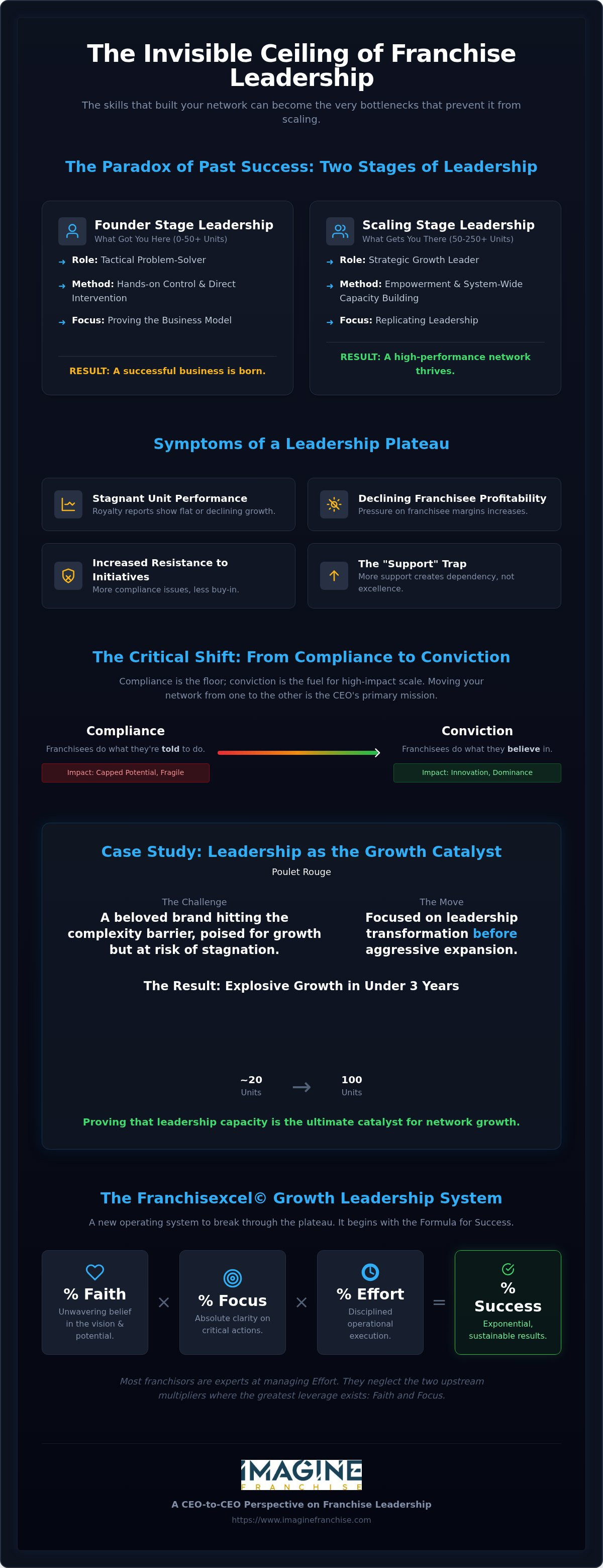
This is the central paradox of franchise CEO leadership: the very skills that make you a brilliant founder can become the primary bottlenecks to scaling a mature, high-performance network. The hands-on, tactical genius required to build a brand from scratch is fundamentally different from the strategic, visionary leadership needed to guide it to 250 units and beyond. Continuing to apply the old formula is a recipe for stagnation, burnout, and a fragile network that depends entirely on you.
- Why the strategies that got you to 50 units will fail you at 200: Early-stage growth is about proving a model. Scaling is about replicating leadership. The former requires control and direct intervention; the latter demands trust, empowerment, and system-wide capacity building.
- The 'Lone CEO' problem: As the network grows, the complexity outpaces your individual capacity. Without a trusted peer advisory mirror, you risk becoming the most isolated person in your organization, making critical decisions in an echo chamber.
- Identifying the symptoms in your royalty reports: A leadership plateau isn't just a feeling; it's a number. Stagnant unit-level performance, declining franchisee profitability, and increased resistance to new initiatives are all lagging indicators of a leadership gap at the top.
- Rethinking the 'Support' trap: The impulse to provide more "support" to struggling franchisees often creates dependency, not excellence. Great franchise CEO leadership involves building a culture where franchisees own their success, rather than renting it from the corporate office.
The Paradox of Past Success
Your "founder energy" was once your greatest asset. It was the force that willed the brand into existence, solved every impossible problem, and inspired the first wave of franchisees to believe. But as the organization scales, that same energy becomes a bottleneck. When you are the ultimate answer to every question, your team learns not to think. When you are the primary driver of every initiative, the organization's speed is limited to your personal bandwidth. You feel like you're working harder than ever, yet the network's gains are becoming smaller and more painful to achieve.
This is the difficult transition every successful franchisor must make: from tactical problem-solver to strategic growth leader. It requires a conscious letting go of the day-to-day operations and a deliberate shift toward shaping the thinking, capacity, and conviction of your leadership team and franchisees. It’s about moving from being the hero in the business to building a business of heroes.
From Compliance to Conviction
In the early days, getting franchisees to simply follow the system is a monumental victory. But for high-impact scale, compliance is not enough. A network where franchisees are merely following the rules is a network that has capped its potential. It’s a system vulnerable to market shifts and competitive pressure because its operators lack the deep-seated belief—the conviction—that drives innovation and local market dominance.
The cost of "Good Enough" performance across your multi-unit operators is staggering. It’s a quiet tax on your brand's potential, paid through missed revenue, inconsistent customer experiences, and a diluted brand promise. The CEO's focus must shift from monitoring rules to building brand magnetism. This means creating a culture so compelling, a vision so clear, and a path to success so well-defined that your franchisees move from doing what they're told to do, to doing what they believe in. This is the essence of mature franchise leadership development.
Case Study Highlight: Poulet Rouge's Explosive Growth
Under the leadership of CEO Moussa Madi, Poulet Rouge faced the classic scaling challenge: a beloved brand poised for growth but at risk of hitting the complexity barrier. By focusing on leadership transformation before aggressive expansion, the network achieved staggering results. Through a strategic alignment process, Moussa shifted from hands-on manager to visionary leader, empowering his team to drive operational excellence. The result: Poulet Rouge scaled from approximately 20 to 100 units in under three years, proving that leadership capacity is the ultimate catalyst for network growth.
The Franchisexcel© Growth Leadership System
Breaking through the leadership plateau requires more than just trying harder. It requires a new operating system. The Franchisexcel© Growth Leadership System is a proprietary, six-stage framework built on over 25 years of franchise leadership and 15 years of executive coaching with more than 100 franchise networks. It’s designed specifically for CEOs of networks with 50-250+ units who are ready to trade incremental gains for exponential growth.
The system is not a collection of theories; it is a practical roadmap for building leadership capacity throughout your network, allowing you to scale without increasing organizational weight, fragility, or dependency on you. It begins with a fundamental truth, captured in our "Formula for Success":
% Faith x % Focus x % Effort = % Success
Most franchisors are experts at managing effort. They have manuals, training programs, and field consultants all dedicated to ensuring franchisees work hard. But they neglect the two upstream multipliers: Faith (unwavering belief in the brand's vision and their own potential) and Focus (absolute clarity on the few critical actions that drive results). Without high levels of Faith and Focus, even maximum Effort produces mediocre results. Franchisexcel© is designed to architect all three.
Diagnosing the Network with 360© Precision
You cannot fix a problem you cannot see clearly. Before any strategy can be effective, you need an honest, unvarnished assessment of your network's current state. The process begins with the Franchise Performance 360©, a comprehensive diagnostic tool that assesses both the business and human dimensions of your leadership team and network. It goes beyond royalty reports and P&L statements to uncover the hidden friction points, misalignments, and "Growth Killers" within your C-suite and your franchisee culture.
This isn't about assigning blame; it's about achieving clarity. The 360© assessment provides a measurable, data-driven baseline that replaces "growth by guesswork" with a strategic roadmap. It reveals the gaps between your intended strategy and the reality on the ground, creating the foundation for a transformation built on truth, not assumptions.
The Six Stages of Franchisexcel©
The Franchisexcel© journey is a structured progression through six distinct stages of leadership maturity. It’s a deliberate process that moves your entire organization from a state of ambiguity and reactive problem-solving to one of profound clarity and proactive growth. The journey guides your leadership team from establishing an initial Clarity of Action—ensuring everyone knows what to do—to achieving an ultimate Unity of Purpose, where the entire network is emotionally and strategically invested in a shared vision.
Central to this process are the principles of accountability and rigorous self-evaluation. We build a high-performance culture where leadership is not a title, but a demonstrated behavior. This disciplined approach fosters the agility needed to navigate a volatile market and the conviction required to make bold moves. It is this combination that enables networks to achieve 3-to-10-fold growth in 3-5 years, transforming not just their unit count, but the very nature of their brand and its impact.
Case Study: Scaling Poulet Rouge from 20 to 100 Units
The story of Poulet Rouge is a masterclass in modern franchise CEO leadership. When CEO Moussa Madi took the helm, he inherited a successful, growing brand. But he recognized the invisible ceiling approaching. The initial challenge was not a lack of demand or a flawed product; it was the burgeoning complexity of rapid scale. He knew that the leadership style that built the first 20 units would break the company on the way to 100.
The transformation began with a crucial insight: leadership development must precede physical expansion. Before signing new franchise agreements, Moussa and his team engaged in the Franchisexcel© system to build the internal capacity required to handle the growth. The interventions were specific and targeted, breaking the 20-unit plateau by first addressing C-suite alignment and then cascading that clarity and conviction throughout the network. The result was one of Canada's most impressive growth stories: achieving 100 units in under three years through strategic alignment, not just aggressive sales.
The CEO’s Personal Transformation
At the heart of Poulet Rouge's success was Moussa Madi's personal evolution. Guided by executive coaching, he deliberately shifted his role from the chief problem-solver to the chief visionary and culture-builder. This meant overcoming the founder's natural fear of losing control and the anxiety that the unique brand culture would dilute during a 5x expansion. He learned to trust his team, empower his leaders, and focus his energy on the highest-value activities: communicating the vision, reinforcing the culture, and making fewer, but better, strategic decisions. The impact of this shift, amplified by a peer advisory structure, was a dramatic increase in decision speed and organizational agility.
Operational Excellence as a Growth Strategy
Many franchise systems chase growth by prioritizing franchise sales above all else. Poulet Rouge took a contrarian approach, focusing intensely on franchisee profitability and operational excellence as the primary drivers of sustainable growth. They understood that a network of highly successful, highly engaged franchisees is the most powerful marketing engine imaginable. The leadership team was rebuilt to execute with precision, freeing Moussa from constant intervention. This demonstrates the real ROI of leadership: the coaching and strategic alignment weren't just "soft" development exercises; they were directly linked to improved unit-level economics, which in turn fueled the explosive and healthy expansion of the network.
The 50/50 Truth: Why Strategy Fails Without Leadership
In franchising, we love to talk about systems, processes, and business fundamentals. And they are critical. But they are only half of the equation. The 50/50 Rule is a core principle of our philosophy: sustainable success is 50% business fundamentals and 50% human leadership. You can have the most brilliant, data-driven strategy in the world, but it will fail if the CEO and the leadership team lack the conviction to execute it, the trust of their franchisees, and the capacity to lead through complexity.
This is why so many strategic plans end up as expensive binders on a shelf. The plan itself may be perfect, but it is launched into a network with a trust deficit or a leadership team that isn't fully aligned. Franchisees can sense a lack of conviction from a mile away. When they do, they hesitate, they question, and they fall back on old habits. Addressing the "soft" topic of leadership is, therefore, a hard performance metric. It is the multiplier that determines whether your strategic investments pay off or fall flat.
The Cost of the Trust Gap
A lack of trust between a franchisor and its franchisees is not a philosophical problem; it is a direct hit to the bottom line. Low trust creates what we call a "compliance tax." It manifests as higher legal costs from prolonged disputes, slower system-wide implementation of new initiatives, and the immense opportunity cost of franchisees withholding their best ideas and discretionary effort. When you have to force every change through with the threat of default, you are burning capital, time, and goodwill. Rebuilding that trust is paramount, and it starts with a leadership team that is aligned, transparent, and consistent.
Leadership Conviction and Enterprise Value
Private equity firms and other investors pay a significant premium for franchise networks with strong, scalable leadership cultures. Why? Because they know that a business with a deep bench of leadership and a culture of franchisee buy-in is far less risky and has a much higher potential for growth. A brand led with conviction becomes a movement. It creates a magnetic field that attracts and retains top-tier, multi-unit franchisees who are looking for more than just a business model—they are looking for a vision to be a part of. As CEO, your primary role is to cultivate this conviction. It is the single greatest driver of your network's long-term enterprise value.
Executing Your Next Leadership Move
Recognizing the plateau is the first step. Executing the shift in your franchise CEO leadership is the next. A C-suite transformation does not have to be a disruptive, high-risk maneuver. When done correctly, it’s a disciplined process of realignment that strengthens operations while simultaneously unlocking new growth.
The journey is powered by the BRAVE Coaching Method™, a framework designed to build organizational discipline and drive measurable results. The process is tailored to the unique DNA of your network, ensuring that the development of your leadership team is directly tied to the strategic objectives of the business.
Initiating Your Leadership Transformation
The first 90 days of an engagement are critical. The process begins not with generic advice, but with a deep diagnostic. Using the Franchise Performance 360© tool, we strip away the noise to find the real growth levers in your network. This baseline assessment gives us a clear, shared understanding of your strengths, weaknesses, and the precise leadership gaps that are holding you back. It provides the data needed to move from frustrating symptoms to root causes.
From there, we work with you and your team to establish the "Impact Question"—the single most important strategic question your leadership team must answer to reach the next level of growth. This question becomes the north star for our work together, ensuring that every coaching session, every team alignment meeting, and every strategic decision is focused on producing a measurable impact on the business.
Choosing Your Growth Path
Every franchise leader's journey is unique. The Franchise Leadership Catalyst™ is a comprehensive 12-month journey designed for CEOs who are committed to profound personal and organizational transformation. It is not consulting in the traditional sense. A consultant might give you a strategic plan; an executive growth coach builds the capacity of your team to create and execute its own superior strategies long after the engagement is over.
The next step is not a sales pitch. It is a strategic conversation between peers. It’s an opportunity to discuss the specific challenges and opportunities facing your network and determine if there is a fit. If you are a franchise CEO leading a network of 50-250+ units and feel that your past success may be limiting your future, the time for a new approach is now.
[Lead Boldly. Scale Smarter. Book Your Strategic Alignment Session Today.](https://www.imaginefranchise.com/)
Frequently Asked Questions (FAQs)
What is the primary difference between franchise consulting and executive coaching?
Franchise consulting typically focuses on providing external solutions to specific business problems—like marketing plans or operational manuals. Executive coaching, particularly our Franchisexcel© program, focuses on building the internal leadership capacity of the CEO and their team to solve their own problems and drive growth sustainably. We build the leader; the leader builds the business.
How do I know if my franchise network has hit a leadership plateau?
Symptoms include slowing unit growth despite a strong brand, increased franchisee complaints or resistance to new programs, key performance indicators (KPIs) that have flatlined, and a feeling that you, the CEO, are the only one pushing for progress. If you're working harder for smaller returns, you've likely hit a plateau.
Can the Franchisexcel© program work for small franchise systems under 50 units?
While our primary focus is on networks of 50-250+ units facing the complexities of scale, the foundational principles of the Franchisexcel© system are applicable to ambitious emerging franchisors. We evaluate smaller systems on a case-by-case basis to ensure we can provide significant value.
How much time does a CEO need to commit to a coaching engagement?
A typical engagement involves structured one-on-one sessions, leadership team workshops, and strategic check-ins. The key is consistency, not volume. The time commitment is designed to integrate into a busy CEO's schedule, focusing on high-leverage activities that create time and capacity in the long run, rather than just adding to your to-do list.
What is the typical ROI of executive coaching for a franchisor?
The ROI is measured in tangible business outcomes: accelerated unit growth, increased franchisee profitability (leading to higher royalties), improved operational compliance, higher franchisee validation and retention, and ultimately, a significant increase in the enterprise value of your network. The Poulet Rouge case study, growing 5x in under three years, is a powerful example of the potential return.
How does leadership coaching help with franchisee compliance issues?
Compliance issues are often symptoms of a deeper problem: a lack of franchisee trust, clarity, or belief in the franchisor's direction. Leadership coaching addresses the root cause by helping the CEO and their team build a culture of conviction, not just compliance. When franchisees are aligned with the vision and trust the leadership, they want to follow the system because they believe it's the path to their own success. For more on this, see our article on why compliance is the enemy of conviction.

