


You’ve seen the survey results. Franchisee satisfaction is at an all-time high. Your team celebrates the win, presenting the polished charts at the next leadership meeting as proof of a healthy, happy network.
Yet, you feel a disconnect. If satisfaction is so high, why did your last major initiative meet so much passive resistance? Why are you still fighting for basic operational consistency? Why does it feel like you’re spending more time managing compliance than leading growth?
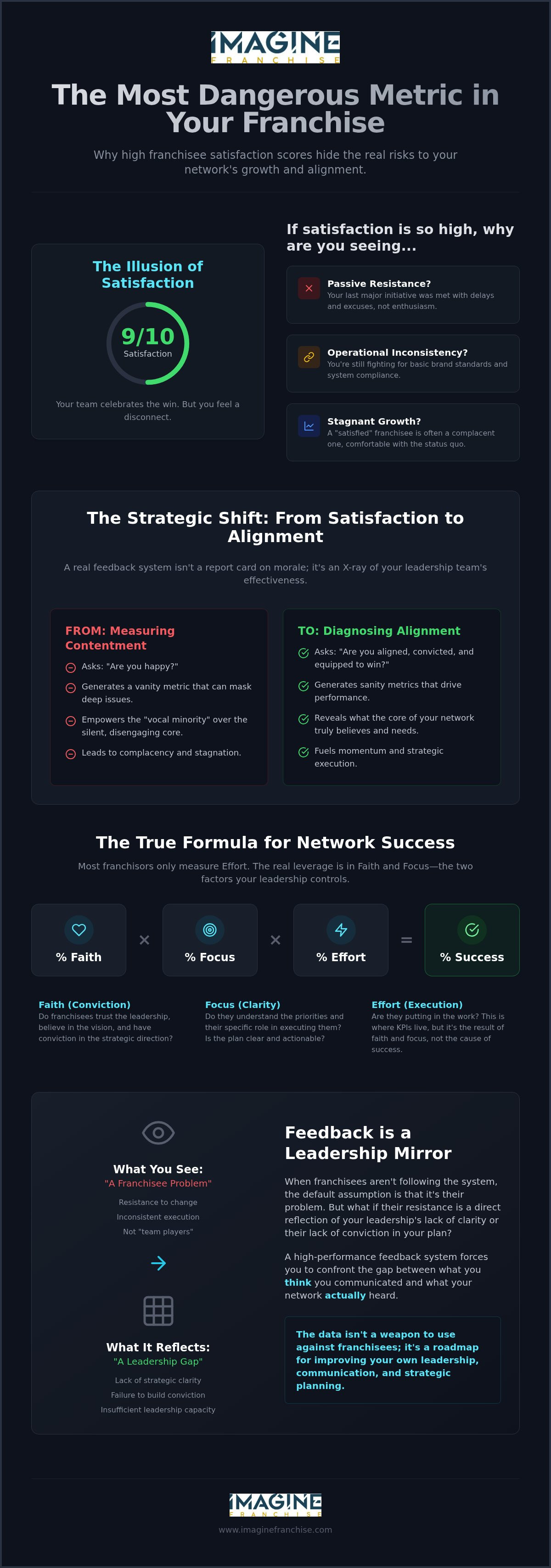
Here is the uncomfortable truth: your franchisee satisfaction score is probably the most dangerous vanity metric in your business. It tells you your franchisees are happy, but it doesn’t tell you if they are aligned. It measures contentment, not conviction. And in a growing network, the gap between the two is where momentum dies.
A true franchisee feedback system isn’t a tool for measuring happiness. It’s a diagnostic instrument for measuring leadership clarity and network alignment. It moves beyond the survey to reveal the invisible barriers preventing your vision from becoming a reality at the unit level. It’s time to stop asking franchisees if they’re satisfied and start building a system that tells you if they’re ready to execute.
Why Your Current Franchisee Satisfaction Metrics Are Lying to You
For most franchisors, the annual survey is a box-checking exercise. You ask about support, training, and marketing, and you get predictable, polite answers. But this approach is fundamentally flawed because it’s built on a dangerous assumption: that a satisfied franchisee is a high-performing, aligned franchisee.
High satisfaction can easily coexist with low growth. A comfortable, complacent franchisee may be perfectly “satisfied” with the status quo because it requires no change, no new effort, and no risk. They’ll give you a 9/10 on your survey and then ignore your new technology rollout because their current, inefficient process works “just fine.”
A real franchisee feedback system is a strategic tool. It shifts the focus from vanity metrics (happiness scores) to sanity metrics:
- Alignment: Do our franchisees understand our strategic priorities and their role in achieving them?
- Conviction: Do they believe in the direction we are heading, even when it requires difficult changes?
- Capacity: Does our leadership team have the capacity to translate our vision into a clear, executable plan that franchisees can win with?
This reframes the entire purpose of feedback. It’s no longer a report card on franchisee morale; it’s an X-ray of your leadership team’s effectiveness. The results don’t just reveal franchisee complaints—they expose your own leadership gaps.
The Danger of the "Vocal Minority" and Silent Majority
Traditional surveys and town-hall meetings create a stage for the vocal minority. A handful of disgruntled, often underperforming franchisees can hijack the narrative, making their niche complaints seem like network-wide crises. You and your leadership team spend weeks debating an issue that affects 5% of your system, while the real, systemic problems remain invisible.
Your biggest risk isn’t the loud franchisee who complains. It’s the silent majority. These are your solid, B-level performers who are quietly disengaging. They won’t complain publicly, but they’ve stopped innovating, stopped pushing for that extra percentage point of profit, and stopped believing that following the system is the best path to their own success. They are the engine of stagnation.
A structured feedback system moves you from anecdotal evidence to statistically significant data. It neutralizes the outliers and gives you a clear, honest view of what the core of your network truly thinks, believes, and needs from your leadership.
Reframing Feedback as a Leadership Mirror
When franchisees aren’t following the system, the default assumption is that it’s a franchisee problem. They’re resistant, they’re not team players, or they don’t “get it.” But what if the problem isn’t their resistance, but your lack of clarity? What if they aren’t executing the plan because they don’t have conviction in it?
A well-designed franchisee feedback system acts as a leadership mirror. It forces you to confront the gap between what you *think* you communicated and what your network *actually* heard and understood. This is why the CEO must own the results. The data isn’t a weapon to use against franchisees; it’s a roadmap for improving your own leadership, communication, and strategic planning.
When you demonstrate that you are listening and, more importantly, acting on the difficult truths, something powerful happens. Trust deepens. The network becomes magnetic, attracting and retaining high-performers who want to be part of a brand where their voice matters and leadership is accountable. As I explore in my article on why franchisees don’t follow the system, the root cause is almost always found in the franchisor’s office, not the franchisee’s location.
The Anatomy of a High-Performance Franchisee Feedback System
To move beyond the limitations of a simple survey, your system needs a dual focus. It must measure both the hard-nosed business fundamentals and the critical human factors that drive commitment. One without the other gives you a dangerously incomplete picture. You might have a network of profitable franchisees who don’t trust you, or a network of loyal franchisees whose unit economics are slowly eroding.
We build this dual focus around a simple but powerful diagnostic I call the "Formula for Success":
% Faith × % Focus × % Effort = % Success
Most franchisors are great at measuring Effort—they track KPIs, sales data, and operational metrics. But if a franchisee is putting in 100% Effort and only seeing 50% Success, the problem isn’t their work ethic. It’s a breakdown in Faith (their trust in you, the brand, and the vision) or Focus (their clarity on what to do and why it matters). A high-performance feedback system is designed to measure all three variables, especially the ones most leaders ignore.
Measuring Business Fundamentals and ROI
Of course, performance starts with profitability. But looking at royalty payments is lazy. A real system digs deeper into the operational and financial health of each unit.
- Unit-Level Profitability: Are you systematically tracking franchisee EBITDA? Do you know the difference between a franchisee who is profitable *because* of your system versus one who is profitable *in spite* of it? * Operational Discipline: This isn’t about compliance checklists. It’s about measuring whether franchisees are adopting the critical processes that drive efficiency and customer experience. Are they using the new software correctly? Are they following the updated marketing playbook? This is about conviction in action, not just checking a box.
- Identifying Top Performers: According to PwC research, the top 20% of companies in any sector outperform their peers by up to 13 times. Your feedback system must help you identify your top 20% of franchisees and, more importantly, understand *why* they outperform. Their best practices are your most valuable, underutilized asset for network-wide improvement.
Evaluating the Human Dimensions of Trust and Commitment
This is where most feedback initiatives fail. They ignore the human element, which is the ultimate driver of execution. Your system must be designed to quantify the “soft stuff” that produces hard results.
- Quantifying Trust: Does the network have faith in the CEO’s vision and the leadership team’s ability to execute it? You can measure this with direct, anonymized questions: “How confident are you in the 5-year strategic plan?” or “Do you believe the leadership team makes decisions in the best interest of the franchisees?”
- Assessing System Conviction: How willing is the network to follow new initiatives? Conviction isn’t compliance. Compliance is doing something because you have to. Conviction is doing it because you believe it’s the right thing to do. This is the difference between a franchisee who reluctantly installs a new POS system and one who champions it to their peers.
- The "Magnetism" Factor: The ultimate test of network health is a simple question: “Knowing what you know today, would you buy this franchise all over again?” The answer to this question tells you more than any satisfaction score. It measures the magnetism of your brand and the strength of your value proposition in the eyes of the people who matter most. Building these strong franchisee relations is a direct outcome of measuring and acting on these human factors.
Compliance Monitoring vs. Franchise Performance 360©
Many franchisors believe their field audit process is a feedback system. It is not. A field audit is a defensive strategy designed to enforce compliance. It’s about checking boxes, correcting errors, and protecting the brand from inconsistency. While necessary, it does nothing to unlock the potential of your franchisees or your leadership team.
A performance-based feedback system is an offensive strategy. It’s about coaching for growth. It moves the conversation from “What are you doing wrong?” to “What’s stopping you from achieving your next level of success?” This is the core philosophy behind our proprietary Franchise Performance 360© assessment.
Compliance is about preventing the downside. Performance is about creating the upside. The former is a cost of doing business; the latter is an investment in your future.
The Limitations of Traditional Field Audits
Think about how your franchisees view your field consultants. Do they see them as a partner and a coach, or as the “brand police” with a clipboard? For most networks, it’s the latter. This dynamic immediately creates a barrier to honest communication.
Standard audits are designed to identify symptoms—a franchisee isn’t using the right signage or is failing to upsell a key product. But they rarely uncover the underlying disease. *Why* is the franchisee cutting corners? Is it a cash flow issue? A training gap? Or a fundamental lack of belief in the system? An audit report can’t tell you that. It focuses on monitoring behavior, but lasting change comes from influencing mindset.
Treating experienced business owners like employees who need to be monitored is a guaranteed way to kill their entrepreneurial spirit. As I detail in my guide for training franchise field consultants, their primary role should be to build leadership capacity, not to enforce rules.
Unlocking Growth with Franchise Performance 360©
The Franchise Performance 360© tool is designed to provide a complete, 360-degree view by gathering structured feedback from three critical perspectives: the CEO, the leadership team, and the franchisees.
The goal is to create alignment by exposing the gaps between these perspectives. The CEO might rate “Strategic Clarity” as a 9/10, believing the vision is crystal clear. The leadership team might rate it a 7/10, understanding the general direction but lacking clarity on execution. The franchisees might rate it a 4/10, feeling confused and disconnected from head office priorities.
This data isn’t just a report; it’s the starting point for our Franchise Leadership Catalyst™, a 12-month strategic journey. The assessment results don’t just say, “You have a communication problem.” They pinpoint exactly where the breakdown is occurring and create a measurable, shared roadmap for the entire leadership team to close that gap. It turns subjective feedback into an objective plan for leadership acceleration.
5 Steps to Implementing a Feedback-to-Action Loop
The single biggest failure of most feedback initiatives is the lack of a structured process for turning data into action. A report sits in an inbox, a few cosmetic changes are made, and a year later, the same problems surface in the next survey. This cycle breeds cynicism and teaches your franchisees that their feedback doesn’t matter.
To break this cycle, we use the BRAVE Model™, an engine designed to ensure feedback drives execution and measurable results.
- Baseline: Establish the unvarnished truth of your current state.
- Realignment: Close the gap between leadership’s vision and the network’s reality.
- Activation: Translate insights into a few high-impact leadership moves.
- Validation & Execution: Ensure the changes produce a measurable return on investment.
Step 1: Establishing the Baseline
The foundation of all future growth is an honest, unflinching look at where you are today. This starts with designing survey questions that target the real drivers of performance, not just satisfaction. We focus on measuring things like Strategic Clarity, Leadership Capacity, and System Conviction.
Before launching the assessment, you must set the expectation for radical honesty. This requires guaranteeing anonymity and communicating that the purpose is not to find fault, but to find clarity. The Baseline is your stake in the ground—the objective starting point from which all progress will be measured.
Steps 2 & 3: Realignment and Activation
This is where leadership is tested. When the results come in, the temptation is to get defensive, explain away the negative feedback, or present a complex, 50-point action plan that tries to address every piece of criticism. All of these are mistakes.
The right approach is to present the feedback themes back to the network transparently and without defensiveness. Acknowledge the gaps. Then, work with your leadership team to identify the “One Big Move”—the single strategic initiative or leadership behavior shift that will address the core of the feedback.
Communicating this realignment is critical. It must be framed as a shared victory, not a top-down correction. It’s a message that says, “We heard you. Based on your feedback, this is the single most important thing we are going to do together over the next 12 months.” This creates focus, buy-in, and momentum.
Steps 4 & 5: Validation and Execution
An action plan is useless without an execution and accountability framework. For your “One Big Move,” you must define what success looks like in 12 months. What specific business outcomes will improve? How will you measure progress?
Validation means regularly communicating progress back to the network. This closes the loop and proves that their feedback led to meaningful change. Execution means your leadership team is held accountable for driving the initiative forward. This rigorous follow-through is what transforms a feedback exercise from a one-time event into a continuous system for improvement and builds a culture of performance and trust.
Scaling Smarter: Turning Insights into Network Alignment
As a franchise network grows, especially in the 50-250+ unit range, its greatest threat isn't the competition; it's internal fragility. The systems, leadership style, and communication channels that worked at 30 units begin to break down at 100. Small misalignments that you could once fix with a phone call become deep, systemic fractures that kill profitability and growth.
A robust franchisee feedback system is your primary defense against this fragility. It’s the nervous system of your network, allowing you to sense and respond to problems before they become crises. This is a core component of our Franchisexcel© Growth Leadership System, which is designed to help networks scale without becoming heavier, more dependent, or more bureaucratic.
The CEO’s role must evolve from being the primary problem-solver to being the architect of a system that builds leadership capacity at every level. You can't be in every location, but a great feedback system can be.
Avoiding the 12-Year Disappearance Trap
Research from the MIT Sloan Management Review delivered a sobering statistic: 75% of new franchisors disappear within 12 years. They don’t fail because their concept was flawed. They fail because they couldn’t manage the complexity that comes with growth. They outgrow their leadership capacity.
An effective feedback system is your early warning system. It signals when your processes are breaking, when your message is getting diluted, and when your franchisees are losing conviction. It allows you to address the subtle signs of network decay before they lead to system-wide failure, a common challenge for networks that are growing too fast without the right leadership infrastructure.
The Path to 10x Growth
The ultimate goal of a franchisee feedback system is not to generate a report. It is to generate alignment. When your entire network—from the C-suite to the front-line employee at a franchisee’s location—has clarity on the mission, conviction in the strategy, and trust in the leadership, you unlock exponential growth.
Our work with over 100 franchise systems has shown that achieving this level of alignment can triple, quintuple, or even tenfold a network’s results in just three to five years. This is the shift from managing a brand to leading a movement.
So, I’ll leave you with one final question. It’s not for a survey; it’s for you and your leadership team to answer in your next strategy session:
Does your current feedback system tell you what you want to hear, or what you need to know?
The future of your network depends on your answer.

