


You announce a revised inventory adjustment process. Every franchisee gets the email, and a few reply that they read it. Three weeks later, some locations use the new process, some use the old one, and a few built their own hybrid.
That gap has real costs. Inventory counts stop matching across locations, so your reports can't be compared. Support staff burn hours on clarifications, and franchisees lose confidence that head office knows what it wants. You end up pulled into a problem your team should have settled.
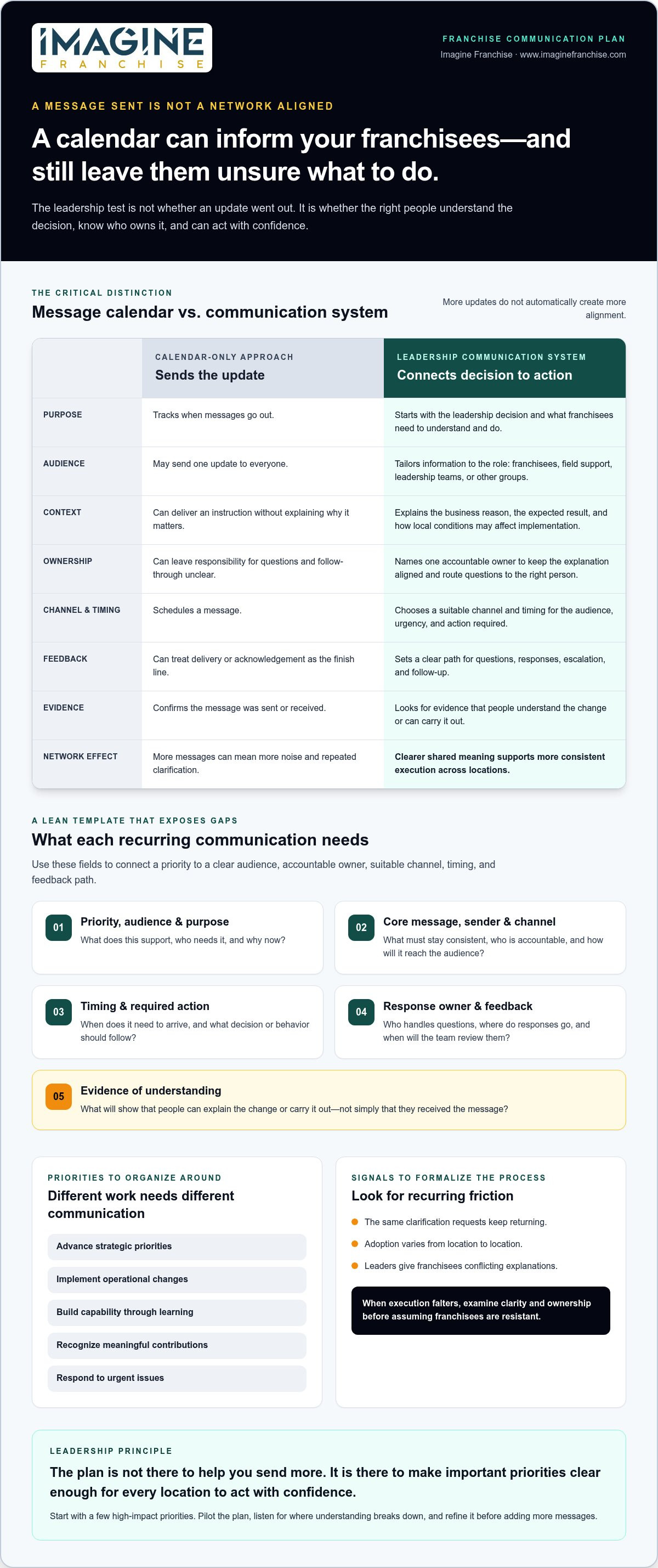
A calendar didn't fail you here. The communication was never built to carry a decision into action. A franchise communication plan template fixes that when you use it as an operating tool, not a form.
Key Takeaways
- A franchise communication plan must connect a leadership decision to understanding, ownership, and action.
- Every message needs a named sender, a named person who answers questions, and a clear action or "no action needed."
- Match the format to the purpose: information, action, consultation, training, or urgent response.
- Start with two or three flows that cause the most friction, not every message you send.
- Judge success by what happens in the field, not by opens or sends.
A Message Was Sent, but Execution Still Failed
Look at what happened with the inventory change. The announcement said what was changing and when. It didn't say why, what to do when a store's stock doesn't fit the new steps, or who to call.
Franchisees are independent operators. A manager running a busy location reads your email between a supplier delivery and a staffing problem. If the message leaves room for interpretation, each owner fills the gap with local logic.
So you get uneven adoption, the same questions asked of four different people, and four slightly different answers. Sending more reminders doesn't help. You need to decide what each franchisee must understand and do, and who owns the follow-through.
Not every announcement deserves this effort. A one-time update with no operating impact needs a clear message and nothing more. Build a plan for recurring or high-impact decisions, especially when you see repeated questions, uneven adoption, or leaders giving conflicting answers.
A franchise communication plan is the system that carries a leadership decision to shared understanding and action across the network.
What a Franchise Communication Plan Must Clarify
Take the inventory example and ask five questions before anyone drafts a word.
- What must the franchisee understand? The new steps, the reason for them, and what happens to existing stock.
- Who owns the communication? One person, such as your operations lead, sends it and answers for it.
- What must they do? Use the revised process starting on a stated date.
- Where do questions go? To one named support contact, not to whoever they happen to know.
- How will you verify execution? Field visits, a short check-in after the first cycle, and a review of the questions that came in.
If you can't answer one of these, the message isn't ready. Often the missing answer is a leadership decision nobody made, like who has authority to grant an exception.
Audiences differ too. Franchisees need context and a path for questions. Field support needs to know how to reinforce the change and what to escalate. Your leadership team needs one shared explanation, so the CEO and the operations lead don't give two versions.
One owner per recurring message matters. Others can contribute, but when three people share responsibility, nobody follows up.
The Franchise Communication Plan Template
Here is a working franchise communication plan template, filled in with one illustrative example. It isn't client data or a rule you must adopt. Copy the columns and change the content.
| Priority | Audience | Purpose | Owner | Channel | Timing | Action | Feedback |
|---|---|---|---|---|---|---|---|
| Illustrative: revised inventory adjustment process | Franchisees; field support | Explain the change and support consistent use | Operations lead sends; designated support contact answers questions | Written guide plus a discussion session | Before the start date; follow-up after the first cycle | Franchisees use the new process from the start date; field support reinforces it | Questions go to the support contact; leadership reviews the questions that come in after the first cycle |
Fill it in this way. Write the intended outcome first, then the message. Name the sender and, separately, the person who answers questions. State the action in plain words: understand, decide, complete, or simply be aware.
Keep the template lean. If your leaders won't maintain eight columns, cut them down. A template people skip is worse than a short one they use.
Five kinds of communication
The same template flexes depending on what you need from franchisees. Pick the category before you pick the channel.
- Information: A supplier moves its delivery day. Say it's for awareness and that no action is required.
- Action: Everyone switches to the new inventory process by a stated date. Give the steps, owner, and deadline.
- Consultation: You're considering a new service standard. Ask operators for input before you decide, and say when the decision will be made.
- Training: A new point-of-sale step needs practice. Use a live session and a place to ask practical questions.
- Urgent response: A product issue needs immediate action. Put the action and the contact at the top, and use a direct route.
The mistake is sending a consultation like an announcement, or burying an urgent action inside a weekly newsletter. Format follows purpose, not habit.
How to Use It Without Creating More Noise
Don't document every message you send. Start with the two or three flows that create the most confusion or pull you into avoidable clarifications.
- Find the friction. List repeated questions, missed actions, and issues that keep reaching your desk.
- Pick a few flows. Choose the ones tied to current priorities.
- Assign owners. One sender and one person answering questions for each.
- Test before you announce. Ask a few franchisees, "How do we get the whole network to adopt this?" Check the timing, the message, and the rollout steps, and confirm the change and its budget make sense before it goes out.
- Review and adjust. After the first cycle, look at what came back and fix the message or the process.
That fourth step saves more pain than any other. Franchisees often spot the problem with timing or wording in minutes. For more on bringing operators in early, see how to get franchisee buy-in for new initiatives.
How to tell whether it worked
Skip open rates. Look at what you can see in the field:
- Your leaders give the same answer to the same question.
- The questions about the inventory change drop after the first cycle.
- Franchisees complete the action by the date.
- Field visits show the process running the same way across locations.
- Fewer issues escalate to the CEO.
If questions keep coming, the message was unclear. If franchisees understood but still didn't act, look at capability, resources, or whether they disagree. Each calls for a different response, and a feedback route lets you tell them apart. A deeper look at that is in building a franchisee feedback system that drives execution.
Review the plan when priorities, audiences, or leadership roles change. Drop duplicated updates and retire channels nobody uses. A plan stays useful by getting shorter as often as it gets longer.
What Communication Failures Reveal About Leadership
When a rollout goes sideways, it's tempting to conclude that franchisees aren't listening. Sometimes they disagree, and that's fair. But often the cause sits closer to home: two executives explained the change differently, nobody owned follow-up, or the reason never made it out of the boardroom.
That's a leadership issue, not an attitude problem. Blaming operators hides the cause and damages trust. It also keeps you personally reinforcing every important message, which doesn't scale as the network grows.
Check yourself on this. Which recurring message still depends on you to land? If the answer is several, your team may not yet share one explanation of your priorities. That's the work behind the template. Related thinking is in why compliance is the enemy of conviction.
Imagine Franchise's Franchisexcel© Growth Leadership System and tailored executive coaching support franchisor leaders as they align priorities and follow through on decisions. Results depend on the leadership work itself, and no template or program replaces it.
So here's the question to take back to your next leadership meeting: Is your leadership team failing to execute your strategy, or are you failing to lead its execution?
Explore a private leadership conversation with Stéphane Breault.
Frequently Asked Questions
What should a franchise communication plan include?
List the priority, audience, purpose, sender, channel, timing, required action, response owner, and feedback method for each recurring communication. Add a way to check that franchisees understood and acted. Keep it short enough that leaders will maintain it, and clear enough that a franchisee can tell whether a message requires action or is only for awareness.
How do you create a communication plan for a franchise network?
Start with a decision that affects how locations operate, such as a new service standard. Identify who needs to understand it and who will lead the message. Test the timing and wording with a few franchisees before announcing. Then choose the channel, set the follow-up, and review what questions come back after the first cycle.
Why does a franchisor need a communication plan?
Without one, important decisions compete with routine updates, and franchisees guess at what you want. A plan makes ownership visible and shows leaders which messages need attention now. It also exposes weak spots, like the same question reaching several people. You fix the explanation once instead of sending another reminder.
How often should a franchise communication plan be reviewed?
No interval fits every network. Review it when strategic priorities, operating conditions, audiences, or leadership roles change. Also review it when you notice repeated questions, missed actions, or duplicate updates. Retire entries that no longer serve a purpose so the plan stays accurate and people keep using it.
How can franchisors reduce communication overload for franchisees?
Give every message one purpose, one owner, and a clear ask. Separate items that need action from items shared for awareness, and say which is which. Combine routine updates for the same audience, and use the channel that fits the message. If franchisees can't tell what matters first, simplify before you send more.
How can you measure whether franchise communication is effective?
Watch what happens in the field. Do leaders give consistent answers? Do repeat questions decline? Did franchisees complete the task on time, and do locations run the process the same way? Treat these as clues about your message and leadership process, not proof of a single cause. Open rates tell you little.

