


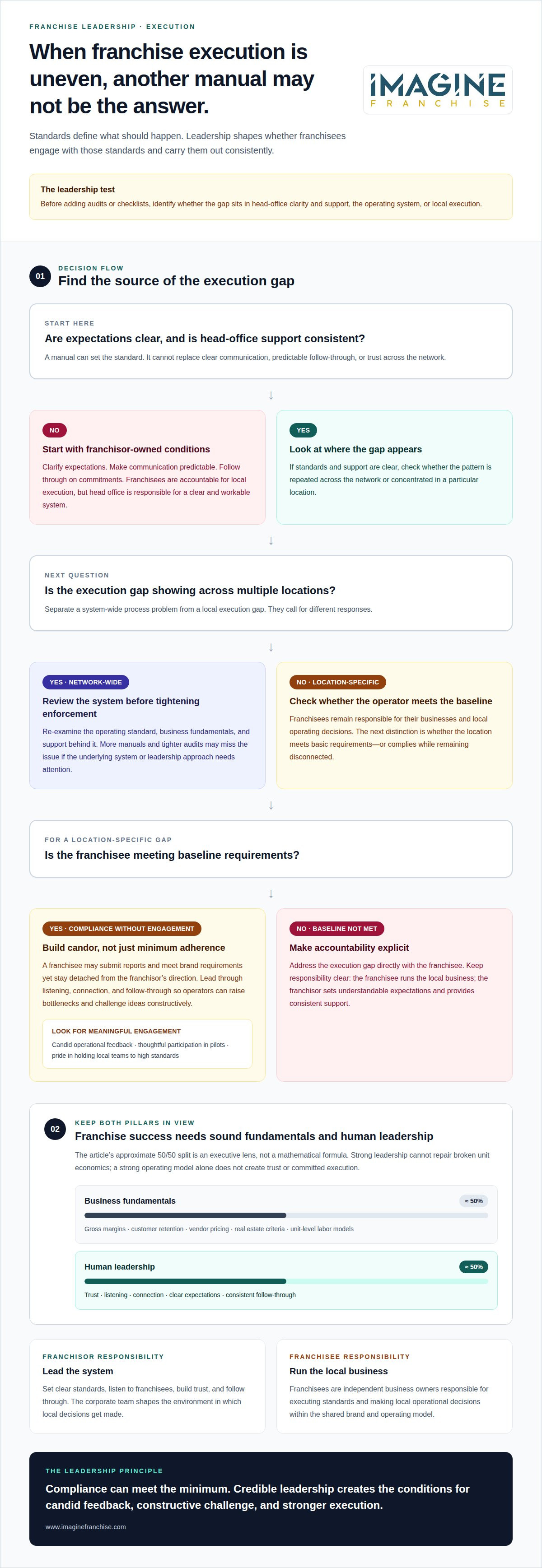
Manuals, proven models, and basic operational support are necessary in franchising, but they are not sufficient. An operating system sets standards; franchisor leadership determines whether franchisees engage with those standards, challenge them constructively, and implement them consistently. Franchisee success reflects distinct responsibilities: franchisors lead the system through trust, listening, connection, and follow-through, while franchisees remain responsible for executing their businesses and making local operational decisions.
Key Takeaways
- Operating systems establish brand standards and consistency, but human leadership determines whether franchisees execute those standards with genuine commitment.
- Franchise success rests on two distinct pillars: sound business fundamentals and the human leadership required to build mutual trust across the network.
- True engagement differs fundamentally from mere contractual compliance; compliance produces minimum adherence, while leadership builds candor and proactive problem-solving.
- Franchisor credibility depends on executive follow-through, predictable communication, and respecting franchisees as independent business owners responsible for local execution.
- Strong interpersonal connection enables constructive challenge and clear accountability rather than creating an environment of avoidance or artificial harmony.
The Limits of the Operating Manual: Why Compliance Is Not Engagement
Every growing franchisor eventually confronts the same frustrating puzzle. You invest heavily in codifying standard operating procedures, refining store layouts, and rolling out field audit software. On paper, the system is tighter than ever. Yet across your locations, execution remains stubbornly uneven.
Some operators embrace new tools immediately, while others drag their feet, treat updates as intrusions, and do only enough to pass inspections. Many CEOs misdiagnose this gap as an operational deficiency and respond by adding more manuals, more checklists, and tighter audit routines. That response misses the underlying issue entirely.
A manual establishes the standard, but it cannot generate the willingness to uphold that standard during an unexpected Friday night rush. In the foundation of the franchising business model, operating systems define how work should be performed, while leadership governs how people choose to behave. A comprehensive operations portal tells a franchisee how to calculate labor cost or prep inventory, but it cannot compel them to care about the brand when head-office staff are not in the building.
There is a massive operational divide between compliance and genuine engagement. Contractual compliance is passive and defensive. An operator who focuses strictly on compliance may meet the baseline requirements of the franchise agreement while remaining emotionally detached from the franchisor's strategic vision. They submit their reports on time, purchase approved supplies, and follow minimum brand guidelines, yet they remain disconnected from the franchisor's strategic direction.
Genuine franchisee engagement looks entirely different. Engaged franchisees offer unvarnished feedback about operational bottlenecks instead of complaining privately to peers. They test pilot programs with an open mind and hold their own unit staff to high standards because they take pride in the business. Operational excellence is not about compliance; it is the natural byproduct of operators who feel respected, understood, and led by a credible corporate team.
When franchisors rely entirely on their contractual agreements and operational handbooks to drive unit-level behavior, they treat business owners like branch managers. Franchisees are independent business owners who operate under a shared brand identity and licensed operating model. Expecting an operations portal to inspire loyalty and drive execution fundamentally misunderstands human motivation.
The Balance: Business Fundamentals and Human Leadership
Franchising industry discussions frequently drift into opposing camps. One camp insists that franchising is purely a numbers game governed by site selection, supply-chain leverage, customer acquisition costs, and unit economics. The other camp treats franchise management as an exercise in relationship building, culture initiatives, and executive charisma. Both perspectives fall short when applied in isolation.
Consider the central argument: franchise success is approximately 50% business fundamentals and 50% human leadership. This ratio is not an exact mathematical equation, but it serves as an indispensable executive lens. A franchisor with outstanding human leadership but broken unit economics will eventually fail when operators run out of working capital. Conversely, a franchisor with an exceptional operating model but adversarial leadership will struggle with network stagnation, litigation, and quiet operational rebellion.
The International Franchise Association's definition of franchising underscores that the model relies on both contractual rights and ongoing operational support. The business fundamentals represent the engine of the enterprise: gross margins, customer retention metrics, vendor pricing, real estate criteria, and unit-level labor models. These elements establish commercial feasibility. Without them, no amount of executive empathy can keep a franchise network solvent.
Human leadership, however, represents the steering and fuel that translate that operational engine into actual network velocity. Consider a hypothetical scenario involving two franchisees operating in identical suburban markets with identical territory demographics. Both operate under the exact same franchisor brand, use the same marketing assets, and sell products at the same retail price points.
Operator A runs a business with healthy margins, low staff turnover, and consistent customer review scores. Operator B struggles with chronic staffing shortages, uneven product quality, and declining sales. The operating manual did not change between these two territories, nor did the underlying business model. What changed was local operational execution, personal ownership, and the quality of leadership practiced both by the franchisee locally and by the franchisor in supporting that operator.
Franchisor executives do not directly control unit-level financial results. A franchisor cannot hire the local cashier, manage the line during peak hours, or ensure the store opens on time every morning. Those daily operational choices belong entirely to the franchisee. What franchisor leadership does control is the environment in which those choices are made: the clarity of corporate expectations, the consistency of head-office support, and the degree of trust underpinning the relationship.
How Franchisor Actions Shape Network Culture
Franchise network culture is not determined by mission statements framed in corporate headquarters or motivational speeches delivered at the annual national convention. Network culture is defined by daily operational behavior: what head office prioritizes, what leadership tolerates, and how corporate executives act when faced with competing business pressures.
Consider how quickly executive credibility erodes when a franchisor breaks operational commitments. If corporate leadership promises to launch an upgraded point-of-sale integration by the second quarter, delays it repeatedly without explanation, and still mandates system updates on short notice, franchisees notice. When head-office teams promise field support visits that are regularly rescheduled, operators conclude that corporate promises are negotiable.
Franchisees evaluate franchisor leadership during moments of friction, not during celebrations. When product costs spike, supply chains fail, or local economic conditions deteriorate, operators look closely at corporate headquarters. Does the leadership team address the issue directly and candidly, or do they retreat behind defensive press releases and canned corporate communications?
Consider a hypothetical franchise network facing sudden commodity price inflation. An executive team that practices transparent leadership immediately convenes a briefing with franchise council representatives. They present the raw cost data, outline the margin impact across typical unit volumes, explain their negotiations with suppliers, and discuss realistic pricing adjustments. They do not minimize the operator's financial pain, nor do they make unrealistic promises about quick market recoveries.
Contrast that response with a corporate team that attempts to protect its public image by ignoring margin compression until the annual convention. By the time leadership finally acknowledges the problem, operators feel deceived and unsupported. When trust deteriorates, franchisees begin questioning every corporate initiative, assuming every new program is designed to enrich the franchisor at their expense.
When leadership demonstrates candor during difficult market conditions, operators respond with operational resilience. When executives hide behind vague reassurances, franchisees develop self-protective habits. A network where franchisees feel blindsided by corporate decisions will struggle to achieve high levels of system adoption, because every directive is viewed with suspicion. Knowing how to improve franchisee relations requires acknowledging that trust is earned through consistent, transparent behavior over time.
Listening Before Prescribing: The Practice of Executive Humility
A common failure among growing franchise systems is the corporate urge to prescribe operational solutions before understanding the underlying operational reality. When unit-level performance dips or customer complaints rise, corporate executives often assume they already know the root cause. They design a new mandatory procedure, send out a circular, and consider the issue resolved.
Field reality is rarely that simple. Frontline operators frequently face practical hurdles that corporate staff do not experience in a test kitchen or pilot location. When head-office leadership designs processes without frontline input, they risk creating administrative burdens that divert an operator's time away from customer service and staff supervision.
Consider a hypothetical multi-unit service franchise where corporate leadership noticed a drop in customer follow-up survey completion rates. The executive team decided that franchisees were neglecting customer communication. Their immediate solution was to mandate a five-step customer feedback workflow requiring technicians to log detailed survey responses on a company tablet before leaving a client site.
Within sixty days, technician turnover increased, job completion times lengthened, and customer satisfaction dropped further. Had corporate leaders spent two days in the field before prescribing the change, they would have discovered that technicians were already spending forty minutes per call troubleshooting unreliable mobile software. Adding more data entry requirements during field appointments exacerbated the root problem instead of solving it.
Active executive listening requires structured operational channels where franchisees can share field feedback without fear of corporate retaliation. This does not mean running endless sentiment surveys or allowing vocal critics to derail corporate strategy. It means establishing deliberate mechanisms—such as focused advisory groups and field reviews—to evaluate how policies actually impact daily operations.
Franchisor executives must ask practical operational questions before implementing system-wide changes:
- What specific problem does this operational change solve for the end customer and the unit operator?
- How much additional labor time will this process require across a typical weekly shift schedule?
- Have we tested this process in normal operating conditions, including peak volume hours and understaffed shifts?
- What operational steps or reporting requirements can we eliminate to offset this new administrative workload?
- What frontline objections do we anticipate, and how do our operational data address those concerns?
Taking the time to validate operational changes with experienced operators demonstrates executive humility. Franchisees do not expect a franchisor to agree with every operational preference they express. They do, however, expect corporate leaders to understand their operating environment before telling them how to run their locations. Developing a franchisee feedback system that drives execution ensures that strategic directives solve real operational problems.
Constructive Challenge: Why Connection Enables Real Accountability
A common misconception in franchise leadership is that focusing on human connection and trust produces a soft corporate environment where accountability suffers. Some CEOs worry that developing closer relationships with franchisees makes it harder to enforce brand standards, address underperformance, or make tough strategic calls. In practice, the opposite is true.
Accountability without interpersonal trust feels like bureaucratic harassment. When a corporate field consultant visits a location strictly to audit violations, record deficiencies, and issue warnings, the operator reacts defensively. The franchisee conceals operational problems, challenges inspection criteria, and treats head office as an adversary trying to catch them slipping.
Accountability built on genuine connection, however, creates an environment where leaders can challenge performance directly. When an operator knows that the franchisor genuinely respects their business and wants them to succeed, tough conversations become productive operational reviews rather than personal conflicts.
Consider a hypothetical franchise partner who has operated three successful units for seven years. Over the past four quarters, customer service scores at one location have fallen significantly below the system median. A compliance-driven franchisor might respond with a formal warning letter citing brand standards and demanding remediation within thirty days.
A leader who combines business fundamentals with human connection handles the situation differently. The executive contacts the franchisee, references their track record of success, and addresses the performance decline with direct candor. The conversation focuses on operational realities: What has changed in that unit's staffing model? Is the general manager struggling? Has local competition shifted?
By framing the issue around shared standards and business performance, the franchisor preserves the operator's dignity while holding the line on brand consistency. The franchisee is asked to present an operational corrective action plan, with clear performance milestones and specific review dates. The relationship remains positioned for productive accountability rather than being damaged by premature aggression.
High-performing franchise systems do not avoid difficult conversations; they master them. Avoiding uncomfortable truths out of fear of franchisee pushback is an abdication of franchisor leadership. When corporate executives permit chronic non-compliance or subpar execution to persist in one territory, they penalize every compliant operator who relies on the brand's collective reputation.
Treating Franchisees as Independent Business Owners
One of the most delicate boundaries in franchise management involves respecting the independent commercial identity of each franchisee. Franchisees are neither corporate employees nor passive investors. They are independent business owners who operate under a shared brand identity and licensed operating model.
When franchisors blur this distinction, operational tension inevitably follows. Corporate leadership teams sometimes treat franchisees as regional subordinates who must execute headquarters' directives without question or context. This top-down posture creates resentment among experienced operators who have their own capital, commercial leases, and balance sheets at stake.
Effective franchisors clearly explain the strategic rationale behind major corporate decisions. When corporate leadership decides to mandate a new enterprise software platform, redesign the retail layout, or adjust menu pricing, they must present the underlying business case to the network. Franchisees deserve to understand the commercial data, market trends, and return-on-investment expectations that justified the strategic shift.
| Leadership Dimension | Compliance-Driven Posture | Leadership-Driven Partnership |
|---|---|---|
| System Adoption | Mandates procedural updates through contractual threats and field audit penalties. | Demonstrates the unit-level business case and tests workflows with operators before rollout. |
| Performance Issues | Issues formal violation notices without investigating local operational constraints. | Identifies operational root causes, provides targeted coaching, and sets measurable milestones. |
| Network Feedback | Collects generic survey scores; treats vocal operational concerns as isolated pushback. | Maintains structured advisory forums; listens to field realities before prescribing solutions. |
| Operational Standards | Relies on manual thickness and audit checklists to enforce minimum acceptable behavior. | Combines strong operational controls with personal accountability and shared commercial ambition. |
Franchisors set and communicate brand standards, intellectual property requirements, product specifications, and system-wide positioning. The franchisee remains responsible for managing local payroll, scheduling unit staff, controlling day-to-day operating expenses, and driving local marketing execution.
When corporate leaders overstep this boundary by attempting to micromanage daily local operations, they dilute franchisee accountability. If a franchisor dictates every minute detail of local staffing schedules, an underperforming operator can easily deflect responsibility by blaming corporate instructions for their unprofitable labor costs. Preserving the boundary between brand standards and local execution keeps accountability where it belongs.
Understanding this distinction is critical for network scalability. As a franchise network expands from 25 to 100 or 200 units, the corporate office cannot manage local execution directly. It must rely on capable, engaged operators who understand how to run profitable businesses within the boundaries of the brand system. Understanding the leadership capacity gap in franchise growth helps executives scale their networks without compromising operational consistency.
Imagine Franchise: Executive Coaching (Franchisexcel© Program)
Imagine Franchise serves as a strategic partner for franchisor CEOs and senior executives navigating network growth and operational execution challenges. Through its proprietary Franchisexcel© program, Imagine Franchise delivers tailored executive coaching designed to enhance franchisor leadership capacity, improve franchisee relations, and build disciplined network alignment.
Led by Stéphane Breault, MBA, a former franchise CEO with over 35 years of experience supporting more than 100 franchise networks, Imagine Franchise works directly with franchisor leadership teams to resolve the friction between operational systems and human execution. Offerings include one-on-one executive coaching, C-suite leadership development, and franchisor strategic planning and execution coaching.
Leaders seeking a comprehensive assessment of their system can also utilize Franchise Performance 360© to evaluate both the business fundamentals and human dimensions of their franchise leadership. When you are ready to evaluate your leadership impact and strengthen network alignment, visit www.imaginefranchise.com to book a private session.
Evaluating Your Leadership Footprint Across the Network
When network performance stalls or operational inconsistencies emerge across locations, the natural executive instinct is to examine the system. Leaders look at the operations manual, review audit reports, update training modules, or add new compliance dashboards. These operational reviews are necessary, but they represent only half of the performance equation.
The central argument remains clear: franchise success is approximately 50% business fundamentals and 50% human leadership. A robust operational model provides the framework, but franchisor leadership determines how effectively that framework is executed across dozens or hundreds of independent locations.
As a franchisor CEO, you must periodically step away from financial dashboards and ask uncomfortable questions about your leadership footprint:
- How is corporate leadership experienced by an operator who is currently struggling with local market challenges?
- Do our field consultants function as trusted business advisors who foster execution, or merely as corporate inspectors checking compliance boxes?
- When we introduce a network-wide operational change, do franchisees view it as a commercial opportunity or as an administrative mandate?
- Do our operators feel safe sharing candid frontline feedback, or do they keep operational problems hidden until performance declines?
- Does our executive team follow through on corporate commitments as rigorously as we expect franchisees to adhere to brand standards?
Your systems establish the operational ceiling of your franchise brand, but your leadership determines how close your network ever comes to reaching that ceiling. Manuals, standards, and contracts protect your brand; authentic executive leadership turns that brand into an engaged, resilient, and enduring business community.
Frequently Asked Questions
Why does compliance not automatically create franchisee engagement?
Compliance represents minimum adherence to contractual obligations to avoid default notices or operational penalties. Engagement reflects voluntary commitment, proactive problem-solving, and personal pride in the brand. An operator can strictly follow operations manuals while remaining disengaged from corporate goals and resistant to strategic change.
Can strong franchisor leadership compensate for weak business fundamentals?
No. Executive leadership and trust cannot overcome unprofitable unit economics, flawed site selection criteria, or uncompetitive gross margins. Strong fundamentals establish commercial viability, while human leadership enables operators to execute those fundamentals consistently over time.
How can a franchisor distinguish between a system flaw and a leadership issue?
When an operational problem appears consistently across the vast majority of franchise locations regardless of owner capability, the issue is typically a flaw in the operating system, pricing structure, or core process. When performance varies widely across locations operating in similar demographic environments under the same model, the gap usually stems from differences in local management execution, franchisee capability, or the leadership dynamic between corporate and specific operators.
How does building human connection support operational accountability?
Human connection establishes mutual trust and respect between corporate leaders and franchisees. When an operator trusts that the franchisor genuinely respects their business investment, performance reviews and operational critiques are perceived as constructive support rather than bureaucratic hostility. This allows corporate leaders to address execution gaps with directness and candor.
What does it actually feel like to be led by us? Your answer should be visible in how franchisees describe your decisions, your responsiveness during difficult periods, your willingness to listen, and your follow-through when commitments become inconvenient.

