


A clean audit can hide a weak business. Operational Excellence Is Not About Compliance. It Is a Growth Strategy. A location can pass every inspection while labor costs rise, margins shrink, or the owner stays buried in daily problems. A completed checklist tells you whether someone followed a process. It doesn’t tell you whether that process helps the business perform.
Compliance matters in a franchise network. Shared standards protect the brand and give franchisees a clear baseline. But compliance is not the same as operational excellence, which asks a harder question: are our standards and processes helping the network run better?
That distinction matters when you’re growing a franchise system with limited head-office capacity. More locations mean more decisions, more support requests, and more pressure on the same people. Adding rules and inspections may create the appearance of control. It won’t necessarily fix the reasons performance varies from one location to another. This article separates useful operating discipline from compliance for its own sake, then offers a practical way to choose an action and judge whether it worked.
Key Takeaways
- Compliance shows whether expectations were met; operational excellence shows whether the network is performing better.
- Operational Excellence Is Not About Compliance. It Is a Growth Strategy. Clear priorities and repeatable execution can help your network grow without requiring every location to operate identically.
- Measure unit performance, recurring problems, and franchisees’ need for head-office support, not just completed checks.
- Before a network-wide change, test the change and its budget, then ask franchisees how to make adoption work across the network.
- Choose one operational problem, take a clear leadership action, and define in advance what result would show that it worked.
Why Franchise Operational Excellence Is More Than Compliance
Your standards may be clear and your locations may pass reviews, while performance across the network still varies. That gap matters. In a franchise system, independent business owners are expected to follow shared standards, but a completed checklist cannot show whether those standards help a unit serve customers well, manage its workload, or perform consistently.
Compliance means meeting established expectations. Operational excellence means improving how the network performs. This distinction is not an argument against standards. It asks what leadership expects those standards to accomplish. Operational Excellence Is Not About Compliance. It Is a Growth Strategy. Discipline creates growth capacity when it helps franchisees execute well and helps the head office learn what works across the network.
Compliance sets the baseline. Performance shows what works.
Franchisees need clear expectations. Without them, each location can interpret the brand in its own way. Standards help protect the customer experience, clarify accountability, and define what must stay consistent. Compliance is necessary.
But confirming that a process was completed doesn’t tell you whether it was useful. A required step may be followed exactly while still wasting staff time, creating delays, or failing to solve a recurring problem. The form records activity. It doesn’t explain the result.
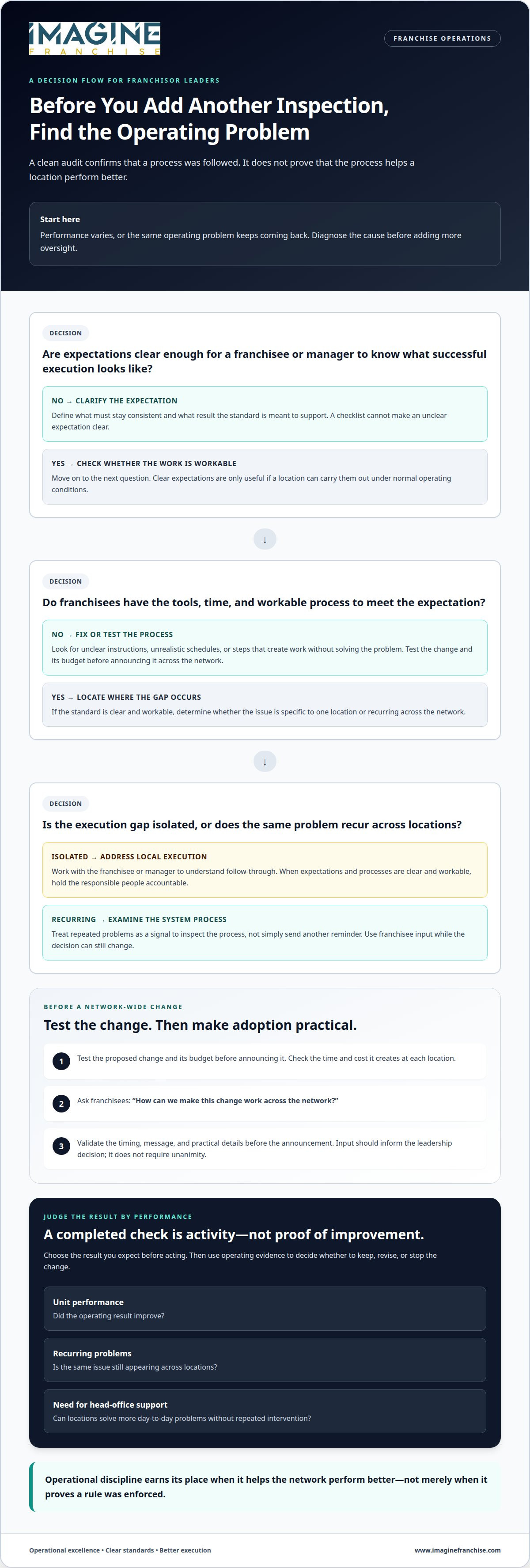
When execution varies, it’s easy to blame franchisee follow-through. Sometimes that’s the problem, and accountability matters. But before adding another inspection, ask whether the expectation is clear, whether the franchisee has the tools to meet it, and whether the process works under normal operating conditions. If head office can’t answer those questions, more oversight may add frustration without improving performance.
What operational excellence means for a franchisor CEO
Operational excellence means improving how work gets done, learning from results across locations, and making strong execution easier to repeat. The broader operational excellence principles provide useful context, but franchisors must apply them to a network where local owners carry responsibility for their businesses and the brand depends on shared execution.
Compliance enforces the agreed standard; operational excellence improves the system’s ability to meet it and perform better. That improvement may mean simplifying a process, clarifying priorities, improving manager follow-through, or removing steps that don’t help anyone make a decision. It should show up in the business, not just in a revised manual.
For you, the stakes include franchisee profitability, brand consistency, and the network’s ability to grow without adding the same burden to a limited head office. Over time, reliable performance supports enterprise value. The CEO’s test is straightforward: does the discipline help the network perform better, or does it only prove that a rule was enforced?
How Operational Excellence Creates Franchise Growth Capacity
Growth adds locations, decisions, and demands to a head office that may already be stretched. The answer isn’t to respond to every variation with another visit or instruction. It’s to help the network solve recurring operating problems. Clear priorities help franchisees and managers decide what matters, standards guide execution, and feedback from locations helps leaders improve the process. That’s how a practice becomes repeatable without constant head-office intervention.
Operational excellence supports growth when it helps the network execute a clear direction. As Harvard Business School professor Michael Porter explains in his discussion of operational effectiveness and strategy, better execution matters most when it supports a clear direction. For a franchisor, that means connecting operating improvements to priorities such as reliable service, productive use of labor, and healthy unit economics. A franchisee who can work from clear expectations and solve more day-to-day problems independently has more capacity to manage the business and consider growth.
From clearer priorities to more consistent execution
Your leadership team must translate broad goals into practical expectations that a location can act on. If customer experience is a priority, specify the core behaviors that support it and give managers a way to coach those behaviors. Then allow reasonable differences in how a location responds to local conditions.
The goal is consistent execution where it matters, not identical decisions in every circumstance. A standard should reduce avoidable variation in essential work while leaving room for franchisees to respond to local conditions where the brand doesn’t require uniformity. That balance supports franchisee judgment and brand consistency. Operational excellence helps franchisees perform more reliably, creating a stronger base for sustainable growth.
From recurring problems to stronger network capability
Illustrative example: Several locations repeatedly struggle to complete a routine opening task on time. Head office could keep reminding managers to finish it. That may help for a day or two. But if the issue keeps coming back, the reminder isn’t solving it.
The CEO can ask: Is the schedule realistic? Are the instructions clear? Is the handoff between employees causing the delay? Does the person responsible have what they need? Franchisees and managers who do the work can often point to obstacles that aren’t visible from head office. Invite them to describe where the process breaks down. Then separate a local execution gap from a system-wide problem. Those require different responses.
Before announcing a wider rollout, test the change in a few locations and review its cost and effort. Ask franchisees, “How do we get the entire network to adopt this change?” Use their input to validate the timing, message, and practical steps before the announcement. Franchisees remain responsible for execution. Head office is responsible for making expectations and processes clear enough to execute.
Track whether delays recur, whether managers can resolve the issue without repeated head-office follow-up, and whether the new process works across different locations. If the problem persists, revisit the process instead of relying on another reminder.
How to Tell Whether Operational Excellence Is Driving Growth
A completed review proves that someone completed a review. It doesn’t prove that a location runs better, that the same issue is less likely to return, or that your team can support growth without more head-office follow-up. To judge whether operational excellence is changing network performance, compare activity with results using measures you already track.
No single measure can tell you whether the whole network is healthy. Look for patterns over time and across locations, then decide what those patterns require from leadership.
Compliance indicators versus performance signals
Review completion: Were checks submitted on time? Performance signal: Are the same operational issues appearing less often?
Standards acknowledged: Locations confirm they received or reviewed expectations. Performance signal: Execution becomes more consistent in the work that matters to customers and unit results.
Support activity: How many calls or visits did head office make? Performance signal: Can franchisees and managers resolve recurring problems with less repeated intervention?
Unit results: What happened to sales, margins, or labor productivity while the change was being tested? Performance signal: Results improve or become more consistent alongside the operating change.
These are prompts, not universal targets. Choose measures your network can define consistently, and be careful about claiming that one operating change caused a shift in sales or margins. Other factors may have affected the result, including market conditions, weak unit economics, limited resources, or a flawed operating model.
Read uneven performance as a leadership signal
When some locations perform well and others struggle, the difference may point to more than franchisee effort. Expectations may be unclear. A manager may lack the skill or follow-through to coach the work. Or the process may be difficult to repeat under normal operating conditions. Those causes need different responses.
Limited head-office capacity makes this diagnosis harder. If the same field leader handles every issue, urgent problems can crowd out useful coaching. If several locations show the same pattern, ask whether the system makes success understandable and repeatable for franchisees.
Pick one measure tied to the problem and decide what decision it will inform. If repeat issues remain high, clarify expectations or improve the process. If results vary mainly by manager, address coaching and accountability. If the measure doesn’t change a decision, it may not be worth collecting.
How to Improve Franchise Operations Without Creating More Bureaucracy
When a process causes trouble, another report can make head office feel more informed without making the work easier. Trace the task from start to finish. Who does it? What information do they need? Where do delays occur? Are people entering the same information in more than one place? Who uses each step, and what decision does it support?
Include the time and cost of the proposed change. A step that looks simple at head office can create work at every location. If a new form or approval step doesn’t support a decision, question whether the network needs it.
Test the change before asking the network to adopt it
Keep the test focused on the specific task causing difficulty. Ask a small group of locations to use the proposed process and watch how it works in real operating conditions. Look for unclear instructions, overlapping steps, and confusion about ownership. This isn’t a test of whether franchisees will comply. It’s a chance for leadership to see whether the change works before deciding what to keep, revise, or drop.
Before expanding the change, compare the result with the original problem using an existing measure or direct observation. Review the budget against the effort required. If the change adds work without improving execution, revise it or stop it, even if the network has already invested time in it.
Involve franchisees before the announcement
Franchisee input should shape the plan while there’s still time to adjust it. Ask them, “How do we get the entire network to adopt this change?” Their answers can help you refine the timing, communication, and steps required.
But consultation shouldn’t leave ownership unclear. Head office owns the direction and the decision. Local operators are accountable for carrying it out. Name who at head office owns the decision and who is responsible locally, and keep follow-up tied to the intended work. At the review point, use the evidence to decide whether the process is helping. If it isn’t, adjust or stop it.
Make Franchise Operational Excellence a Leadership Growth Strategy
Hiring, franchisee support, and growth compete for attention. So do the operational problems that keep returning to the CEO. If everything is a priority, execution becomes uneven. Your job is to set a clear focus, assign ownership, and help your leadership team carry decisions through without sending every issue back to you.
That requires looking beyond whether people followed the rules. It means asking whether the rules, tools, and support help them do the work well.
Build leadership capacity alongside operating discipline
When an operating challenge exposes a gap in leadership capacity or follow-through, executive coaching can help a CEO examine the issue, test assumptions, prepare for a difficult decision, and stay accountable for follow-through. It doesn’t replace operational expertise or the CEO’s judgment. The decisions and the work still belong to the leadership team.
Imagine Franchise’s Franchisexcel© program and tailored Executive Coaching support franchisor leaders as they align priorities and follow through. Imagine Franchise brings over 35 years of overall experience and has supported more than 100 franchise networks in Canada and worldwide. Results depend on the leadership work itself.
Turn the next operational challenge into a leadership decision
Choose one recurring problem that is limiting network performance. Decide what must change, who owns the decision, and where franchisee input could sharpen the response. Then identify evidence that would show whether execution improved.
Make the Next Operating Decision Count
Choose one recurring problem that limits network performance. Decide what needs to change, who owns the decision, and what evidence would tell you whether the response helped.
Operational excellence is a growth strategy when it improves how the network performs as it grows. Start with one problem, one clear decision, and a practical way to judge the result.
If you’re considering where your leadership team should focus next, schedule a private exploratory session to discuss your execution challenges.
Frequently Asked Questions
Is operational excellence the same as compliance in a franchise system?
No. Compliance checks whether a location meets an agreed requirement; operational excellence asks whether the way work is designed and led supports stronger performance. For example, a location might complete a required inventory review while still ordering too much of a slow-moving item. The review is compliant, but leaders may need to examine whether the process gives the franchisee useful information for purchasing decisions.
Can operational excellence help franchisees improve unit performance?
Yes, when an operating change addresses a real barrier to performance and franchisees can apply it in their locations. A clearer labor-planning routine, for example, may help a manager match staffing to expected demand. The franchisor should compare relevant existing measures before and after the change, while considering other factors that could affect unit results.
How can a franchisor tell whether an operating process is creating unnecessary work?
Look for steps that consume time without helping anyone make a decision or complete the work more reliably. A process may be creating avoidable effort if franchisees enter the same information into separate reports, managers request data already held elsewhere, or head office receives updates that never prompt action. Trace one task from start to finish and identify who uses each step and what decision it supports.
What should a CEO do when the same operational issue keeps recurring across locations?
First, establish whether locations are facing the same cause or only a similar symptom. Ask managers to describe where the work breaks down, what they tried, and what happened next. Then decide whether the response belongs in clearer instructions, manager coaching, or a process change. Assign someone to test that response and review whether the issue recurs, rather than relying on another reminder alone.
How can franchisees contribute to operational changes before they are announced?
Bring franchisees into the discussion while the change is still being shaped. Ask, “How do we get the entire network to adopt this change?” Then invite practical feedback on timing, communication, and what a location needs to put the change into practice. This helps expose conflicts with busy operating periods or unclear responsibilities before rollout. Franchisee input informs the decision; the franchisor still owns the final direction and follow-through.
When should a franchisor pause or revise an operational change?
Pause or revise it when the test creates new problems, the intended outcome doesn’t improve, or locations can’t carry it out as planned. Recheck the original problem, implementation demands, and budget before expanding the change. If the evidence is mixed, gather more useful feedback instead of treating silence as approval. A clear review point helps you decide whether to continue, adjust, or stop without leaving franchisees uncertain.

