


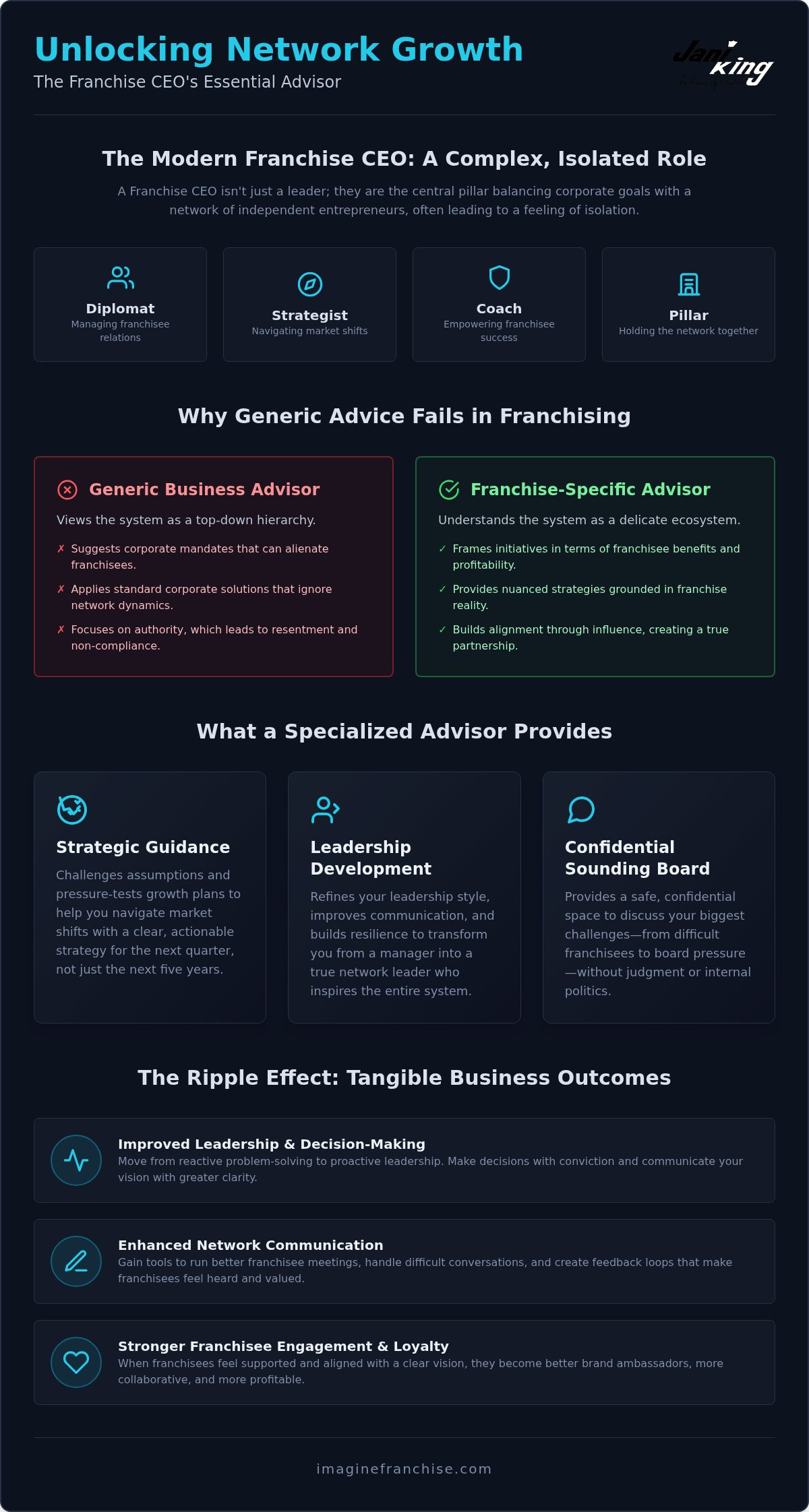
The role of a franchise CEO is unlike any other in business. You aren’t just a leader; you’re a diplomat, a strategist, a coach, and the central pillar holding together a network of independent business owners. It’s a position defined by a unique tension: the need to enforce system-wide standards while empowering individual franchisee success. Many CEOs in this position feel isolated, caught between corporate goals and the realities on the ground. They have a board to answer to and a network of franchisees who are, in essence, their primary customers. The stakes are incredibly high, and stagnation is a constant threat.
This is where the right advisor comes in. But let’s be clear: generic executive coaching won’t cut it. The advice that works for a tech startup CEO or a manufacturing executive will fall flat in the complex world of franchising. You need someone who understands the intricate dynamics of the franchisor-franchisee relationship, the challenges of scaling a distributed network, and the psychology of leading entrepreneurs. Choosing the right franchise CEO advisor isn't just a good idea; it can be the single most important decision you make for the future of your network. It’s the difference between muddling through and achieving exponential, sustainable growth.
Understanding the Role of a Franchise CEO Advisor
A franchise CEO advisor is more than a consultant or a coach. They are a strategic partner who brings an outside perspective sharpened by deep, specific industry experience. Unlike a general business advisor who focuses on standard corporate structures, a franchise CEO advisor operates at the intersection of leadership development, network management, and strategic growth—all through the unique lens of the franchise model.
Their key responsibilities go far beyond simple advice. They provide:
- Strategic Guidance: Helping you see the forest for the trees. They challenge your assumptions, pressure-test your growth plans, and help you navigate market shifts with a clear, actionable strategy. This isn’t about abstract five-year plans; it’s about making the right moves next quarter.
- Leadership Development: The CEO sets the tone for the entire network. An advisor works with you to refine your leadership style, improve communication, and build the resilience needed to lead a diverse group of franchisees. This is where you transform from a manager into a true network leader.
- A Confidential Sounding Board: The loneliness of the CEO role is amplified in franchising. An advisor provides a safe, confidential space to discuss your biggest challenges—from difficult franchisees to board pressure—without judgment or internal politics.
Why is this specialization so critical? Because a franchise system isn’t a top-down hierarchy. It’s a delicate ecosystem. A generic advisor might suggest a corporate mandate that alienates your entire franchisee network. A franchise-specific advisor understands that true alignment comes from influence, not authority. They know that a change in your supply chain isn’t just a logistical problem; it’s a relationship problem that affects the profitability and morale of every single franchisee. The impact of finding the right partner is profound, leading to a more aligned, profitable, and resilient franchise network.
Common Challenges Faced by Franchise CEOs
If you’re a franchise CEO, these challenges will sound familiar. They are the issues that keep you up at night, and they are precisely where a specialized advisor proves their worth. Generic solutions don’t work here; you need nuanced strategies grounded in franchise reality.
- Navigating Franchisee Relations and Compliance: How do you enforce brand standards without being perceived as a dictator? How do you support struggling franchisees while holding them accountable? A great advisor helps you develop systems and communication strategies that build partnership, not resentment, ensuring compliance becomes a shared goal rather than a constant battle.
- Scaling Operations While Maintaining Quality: Rapid growth can be a brand’s worst enemy if it leads to inconsistent customer experiences. An advisor helps you build scalable systems for training, support, and quality control, ensuring that location #100 is just as strong as location #1. They help you grow smarter, not just faster.
- Aligning Franchisee Interests with Corporate Goals: Your franchisees are focused on their local P&L. You’re focused on system-wide growth, brand value, and long-term strategy. These perspectives can easily clash. An advisor is an expert at creating alignment, helping you frame corporate initiatives in terms of franchisee benefits and building a culture where everyone is pulling in the same direction.
The Benefits of Executive Coaching for Franchisors
Engaging a franchise CEO advisor is an investment in your leadership, and the returns ripple throughout your entire organization. It’s about building capacity at the top so the whole network can thrive. The core benefits aren’t just theoretical; they are tangible business outcomes.
- Improved Leadership Skills and Decision-Making: With a strategic advisor, you move from reactive problem-solving to proactive leadership. You learn to anticipate challenges, make decisions with more conviction, and communicate your vision with greater clarity. This confidence is contagious and sets a new standard for your entire leadership team.
- Enhanced Communication Within the Franchise Network: An advisor provides tools and frameworks for more effective communication. You’ll learn how to run better franchisee meetings, handle difficult conversations, and create feedback loops that make your franchisees feel heard and valued. This is the bedrock of a healthy franchise system.
- Stronger Franchisee Engagement and Loyalty: When franchisees feel supported, understood, and aligned with a clear vision, their engagement skyrockets. They become better brand ambassadors, more collaborative partners, and more profitable operators. Effective executive coaching for franchise leaders directly translates to a more stable and successful franchisee base.
Key Qualities to Look for in a Franchise CEO Advisor
Not all advisors are created equal. When you're vetting potential partners, you need to look past the slick presentations and generic business-speak. You are looking for a specific set of qualities that demonstrate a true understanding of the franchise world. The wrong advisor can waste your time and money; the right one can transform your business.
Here are the non-negotiables:
- Deep Experience in Franchising: This is the most critical factor. Have they worked with franchisors before? Do they understand the legal, operational, and relational complexities of the model? Ask them to describe the difference between leading employees and leading franchisees. Their answer will tell you everything you need to know.
- A Track Record of Provable Results: Don’t be swayed by vague promises of "growth." Ask for specifics. Can they point to franchise systems they’ve helped scale? Can they provide case studies or references who can speak to their impact? Look for evidence of tangible improvements in franchisee profitability, network growth, or system-wide alignment.
- A Commitment to Customization, Not a Canned Program: Your franchise is unique. A great advisor recognizes this and tailors their approach to your specific challenges, goals, and leadership style. Be wary of anyone selling a one-size-fits-all solution. They should be asking you more questions than you ask them in the initial conversations.
- Exceptional Communication and Interpersonal Skills: This person will be your confidant and challenger. You need someone you can be candid with, who listens intently, and who can deliver difficult truths in a constructive way. They must have the emotional intelligence to navigate the sensitive dynamics of your role.
- A Focus on Measurable Outcomes and Accountability: A good advisor isn't just there to talk; they're there to drive results. They should work with you to define what success looks like from the outset, establishing clear KPIs and milestones. They hold you accountable for your commitments, and they should be willing to be held accountable for their impact on the business.
Evaluating Experience and Expertise
Drill down on their background. A general business coach who has had one or two franchise clients is not a franchise expert. You need someone who has lived and breathed this world. Look for advisors who have been franchisors themselves, or who have spent a significant portion of their career consulting exclusively with franchise networks. This isn't a field for generalists.
When you review their materials or speak with them, listen for the language they use. Do they talk about "unit-level economics," "franchisee validation," and "Field Business Consultant effectiveness"? Or are they using generic corporate jargon? The right advisor speaks your language because they’ve walked in your shoes. Ask for client testimonials and, if possible, speak directly with one or two of their past or current franchisor clients. Ask those references about the advisor's biggest impact and how they handled a difficult situation.
Assessing Coaching Style and Compatibility
Expertise is essential, but compatibility is what makes the relationship work. This is a deeply personal and professional partnership. You need to find a coaching style that resonates with you and pushes you to be better. Are you looking for a direct, no-nonsense challenger who will hold your feet to the fire? Or do you work better with a more nurturing, Socratic approach that guides you to your own conclusions? There is no right answer, but a mismatch in style can doom the engagement from the start.
Be honest with yourself about what you need. During your initial conversations, pay close attention to the dynamic. Do you feel heard? Are they challenging you in a way that feels productive? Discuss their availability and the structure of the engagement. Will you have regular, scheduled calls? Is there support available for urgent issues that arise between sessions? A clear understanding of the working relationship is crucial for building the trust required for a successful partnership.
How to Assess Potential Franchise CEO Advisors
Finding the right advisor requires a structured and disciplined process. It’s too important a decision to leave to chance or a gut feeling. By following a clear set of steps, you can move from a vague need for "help" to a confident decision to partner with an expert who can truly elevate your leadership and your network. This is not a time for shortcuts.
Step 1: Define Your Franchise's Unique Needs and Challenges.
Before you even think about looking for an advisor, you must first look in the mirror. What are the most pressing issues facing your network right now? Where are you, as a leader, feeling the most stuck? Be brutally honest. Is it franchisee rebellion? Stagnant unit sales? A dysfunctional leadership team? Write it all down. Then, translate those challenges into goals. What would success look like in 6, 12, and 24 months? This clarity is your compass. Without it, you can’t possibly evaluate if an advisor is the right fit.
Step 2: Research Potential Advisors and Their Backgrounds.
With your needs defined, start building a list of candidates. Tap into your professional network. Ask other franchisors who they trust. Look for speakers at franchise industry conferences or authors of articles in franchise publications. Use LinkedIn to find consultants who specialize exclusively in the franchise sector. As you vet each one, go deep. Scrutinize their website, read their articles, and look for a clear, consistent point of view that resonates with your challenges. Discard any generalists immediately.
Step 3: Conduct Structured Interviews to Assess Fit and Approach.
This is the most critical stage. Treat it like you’re hiring a C-level executive. Prepare a list of questions in advance. Ask them about their experience with challenges similar to yours. Ask for their philosophy on franchise CEO coaching. Give them a hypothetical (but real) problem you’re facing and ask how they would begin to approach it. Pay attention not just to *what* they say, but *how* they say it. Are they listening, or are they just waiting to talk? Are they giving you a canned sales pitch, or are they genuinely engaging with your situation?
Step 4: Request and Diligently Check References.
Never skip this step. Any credible advisor will be happy to provide references from other franchise CEOs they have worked with. When you speak to these references, go beyond "Did you like working with them?" Ask pointed questions: "What was the single biggest change you saw in your business as a result of their coaching?" "How did they handle a moment of disagreement or a difficult truth?" "What kind of leader would get the most—and the least—out of working with this advisor?"
Step 5: Make an Informed Decision Based on a Holistic View.
Finally, review all the information you’ve gathered. It’s not just about who has the most impressive resume. It’s about the intersection of expertise, coaching style, and personal chemistry. Who do you trust to challenge you? Who demonstrated the deepest understanding of your specific situation? Who gave you the most confidence that they could help you achieve your goals? This is a decision about partnership. Choose the advisor you believe will be the most effective partner in your journey.
The Long-Term Value of a Franchise CEO Advisor
Hiring a franchise CEO advisor is not a short-term fix. It’s a long-term investment in the sustainable health and growth of your entire network. While you may be focused on solving an immediate problem, the true value of a great advisory relationship unfolds over months and years, fundamentally changing the trajectory of your business and your leadership.
A good advisor helps you move beyond firefighting. They work with you to install new systems, new ways of thinking, and new leadership habits that build organizational resilience. This leads to sustainable growth—not just adding more units, but improving the profitability and performance of your existing ones. It’s about building a brand that lasts. The ongoing accountability is a powerful force. It’s easy to let strategic priorities slide in the face of daily urgencies. Your advisor is the one who keeps you focused on what’s important, not just what’s urgent, ensuring you make consistent progress on your most critical goals.
Over time, this partnership can be transformative. CEOs often report not just improved business metrics, but a renewed sense of clarity, confidence, and purpose. They feel less isolated and more in control. This shift at the top has a cascading effect, creating a more positive, aligned, and high-performance culture throughout the franchise network. This isn't just about business growth; it's about personal and professional evolution.
Measuring the Impact of Your Advisor
To ensure you’re getting a return on your investment, the advisory relationship must be grounded in measurable outcomes. This isn't about "feeling good"; it's about moving the needle on key business metrics. Before the engagement begins, work with your advisor to establish clear Key Performance Indicators (KPIs). These might include:
- Franchisee satisfaction scores (e.g., from an annual survey).
- System-wide revenue growth or average unit volume.
- Franchisee profitability trends.
- A reduction in franchisee turnover or disputes.
- The speed and success of new program rollouts.
Schedule regular check-ins—quarterly is often a good cadence—to review progress against these KPIs. This creates a powerful feedback loop, allowing you to see what’s working and adapt your strategies as needed. It also reinforces the accountability of both you and your advisor to achieve the desired results.
Fostering a Collaborative Partnership
The success of the advisory relationship depends on you. You must be willing to be open, vulnerable, and coachable. Treat your advisor as a true partner, not a vendor. This means encouraging open communication and being willing to share the bad news along with the good. The more context you provide, the better their advice will be.
Be proactive. Don't wait for your scheduled meeting to raise a critical issue. Invest the time to build a strong working relationship based on mutual trust and respect. The CEOs who get the most value from their advisors are the ones who fully commit to the process, embrace the challenges, and are willing to do the hard work of leadership required to implement new ideas. When you approach it as a genuine partnership, the potential for transformation is limitless.
Taking the Next Steps: Finding Your Franchise CEO Advisor
You’ve recognized the unique pressures of your role and the potential of a specialized advisor to help you navigate them. Now it's time to move from understanding to action. The process of finding the right partner is a strategic project in itself. By approaching it with diligence and clarity, you can forge a relationship that will become one of your greatest assets.
The journey begins with the research and vetting process we’ve outlined. Create a shortlist of 2-3 highly qualified advisors who specialize in franchising. Don’t settle for generalists. From there, schedule in-depth consultations. This is your opportunity to confirm their expertise and, just as importantly, to assess your personal and professional chemistry. Evaluate their proposals not on price alone, but on the depth of their understanding of your needs and the clarity of their proposed approach. Finally, make your decision and commit to starting the partnership with a clear, mutually agreed-upon plan for the first 90 days.
Tips for a Successful Initial Consultation
To get the most out of your first conversations with potential advisors, preparation is key. This is not a casual chat; it's a critical due diligence meeting. Come prepared to lead the conversation.
- Prepare Specific Questions: Go beyond "Tell me about yourself." Ask questions that test their franchise-specific knowledge. For instance, "Describe a time you helped a franchisor overcome franchisee resistance to a new initiative." Or, "What are the top 3 mistakes you see franchise CEOs make?"
- Be Candid About Your Challenges: Don't sugarcoat your problems. The only way an advisor can truly help is if they understand the reality of your situation. Share your biggest frustrations and fears. A great advisor will meet your candor with insightful questions, not a generic sales pitch.
- Gauge Their Understanding of Your Niche: While they should be a franchise expert, it’s also helpful if they can quickly grasp the nuances of your specific industry, whether it's QSR, home services, or retail. Pay attention to whether they are asking smart, clarifying questions about your business model and competitive landscape.
Establishing a Productive Advisor Relationship
Once you’ve chosen your advisor, the real work begins. The first few months are critical for setting the foundation for a successful long-term partnership. Success requires structure and commitment from day one.
- Set Clear Expectations and Goals Immediately: In your first official meeting, co-create a document that outlines the primary goals for the engagement, the KPIs you will use to measure success, and the roles and responsibilities of both parties. This clarity prevents misunderstandings down the road. Programs designed for franchisor growth, like our Franchisexcel© program, are built on this principle of initial alignment.
- Schedule a Regular Cadence for Meetings: Lock in a consistent schedule for your check-ins, whether it's weekly, bi-weekly, or monthly. Protect this time fiercely. These meetings are the engine of your progress and accountability.
- Commit to Openness and Action: The best advice in the world is useless if it isn't implemented. Be open to feedback, even when it’s difficult to hear, and be willing to experiment and adapt your strategies. Your advisor is your guide, but you are the one who has to walk the path.
Choosing your franchise CEO advisor is a defining moment. By investing the time to find the right expert—one with proven franchise experience, a compatible style, and a focus on results—you are giving yourself and your network the ultimate competitive advantage. With over 35 years of experience supporting more than 100 franchise systems, we’ve seen firsthand the transformative power of the right advisory partnership. The challenges are real, but you don’t have to face them alone.

