


You’ve seen it happen. A star franchisee, one of your best performers, starts going off-script. First, it’s a small change to a local marketing campaign. Then they source an unapproved product. Soon, they’re running a fundamentally different business that happens to share your logo. You’re left asking the one question that haunts every franchise CEO: "Why did they buy my system if they weren't going to follow it?"
The common answer is to blame the franchisee. They’re a ‘rogue,’ a ‘bad apple.’ You schedule a call with your legal team, review the Franchise Disclosure Document, and prepare for a fight. You brace yourself to enforce compliance.
This is a trap. And it’s costing you millions.
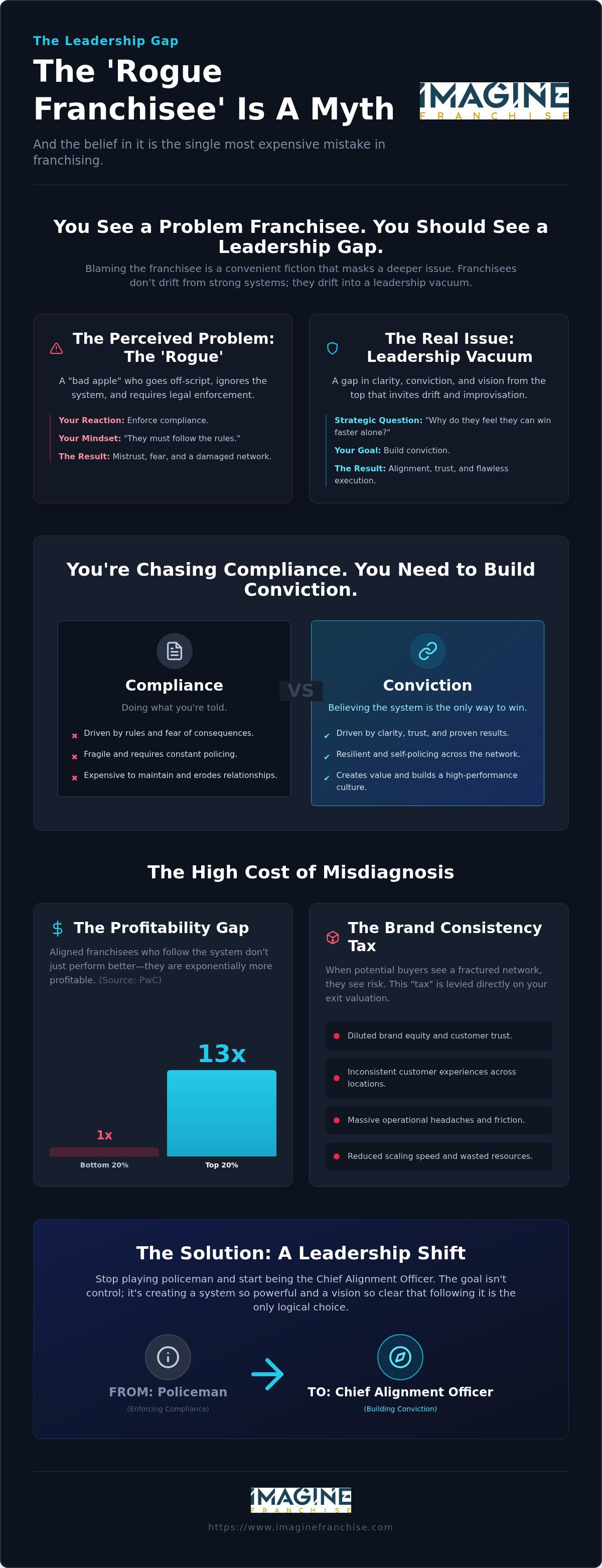
The belief that non-compliance is a franchisee problem is the single most expensive myth in franchising. It’s a convenient fiction that masks a deeper, more critical issue: a gap in your leadership. Franchisees don’t drift away from strong systems; they drift into the vacuum left by a lack of leadership conviction.
The Myth of the 'Rogue' Franchisee: Why Blame is a Strategy for Failure
Let's be direct. The ‘rogue franchisee’ doesn’t exist. They are a symptom, not the disease. Labeling a high-performer who questions the system as a ‘bad apple’ is an abdication of leadership. It allows you to sidestep the real question: "What in our system or leadership has made a smart, driven entrepreneur believe they can get better results by ignoring us?"
This isn't rebellion for its own sake. It's a search for a better way, often born out of frustration. When you react with a ‘policeman’ mindset, you treat the symptom while the underlying issue—a disconnect between your model and their reality—festers. This approach doesn’t just damage one relationship; it sends a ripple of fear and mistrust across your entire network, eroding your enterprise value with every compliance letter you send.
Compliance vs. Conviction
The core of the issue lies in a fundamental misunderstanding. You are chasing compliance, but what you desperately need is conviction.
- Compliance is doing what you're told. It’s driven by rules and the fear of consequences. It’s fragile and expensive to maintain.
- Conviction is believing the system is the only way to win. It’s driven by clarity, trust, and proven results. It’s resilient and self-policing.
You can't enforce your way to a high-performance culture. A network runs on conviction, and that conviction starts and ends in the CEO’s office. The invisible link between your clarity of purpose and their flawless execution is the most important asset you have. When it breaks, the system breaks.
The Leadership Vacuum: How You Unintentionally Invite Rebellion
Franchisees don't wake up one day and decide to ignore the playbook. They drift. They drift when the perceived value of the Standard Operating Procedure (SOP) is eclipsed by their own on-the-ground experience. This drift happens when a leadership vacuum forms, and it's almost always self-inflicted.
This vacuum is created by a subtle erosion of clarity. It begins when your own team, from field consultants to the C-suite, stops believing in your model with absolute certainty. They allow for "System Creep"—small deviations that signal the rules are optional. Inconsistent enforcement tells the network that the manual is a set of suggestions, not a formula for success. In a volatile, uncertain, complex, and ambiguous (V.U.C.A.) world, this lack of a firm anchor causes franchisees to revert to their own instincts. They aren't abandoning your ship; they’re just trying to stay afloat in a storm you failed to navigate.
The Support Trap
Here’s a contrarian truth: sometimes, more support is the problem. When your support systems are designed to prop up your weakest performers, you create a culture of dependence. You enable mediocrity rather than empower excellence. Your top franchisees—the ones who need your leadership most—see this. They see you spending resources on the bottom 20% while they are left to innovate on their own. This isn't just inefficient; it's a quiet betrayal. They don't need you to solve their problems; they need you to create a system so powerful and a vision so clear that their path to success is faster with you than without you.
Why Your Current Compliance Strategy is Costing You Millions
Chasing non-compliant franchisees isn't just a drain on your time and morale; it's a direct attack on your balance sheet. The correlation between system-wide adherence and unit-level EBITDA is undeniable. In our work with over 100 franchise systems, we’ve seen that networks with high alignment don't just grow faster—they are fundamentally more profitable.
A PwC study revealed a stunning gap: the top 20% of franchisees in a network can be up to 13 times more profitable than the bottom 20%. The secret isn't that they are better entrepreneurs. It's that they extract maximum value from a system they believe in. They follow the model because it works, and their success is a direct result of that conviction.
The Brand Consistency Tax
Think about your exit valuation. What happens when a potential buyer discovers that 30% of your network is ‘off-script’? They don't see a collection of local innovators; they see a brand in chaos. They see inconsistent customer experiences, diluted brand equity, and a massive operational headache. This "Brand Consistency Tax" will be levied directly on your multiple.
Every exception you manage and every rogue franchisee you chase adds friction, slowing your scaling speed and consuming resources that should be dedicated to growth. It’s time to reframe the conversation. System discipline isn't about control; it's a wealth-building tool for both you and your franchisees. For a deeper dive into bridging this leadership gap, consider how franchise CEO coaching can be the catalyst for change.
Rebuilding Network Alignment: A 5-Step Leadership Shift
If the problem is a leadership vacuum, the solution is a leadership shift. It's time to stop playing policeman and start acting as the Chief Alignment Officer. This isn't about a new enforcement policy; it’s about fundamentally re-selling the system to your network by re-establishing its value. This requires moving from a mindset of control to one of shared purpose. Here is the five-step process to reclaim your network and drive unified growth.
Step 1: Audit Your Own Conviction
The process begins with you. Before you can demand conviction from your network, you must have it yourself. Your franchisees can sense hesitation and uncertainty. If you don't believe your system is the absolute best path to success, why should they? Ask yourself and your leadership team these brutally honest questions:
- If you were a franchisee today, with your own money on the line, would you follow your current system to the letter?
- Which parts of our operations manual are "dead wood"—outdated processes we keep out of habit, not because they drive results?
- What are the 5-10 "Non-Negotiables" that truly define our brand and drive profitability? Can every single person on our leadership team name them?
This audit isn't a formality. It’s a gut-check. You must be willing to kill what isn’t working to protect what is. Your conviction must be renewed before it can be transferred.
Step 2: Define and Defend the Non-Negotiables
Once you have clarity, you must simplify. A 500-page operations manual is a reference guide, not a leadership tool. Your Non-Negotiables are your "Brand Constitution." These are the handful of core standards, processes, and brand principles that deliver your promise to the customer and drive unit-level profitability. They are not open to interpretation.
Communicate these Non-Negotiables relentlessly. Train your field consultants to be brand champions, not just auditors. Empower them to defend these core tenets while allowing for flexibility on the periphery. When everyone—from your newest franchisee to your most senior executive—knows what truly matters, they can execute with both precision and confidence.
Step 3: Use the Franchise Performance 360© Diagnostic
You can’t fix what you don’t understand. Right now, you are operating on assumptions about why franchisees are drifting. The Franchise Performance 360© diagnostic is designed to replace those assumptions with data. It moves beyond simple satisfaction surveys to evaluate the core human and business dimensions of your leadership.
This tool uncovers the "Trust Gap"—the space between your strategic intent and their operational reality. It pinpoints exactly where communication is breaking down, where support is failing, and where belief in the system is eroding. The output isn't just a report; it's a strategic roadmap for rebuilding alignment, tailored to the specific fractures within your network.
Step 4: Communicate the 'Next Level' Vision
Armed with conviction and data, you must now enroll your network in a new future. This is your moment to lead. It often takes the form of a "State of the Network" address where you acknowledge past challenges not as failures, but as lessons learned on the path to a "New Era" of partnership.
This communication must be built on two pillars: compassion and contribution. Acknowledge the pressures your franchisees face. Show them you understand their reality. Then, pivot to a vision of the future where their contribution is essential. Frame the renewed focus on the system not as a crackdown, but as the strategy that will make everyone more successful. This isn't about apologies; it's about a credible pivot to a stronger, more unified future.
Step 5: Shift from Accountability to Mutual Ownership
The final, most crucial step is to change the dynamic permanently. True alignment isn't a top-down mandate; it's a shared commitment to protecting a valuable asset. You must create structures that foster mutual ownership of the brand and the system.
- Empower a Franchisee Advisory Council (FAC): Give your FAC a real voice in system evolution. Use this group of leaders to vet new initiatives and provide feedback on system-wide challenges. - Create Innovation Forums: Harness the energy of your "rogue" franchisees. Create a formal process for them to test and propose system improvements. When they see a path to contribute, their rogue energy becomes a powerful R&D engine.
- Tie Rewards to System Alignment: Make system adherence a key criterion for awards, growth opportunities, and other recognition. Celebrate those who excel within the model.
When franchisees feel like owners of the system, not just renters, they become its most passionate defenders. This is the final stage of network maturity: Unity, where the franchisor and franchisees work as one to dominate the market.
Scaling Beyond Compliance with Franchisexcel©
This five-step shift is a profound transformation. It requires you to move from managing a network to leading a movement. This is the work we do every day with the Franchisexcel© program. We help CEOs triple their results not by working harder, but by shifting their leadership approach from operational policing to strategic alignment.
Your leadership capacity is the ultimate ceiling on your network’s growth. If you are stuck in a cycle of enforcement and reaction, you cannot break through to the next level. Executive coaching provides the framework, tools, and accountability to make this essential transition.
Take the First Step
Look at your network today. Are you leading, or are you chasing? Are you building conviction, or just demanding compliance? The difference between those two states is the difference between stagnation and exponential growth.
If you are ready to stop fighting symptoms and start building a truly aligned, high-performance network, the path is clear. It’s time to transform your leadership.
Stop chasing compliance and start leading growth with Franchisexcel©.
Frequently Asked Questions
- Why do successful franchisees suddenly stop following the system?
-
It's rarely sudden. It's a gradual drift caused by a perceived gap between the system's promise and their daily reality. This "value gap" emerges when the franchisor's leadership, clarity, or system evolution fails to keep pace with the market, leading smart franchisees to innovate on their own.
- How do I handle a 'rogue' franchisee who is also a top performer?
-
Reframe them from a "rogue" to a "frustrated innovator." Their performance proves they have talent. Your first step is to listen and understand what system deficiencies or market realities are driving their behavior. The goal is to harness their energy and bring their innovations inside the system, rather than trying to suppress them.
- Can a broken franchise relationship really be fixed without legal action?
-
Absolutely. Most compliance issues are rooted in a breakdown of trust and communication, not malice. By applying the 5-Step Leadership Shift—starting with auditing your own conviction and listening to your network—you can address the root cause of the disconnect and rebuild the relationship on a foundation of mutual respect and shared goals.
- What is the difference between franchisee support and franchise leadership?
-
Support is reactive and operational; it helps franchisees solve today's problems. Leadership is proactive and strategic; it gives franchisees a clear vision and a powerful system to prevent tomorrow's problems. Over-supporting can create dependence, while strong leadership creates capability and conviction.
- How much does non-compliance actually affect my franchise's resale value?
-
Significantly. Inconsistent branding, operations, and customer experience create perceived risk for potential buyers, which directly lowers your enterprise valuation multiple. A highly aligned network is a predictable, scalable asset and commands a premium price.
- How does the Franchisexcel© program address franchisee compliance?
-
It doesn't. Instead, Franchisexcel© addresses the root cause: leadership alignment. The program guides CEOs through the process of rebuilding conviction, clarity, and trust across their network. Compliance becomes a natural byproduct of a healthy, aligned system, rather than a goal in itself.

