


Your search for “C-suite coaching franchise” likely led you to one of two places: a list of coaching businesses you can buy, or generic executive advisors who claim leadership is the same in every industry. Both are the wrong answer to the right question. You aren’t looking to start a new business; you’re trying to scale the one you’ve already built. And you know, deep down, that the intricate, human-centric dynamics of a franchise network are anything but generic.
The real issue is that the leadership conviction that got your franchise to 50 units is now the very thing preventing it from reaching 500. Growth has stalled, franchisees seem to be resisting the system, and your executive team is caught in a cycle of reactivity. This isn't a franchisee problem; it's a leadership ceiling. Your franchise network is a direct reflection of your C-suite’s alignment and capacity. If execution is failing at the unit level, the breakdown started in your boardroom.
This article will explore why traditional executive coaching fails franchisors and introduce a specialized C-suite framework designed to translate leadership conviction into network-wide execution—transforming your executive team from a management function into a true growth engine.
What Is a C-Suite Coaching Franchise vs. Coaching for Your C-Suite?
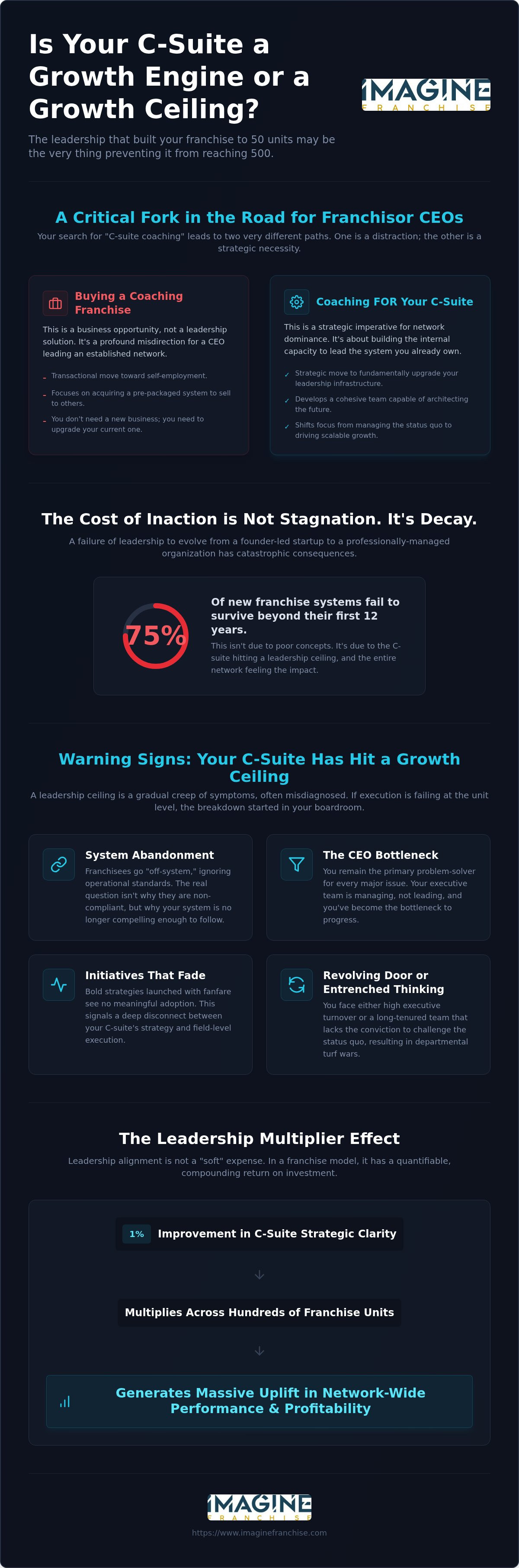
The ambiguity in the term “C-suite coaching franchise” creates a critical fork in the road for a franchisor CEO. One path leads to a business opportunity, while the other leads to a strategic necessity for your existing enterprise. Understanding this distinction is the first step toward breaking through your growth plateau.
Most search results point you toward buying a coaching franchise—a pre-packaged business model where you become a certified coach. This is a valid path for an individual seeking a new career. However, for a CEO leading an established network, it’s a profound misdirection. You don’t need a new business; you need to fundamentally upgrade the leadership infrastructure of your current one.
The stakes are incredibly high. Industry data reveals a stark reality: approximately 75% of new franchise systems fail to survive beyond their first 12 years. This isn't due to poor concepts or bad marketing. It's a failure of leadership to evolve from a founder-led startup to a professionally-managed, scalable organization. The C-suite hits a ceiling, and the entire network feels the impact. This is where "Growth Leadership"—a specific discipline for guiding decentralized networks—becomes non-negotiable.
The Difference Between a Business Opportunity and a Strategic Necessity
Choosing the right path requires recognizing the fundamental difference in intent. Buying a coaching franchise is a transactional move toward self-employment. It's about acquiring a system to sell to others. In contrast, investing in C-suite coaching for your existing franchise is a strategic imperative for network dominance. It's about building the internal capacity to lead the system you already own.
Many franchisors mistake hiring more staff for developing more leadership. They add another VP of Operations or a Director of Marketing, believing that more hands will solve the problem. But without a unified strategic vision and the discipline to execute it, you’re simply adding more silos. The real need isn’t for more managers to oversee the status quo; it’s for a cohesive leadership team capable of architecting the future.
The ROI of C-Suite Alignment
Skeptics often label coaching as a "soft" expense. This is a failure of perspective. In a franchise model, leadership alignment has a quantifiable, compounding return. Imagine a 1% improvement in strategic clarity at the executive level. That clarity informs better tools, simpler processes, and more effective field support. When multiplied across 100, 200, or 500 franchise units, that single percentage point of improvement at the top generates a massive uplift in network-wide performance and franchisee profitability.
This investment shifts the C-suite’s core metric from "support" to "performance." The goal is no longer to simply answer franchisee questions but to build a system where franchisees have fewer questions because the path to success is unequivocally clear. The cost of inaction is not merely stagnation. It's a slow erosion of the brand, a rise in franchisee disputes and litigation, and the gradual decay of the enterprise value you've worked so hard to build.
Signs Your Franchise Leadership Team Has Hit a Ceiling
A leadership ceiling isn’t a sudden event; it’s a gradual creep of symptoms that are often misdiagnosed. You see the effects in your P&L, your franchisee satisfaction surveys, and your late-night strategy sessions. But the root cause lies within the C-suite’s inability to scale its own thinking and behaviors. Recognizing these signs is the first step toward a breakthrough.
- System Abandonment: Your franchisees are increasingly going "off-system," creating their own marketing, sourcing their own supplies, or ignoring operational standards. Your leadership team’s immediate reaction is to blame the franchisees for non-compliance, creating an "us vs. them" narrative that completely misses the point. The real question isn't why they are ignoring the system, but why the system is no longer compelling enough to follow.
- The CEO Bottleneck: You, the CEO, are still the primary problem-solver for every major issue, regardless of department. The VP of Marketing needs your final approval on a campaign, the Head of Operations needs you to resolve a franchisee dispute, and the CFO needs you to weigh in on a minor budget variance. Your team isn't leading; they're managing, and you've become the bottleneck to progress.
- Initiatives That Fade: Your C-suite launches bold strategic initiatives with great fanfare—a new technology platform, a customer service overhaul, a local marketing program. But six months later, there's been no meaningful adoption at the unit level. The brilliant idea conceived in the boardroom never survived contact with the field, indicating a deep disconnect between strategy and execution.
- A Revolving Door or Entrenched Thinking: You’re experiencing either high turnover in key executive roles or, conversely, a C-suite that has been with you for a decade and lacks the conviction to challenge the status quo. There's a palpable lack of unified belief in the company's direction, replaced by departmental agendas and turf wars.
The 'Founder's Trap' in Scaling Networks
One of the most common ceilings is the "Founder's Trap." The very skills that made you successful in the beginning—your hands-on approach, your intuitive decision-making, and your ability to do every job in the business—are now strangling its growth. The transition from "doing" to "leading through others" is the single most difficult evolution for a founder or CEO to make.
Your C-suite has become a bottleneck when your direct reports still bring you problems instead of proposed solutions. They wait for your direction instead of creating it. This isn't a failure of their talent; it's a failure of the system you’ve created. True scale requires a leadership team that can operate with delegated authority and shared conviction, not one that functions as an extension of the CEO's to-do list.
Network-Wide Symptoms of Leadership Breakdown
The cracks in the C-suite inevitably show up across the entire network. These are not isolated franchisee issues; they are systemic indicators of a leadership deficit at the franchisor level.
- Inconsistent Brand Experience: A customer has a five-star experience in one city and a one-star experience in another. This variance signals a breakdown in the transfer of standards, training, and culture—all of which are the C-suite’s responsibility to maintain.
- Stagnant Royalty Growth: You are opening new locations, but your top-line royalty stream is flat. This means your new units are simply masking the declining performance of your existing ones. Your C-suite is focused on selling franchises, not on driving unit-level profitability.
- A Culture of Conflict: The relationship between the corporate office and franchisees is defined by tension, mistrust, and adversarial communication. Franchisee advisory councils become complaint sessions rather than strategic collaborations. This is a direct result of a leadership team that views franchisees as a source of revenue instead of as business partners and brand ambassadors. For a deeper dive into this dynamic, explore the leadership myths that explain why franchisees don’t follow the system.
Why Generic Executive Coaching Fails the Franchisor
Once you’ve identified the ceiling, the logical next step is to seek help. However, this is where most franchisors make a critical error. They hire a generic executive coach—someone with a background in Fortune 500 leadership or a certification in a popular psychological framework—believing that "leadership is leadership."
This approach is doomed to fail. The franchise model is a unique ecosystem with complexities that standard corporate coaching frameworks cannot comprehend. A generic coach, no matter how skilled, will misdiagnose the problems and prescribe the wrong solutions because they don't understand the fundamental physics of franchising.
They ignore the complex, three-way relationship between the franchisor CEO, the C-suite, and the franchisee network. They apply traditional top-down accountability models that shatter when applied to a network of independent business owners. The danger of "soft" coaching is that it avoids the hard metrics that define franchise success: unit-level profitability, franchisee validation, and network-wide ROI. You need a coach who has sat in your chair and felt the pressure of making payroll while managing a franchisee rebellion.
The Complexity of the Franchise Model
The central paradox of franchise leadership is that you are responsible for the performance of hundreds of people you don't actually employ. Your franchisees are not your staff; they are investors, entrepreneurs, and partners. You cannot mandate performance; you must inspire it. You lead through influence, not authority.
This requires a system that addresses both the human and economic dimensions of the relationship. A generic coach might focus on improving C-suite communication skills, but they will miss the fact that the communication breakdown is a symptom of a misaligned business model or a lack of trust in the franchisor's strategic direction. They lack the context to connect the "soft skills" to the hard-dollar outcomes.
What to Look for in a Franchise-Specific Coach
When evaluating a coach or a program for your C-suite, you must filter for franchise-specific expertise. The criteria are non-negotiable.
- Experience vs. Theory: Look for a coach with 25+ years of hands-on franchise leadership experience, preferably as a franchisor CEO. You need someone who has lived the challenges, not just studied them. Academic theory is useless when you're facing a network-wide revolt over a new technology fee.
- A Proven Framework vs. Improvised Sessions: Demand a structured, proven system designed specifically for franchisors. Improvised, conversational coaching sessions might feel good, but they rarely lead to lasting change. A system like Franchisexcel© provides a roadmap for transformation, not just a sympathetic ear.
- A Focus on Network Magnetism and Operational Excellence: The right coach understands that the ultimate goal is to create "Network Magnetism"—a state where your system is so profitable, supportive, and well-run that high-quality franchisees are drawn to you and existing ones are eager to expand. This is achieved through a relentless focus on operational excellence, not motivational platitudes. Effective franchise CEO coaching is about building this magnetism.
The Franchisexcel© Framework: A Growth Leadership System
Generic coaching fails because it lacks a system. The Franchisexcel© Framework is different. It’s not a collection of tips or motivational speeches; it’s a comprehensive Growth Leadership System engineered specifically for the complexities of a franchise network. It moves your C-suite from a reactive management group to a proactive leadership engine by installing discipline across four critical pillars.
- Clarity of Action: The system forces your C-suite to align on the "One Thing" that will drive scalable growth. It eliminates competing priorities and departmental agendas, creating a single, shared definition of success that cascades through the entire organization and out to the franchisee network.
- Structured Leadership: We build your team’s capacity to lead a decentralized network. This involves establishing clear roles, decision rights, and communication rhythms that foster accountability without creating bureaucracy. It’s about building a machine that can run and grow without the CEO’s constant intervention.
- Accountability and Self-Evaluation: The framework moves your team from a culture of blame ("the franchisees aren't...") to one of 100% responsibility ("we haven't given them..."). It installs a rigorous process of self-evaluation, using data and franchisee feedback to measure performance against clear, objective standards.
- Unity and Agility: Finally, the system ensures that your brand promise, your operational processes, and your company values are inseparable. This unity creates an agile organization that can adapt to market changes without losing its core identity, building a culture of trust and conviction that franchisees can feel.
Franchise Performance 360©: The Diagnostic Tool
Transformation begins with an honest assessment. The Franchisexcel© process starts with the Franchise Performance 360©, a proprietary diagnostic tool that goes far beyond typical business analysis. It evaluates your leadership and network performance across both hard business metrics and critical human dimensions—like trust, conviction, and strategic alignment.
This tool uncovers the "blind spots" in your executive team's execution. It identifies the gaps between what your C-suite believes to be true and what your franchisees are actually experiencing. The result is a data-driven roadmap for your C-suite’s development, ensuring our work is focused on the root causes of your plateau, not just the symptoms.
The 6 Stages of Growth Leadership
The Franchisexcel© system guides your C-suite through six distinct stages of network maturity, from establishing a Baseline to achieving full Realignment and Unity. This is not an à la carte menu of services; it's a sequential journey. Each stage builds upon the last, systematically installing the disciplines required for exponential growth.
Attempting to skip a stage—for example, trying to drive franchisee engagement before you have achieved absolute clarity within your own leadership team—is why most growth initiatives fail. It leads to system collapse during periods of rapid scaling. Our process instills the necessary business discipline in your entrepreneurial environment, ensuring your foundation is solid enough to support your ambition. This structured approach is central to any effective strategic plan for scaling CEOs.
How to Begin Your C-Suite Transformation
Recognizing the need for change is the first step. Committing to the process is what separates thriving networks from stagnant ones. The transformation of your C-suite is not a project with an end date; it’s a fundamental shift in how your company is led.
Stop treating leadership development as a luxury. Start treating it as infrastructure. It is just as critical as your technology stack or your supply chain. The journey from a siloed team of managers to a unified growth engine is typically a 12-month commitment. It requires discipline, vulnerability, and unwavering focus. And it must start with you. The CEO must be the first to embrace the challenge, model the behavior, and hold themself accountable to the new standard.
Assessing Your Team's Readiness
Before you begin, ask yourself a hard question: Is your C-suite ready to be challenged? The biggest obstacle to growth is often ego. If your VPs are more interested in defending their turf than in building a stronger enterprise, the process will fail. True transformation requires a leadership team that is willing to put the network's success ahead of their personal comfort.
Our "Formula for Success" is simple: Faith x Focus x Effort. Your team must have faith in the potential of the network, an intense focus on the vital few priorities, and a relentless effort to execute with discipline. As a first step, try this exercise with your team: can you, as a group, write a single sentence that defines the "Clarity of Action" for your business for the next 12 months? If you can't, your journey needs to start now.
Booking Your Exploratory Session
This is not about a sales pitch. It’s about a strategic diagnosis. A private 45-minute exploratory session with Stéphane Breault is a CEO-to-CEO conversation designed to move beyond the surface-level symptoms and identify the root cause of your growth plateau.
In this session, we will discuss your network’s current state, the ceiling you’re facing, and whether the Franchisexcel© system is the right fit to help you break through. It’s a moment of clarity and a first step toward building the leadership capacity your franchise deserves.
Your leadership team is the ceiling of your growth. It’s time to raise the roof.
Schedule your private 45-minute exploratory session here.
Frequently Asked Questions
- Is C-suite coaching different from business consulting?
-
Yes, fundamentally. A consultant typically analyzes a problem and provides you with a report of recommendations—the "what." C-suite coaching, specifically through the Franchisexcel© system, builds your leadership team's capacity to solve its own problems. We provide the "how"—a framework for thinking, aligning, and executing that becomes a permanent asset for your organization. Consulting delivers an answer; coaching builds a capability.
- How long does it take to see results in the franchise network?
-
You will see tangible shifts in your C-suite's alignment, focus, and accountability within the first 90 days. Network-wide results, such as improved franchisee engagement and unit-level performance, begin to manifest as that leadership clarity cascades through the system, typically showing measurable impact within 6 to 12 months.
- Can coaching help with franchisee compliance issues?
-
Absolutely, but not in the way you might think. We reframe "compliance" as a problem of conviction. Franchisees don't follow systems they don't believe in. Our process helps your C-suite build a system that is so clear, profitable, and supportive that franchisees *want* to follow it. We fix the source of the problem in the C-suite, not just the symptom in the field.
- Do you coach the CEO only or the entire leadership team?
-
Our core Franchisexcel© program is designed for the entire C-suite. A franchise network is too complex to be transformed by a single leader. Lasting change requires a unified executive team operating from a shared playbook. We work with the CEO and their direct reports as a cohesive unit to ensure alignment is built at the top.
- What is the Franchisexcel© Growth Leadership System?
-
It is a proprietary, structured framework designed to help franchisor leadership teams build the clarity, discipline, and accountability required to scale their networks. It's a complete system—not just a series of conversations—that installs a new operational rhythm for leadership and transforms how your C-suite drives performance.
- Is this program suitable for small, emerging franchisors?
-
Our system is most effective for established franchisors who have hit a growth ceiling, typically with 25 to 500+ units. Emerging franchisors often face different challenges related to initial setup and validation. Our focus is on helping successful networks navigate the complexities of scale and unlock their next stage of exponential growth.
- How do you measure the ROI of executive coaching in franchising?
-
We measure ROI through both leading and lagging indicators. Leading indicators include C-suite alignment scores, the speed of strategic decision-making, and franchisee engagement metrics. Lagging indicators are the hard numbers: improvements in system-wide sales, unit-level profitability, franchisee retention rates, and ultimately, the enterprise value of the franchisor.
- What if my C-suite is resistant to outside coaching?
-
Resistance is often a symptom of two things: fear of being exposed or skepticism born from past experiences with generic coaches. Our CEO-to-CEO approach, grounded in decades of real-world franchise experience, is designed to build trust quickly. We position the process not as a critique of past performance, but as a strategic upgrade necessary to win the future.

